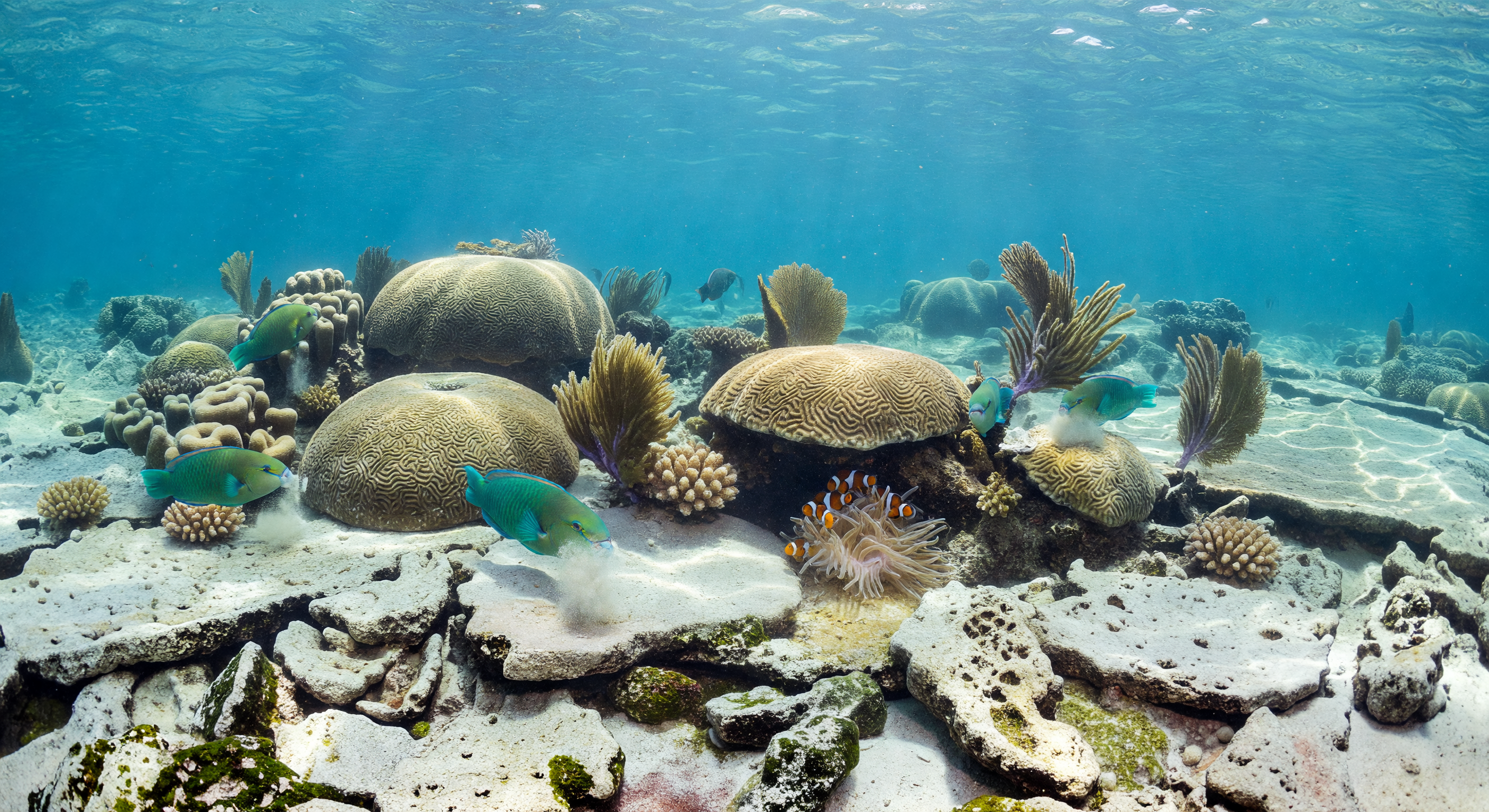
Sunlight descends through the shallow water column in shifting sheets, its caustic patterns rippling ceaselessly across the carbonate pavement in a choreography that has played out over this terrace for millennia without pause. Several parrotfish work the reef's surface with their fused, beak-like dental plates — dermal teeth evolved specifically to excavate calcium carbonate — releasing small bursts of fine white sediment that bloom and slowly settle, a process that, collectively across the reef, generates tonnes of the white tropical sand that accumulates in pockets between coral heads. The massive dome corals here are themselves geological structures: centuries-old colonies of polyps secreting aragonite skeletons at only a few millimetres per year, their surfaces textured with living tissue and encrusting algae that together form a carbonate framework hosting extraordinary biological density, from gorgonian fans swaying in the gentle current to an anemone — its column anchored in a sheltered crevice — holding clownfish that dart among translucent tentacles armed with nematocysts. At this shallow depth, pressure reaches only two to three atmospheres and the full spectrum of sunlight still floods the water column with blue-green clarity, supporting the zooxanthellae — photosynthetic dinoflagellates living within coral tissues — upon which the entire biochemical architecture of the reef ultimately depends. This terrace exists as it has always existed: a world of extraordinary biological complexity, structurally ancient, continuously alive, and entirely indifferent to any observer.
Other languages
- Français: Terrasse Carbonatée des Perroquets
- Español: Terraza Carbonatada del Pez Loro
- Português: Terraço Carbonático dos Peixes-Papagaio
- Deutsch: Karbonatterrasse der Papageifische
- العربية: مصطبة كربونات سمك الببغاء
- हिन्दी: तोता मछली कार्बोनेट छत
- 日本語: ブダイの石灰岩テラス
- 한국어: 앵무고기 탄산염 테라스
- Italiano: Terrazza Carbonatica dei Pesci Pappagallo
- Nederlands: Papegaaivis Carbonaat Terras