Scientific confidence: Very High
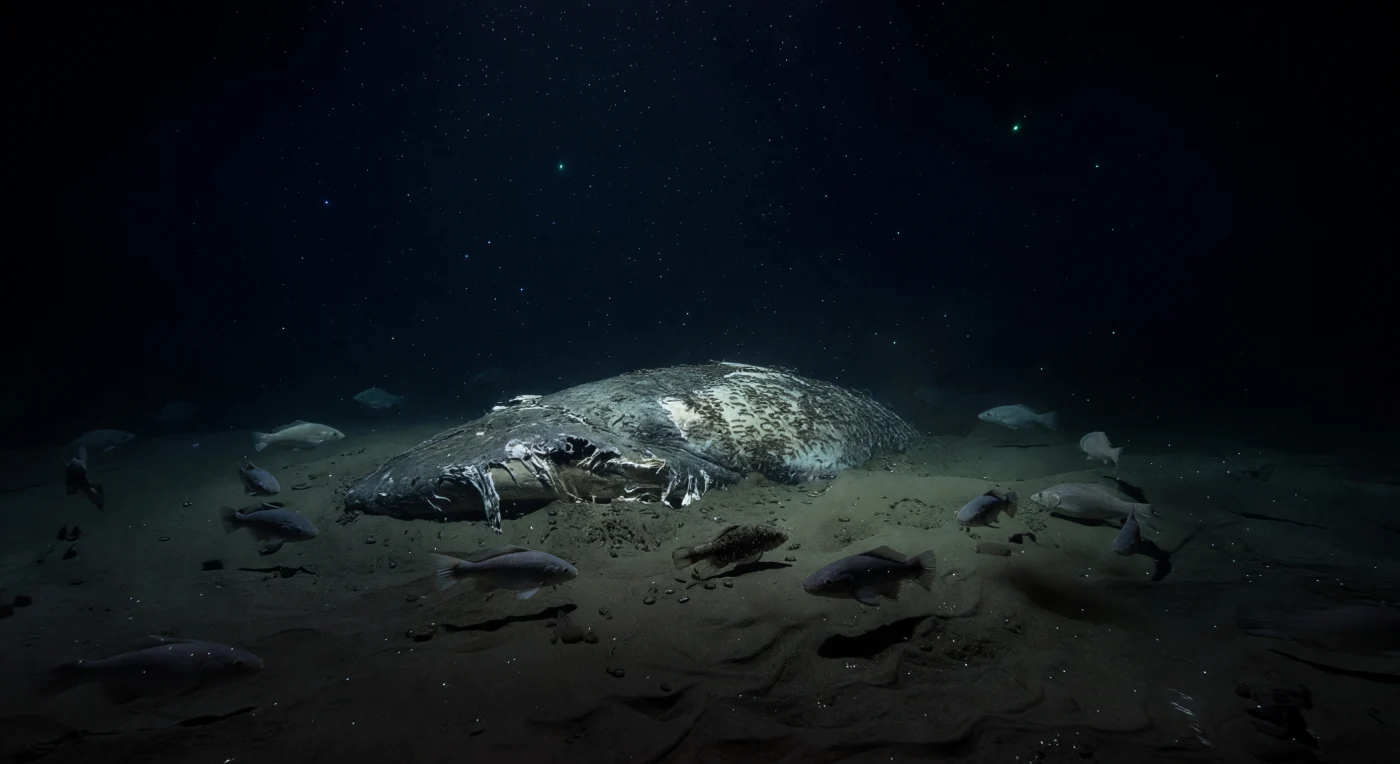
The lander's beam cuts a hard circle into absolute blackness, revealing a sperm whale carcass sprawled across flat abyssal mud as though dropped from a world that no longer exists above — at these depths, between one thousand and four thousand metres, no photon of sunlight has ever reached, and the pressure alone exceeds one hundred atmospheres, enough to crush unprotected tissue in an instant. Inside that cold white cone of LED light, dense carpets of amphipods surge across torn blubber and exposed pale fatty tissue, their bodies so numerous they give the wounds a trembling, almost liquid quality, while grenadiers — rattails, with their great heavy heads and tapering ghost tails — wheel slowly at the edge of illumination, sliding in and out of darkness as though testing the boundary between the known and the void. Marine snow drifts steadily through the beam, each particle a fragment of the surface world sinking for weeks to reach this point, and the disturbed sediment around the carcass shows shallow pits and furrows where scavengers have already dragged and foraged, the soft abyssal mud recording every visitation like slow memory. Beyond the lander's reach, faint blue-green bioluminescent pulses flicker in the darkness — organisms drawn by chemical plumes already diffusing outward through cold still water — and for the creatures gathering here, this fallen giant represents not death but an extraordinary eruption of energy into an otherwise near-barren plain, a food source so vast it will restructure this small patch of seafloor for decades to come.
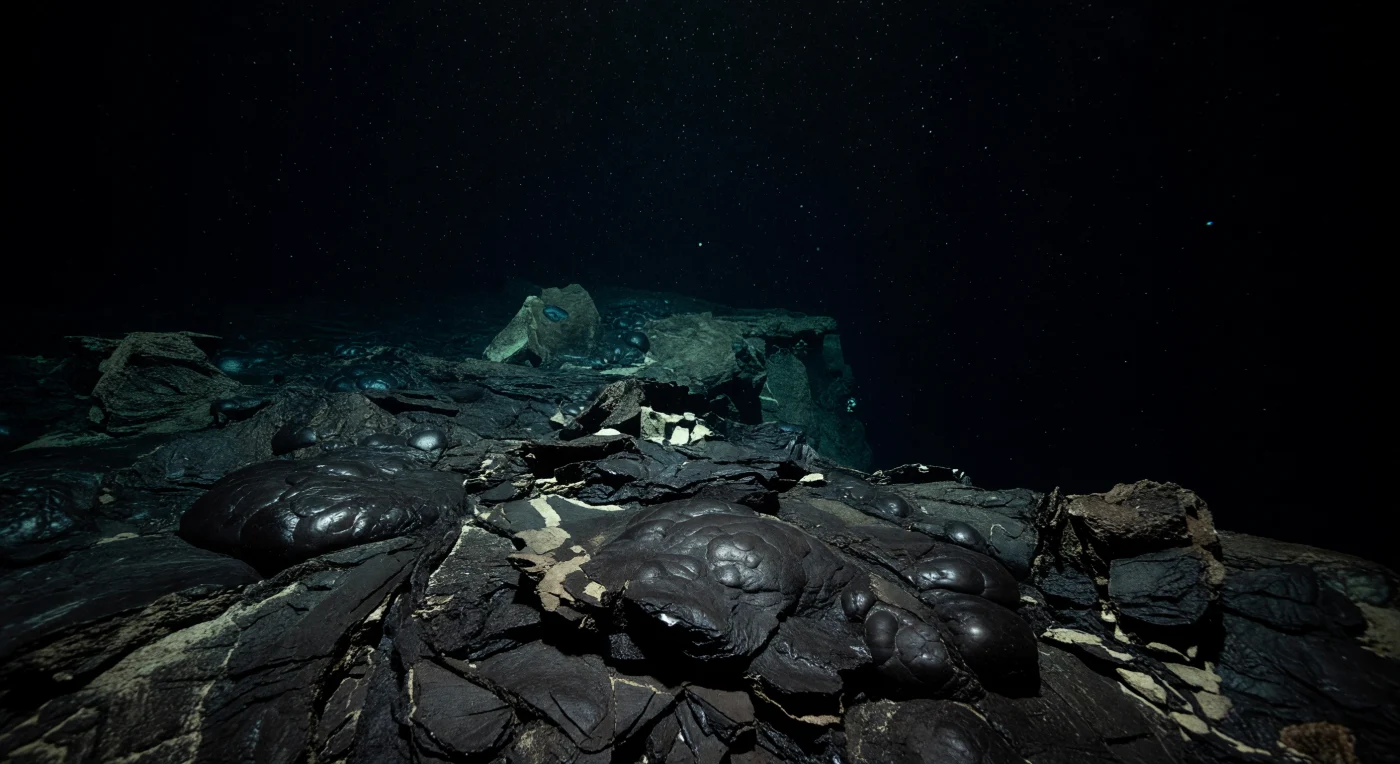
The ROV drifts mere centimeters above a mid-ocean ridge axis where the seafloor is so young it barely exists as geology — bulbous pillow lobes still wear their original volcanic glass like a skin, their surfaces catching the vehicle's cold LED wash with an almost oily metallic sheen, sharp fracture edges casting miniature shadows into collapse cracks that split the crust where the lava drained back into itself. At these depths, somewhere between one and four kilometers beneath the surface, seawater pressure exceeds several hundred atmospheres and the temperature hovers just above freezing, conditions that quench erupting magma almost instantaneously, locking in textures that would take centuries to weather on land. Marine snow — the slow, perpetual rain of organic particles from the sunlit world far above — drifts through the light cone like pale confetti, settling into the finest crevices of the basalt and marking time against surfaces that may have formed only decades ago along the diverging tectonic plates below. Beyond the tight radius of illumination, the ridge skin drops abruptly into an absolute void, and somewhere out in that blackness a cold blue-green pulse flickers and vanishes, the signature of an animal that has never known sunlight and never needed it.
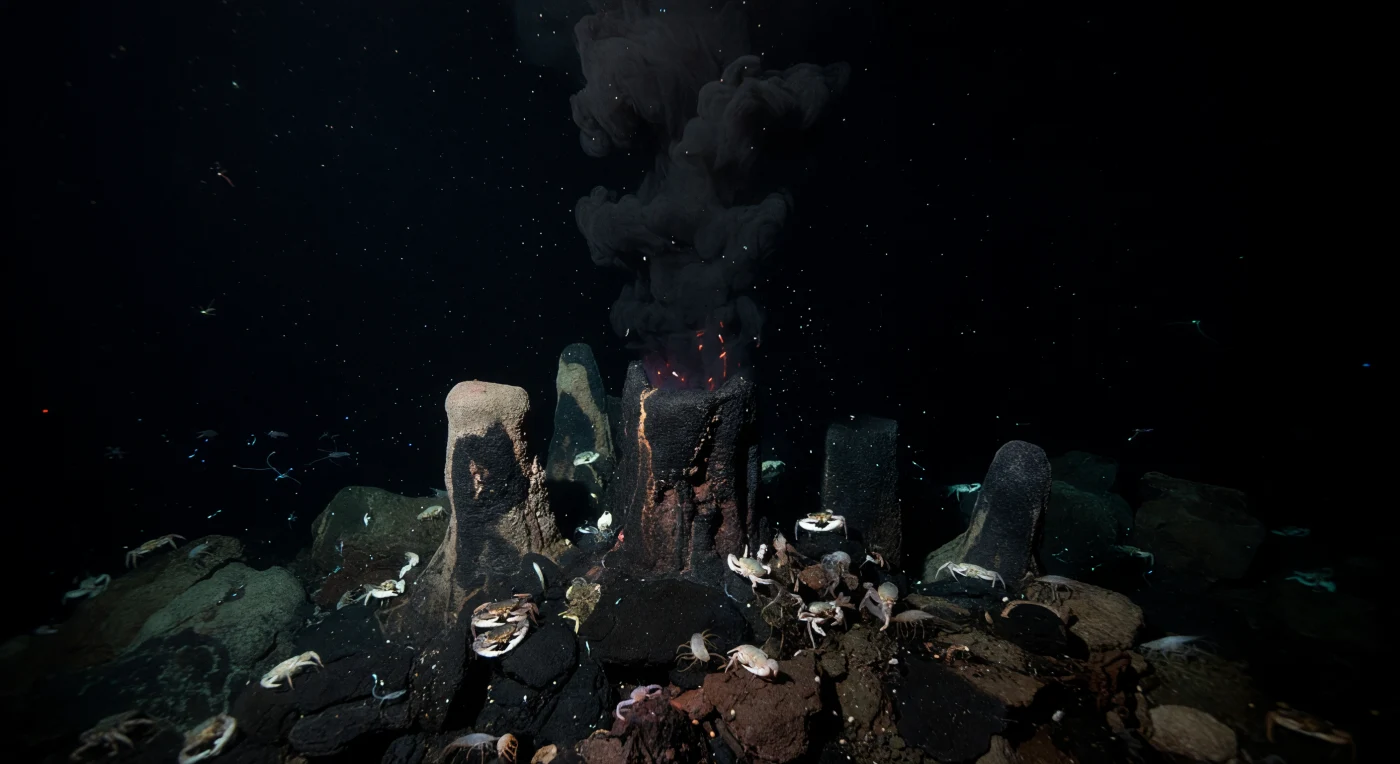
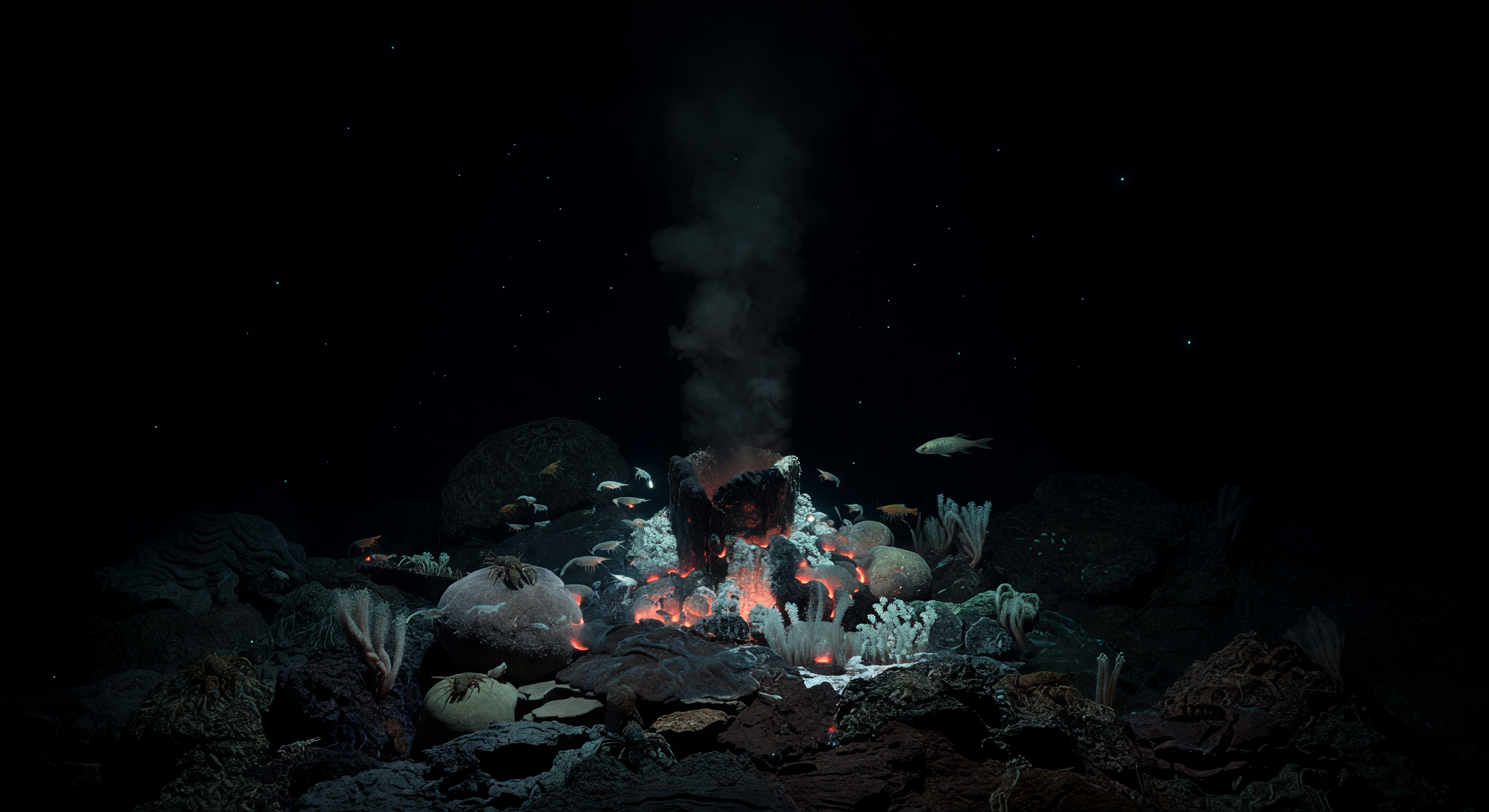
The submersible drifts to a near-halt as its twin lamps sweep across the field of sulfide towers, each chimney's mineral surface catching the amber beam in a brief hard glint before the darkness reclaims it—here, at pressures exceeding 200 to 400 atmospheres, the viewport glass transmits a world that no sunlight has ever touched. The dominant spire vents a dense black plume of superheated, metal-rich fluid reaching upward of 350 °C, the effluent laced with iron sulfide nanoparticles that render it opaque as ink; around its base, the surrounding seawater hovers just above freezing, a thermal boundary so sharp the lamps reveal faint schlieren distortion where the two regimes collide. Clustered along the fractured basalt apron, colonies of Munida-type squat lobsters and alvinocaridid shrimp—many of them bearing chemosynthetic episymbionts on their gill chambers and backs—feed on microbial mats sustained entirely by hydrogen sulfide oxidation, a food web that owes nothing to photosynthesis or the sunlit ocean above. Fine marine snow, a perpetual slow rain of organic aggregates descending from the productive surface layers a kilometer or more overhead, drifts luminous and momentary through the cone of light before dissolving back into the absolute black that presses in on every side. Beyond the reach of the lamps there is nothing—no gradient, no horizon, no blue—only the void that reminds every observer that this is the ocean's true interior, and that the vehicle's hull is the only barrier between a human body and a pressure that would collapse it in an instant.
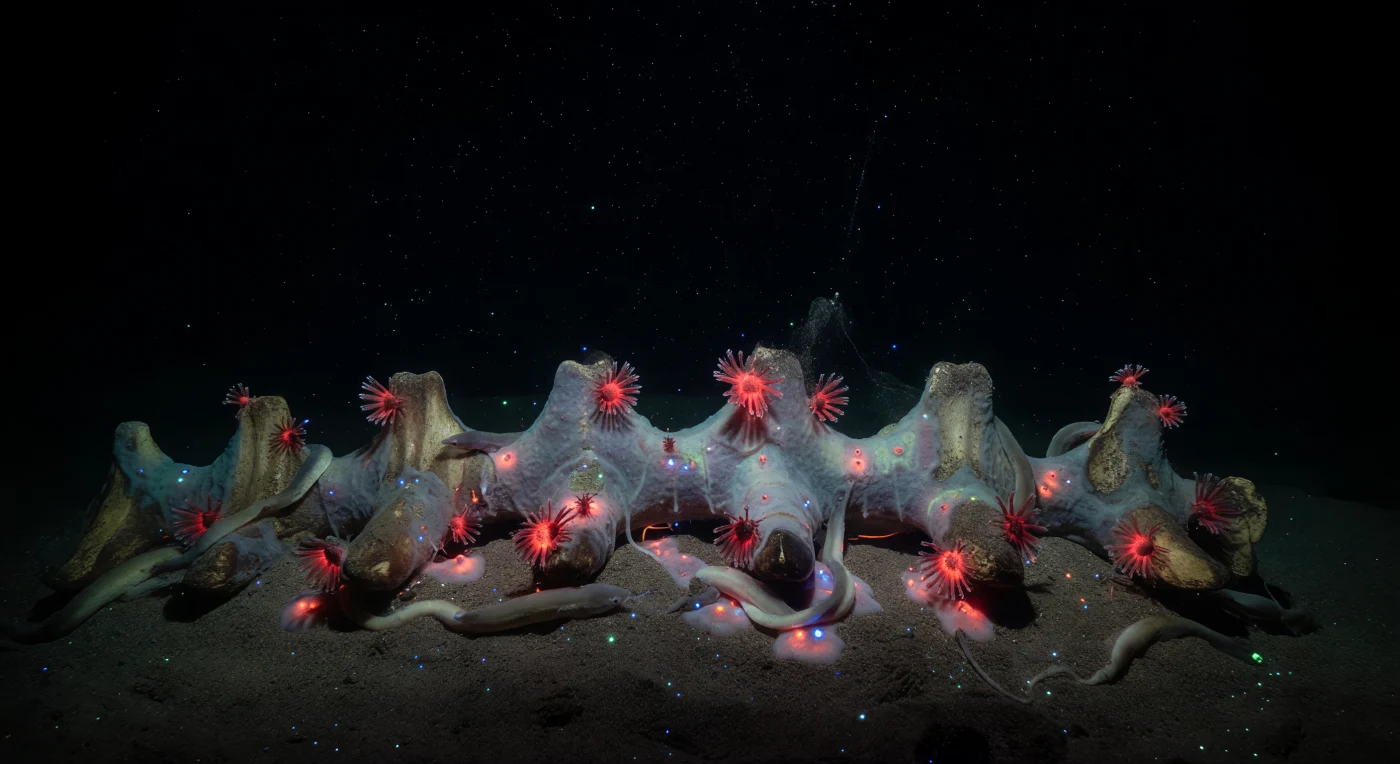
The ROV glides forward on thruster whispers, its twin lamps carving cold blue cones through water that has never known sunlight — only the faint, drifting confetti of marine snow suspended in near-freezing stillness. Ahead, exposed whale vertebrae emerge from fine dark sediment like monuments, their surfaces blanketed in thick white bacterial mats fueled not by photosynthesis but by the slow anaerobic oxidation of lipids still seeping from within the bone itself — a chemosynthetic oasis that can sustain distinct ecological succession stages for decades after a carcass settles. At this depth, pressure exceeds two hundred atmospheres, compressing every material and slowing every biological process, yet concentrated around these remains is a rare explosion of activity: clusters of *Osedax* worms — bone-eating annelids with no mouth or gut, relying entirely on symbiotic bacteria housed in their roots — project vivid crimson plumes that saturate only at the very center of the lamp beams before bleeding into cold grey at the margins. Hagfish weave through the sediment in slow, muscular coils, their slick bodies catching blue highlights as they disturb translucent wisps of silt, drawn by chemoreception to oils no eye would ever have found. Beyond the reach of the ROV's lamps there is nothing — not dim, not dark, but a pure and total black that presses against the light like a physical wall, punctuated only by the occasional cold pinprick of bioluminescence drifting past, indifferent and ancient.
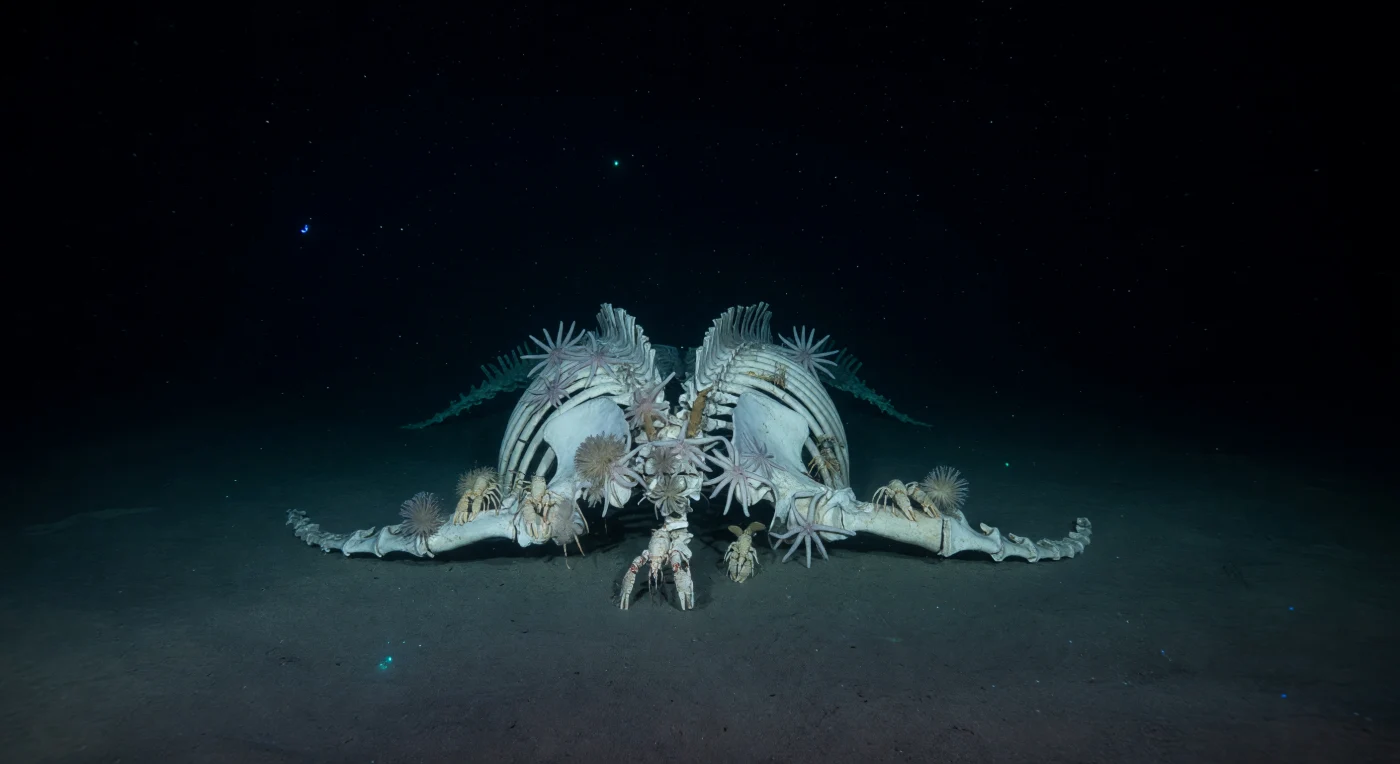
The ROV's lamps sweep across what appears, at first, to be a pale architectural ruin rising from the sediment — then the geometry resolves: ribs, vertebrae, the unmistakable scaffold of a great whale, stripped clean and colonized into something entirely new. At pressures exceeding 250 atmospheres and temperatures hovering near 2°C, this skeleton has become the sole hard substrate for kilometers in any direction, and the community clinging to it reflects that scarcity with extraordinary density — brisingid sea stars drape their elongated arms across the uppermost ribs like sentinels, anemones crowd every articular surface of the vertebrae, and squat lobsters wedge themselves into the osseous gaps, their chelae barely moving in the near-motionless water. This is the whale-fall reef stage, the final chapter of a succession that began when the carcass first sank, progressed through mobile scavengers and enrichment opportunists, and arrives here at a low-sulfur, carbonate-hardground community that may persist for decades sustained by the last organic compounds leaching from the bone matrix itself. Beyond the tight cone of the ROV's cold-white lamps, where the light gradient collapses into pure black within a body-length, faint bioluminescent sparks drift past like slowly cooling embers — the only evidence that the surrounding water column, featureless and immense, is anything other than void.
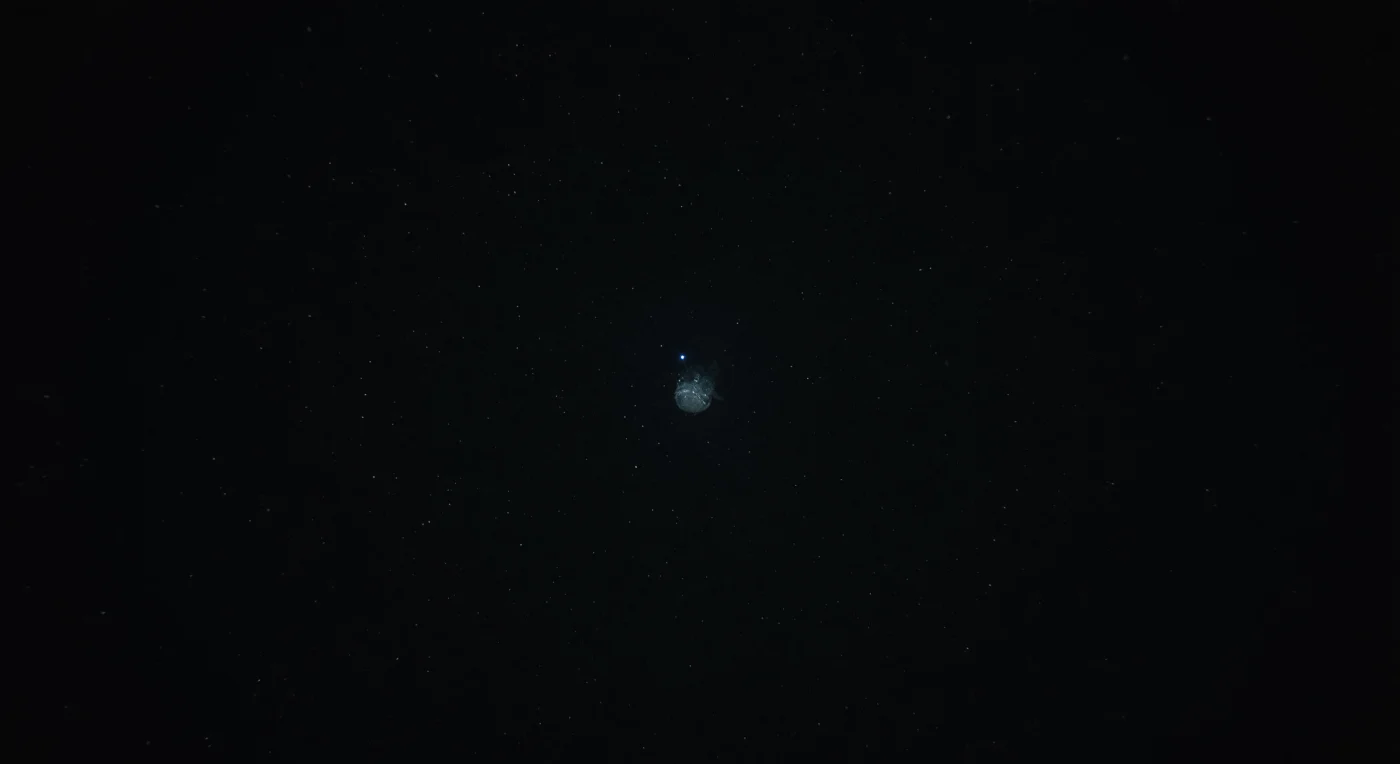
The submersible's lamps punch a narrow white cone into water that has not seen sunlight in any geological memory, and for a long moment there is nothing — only marine snow drifting in slow suspension, each particle catching the beam like static on an old monitor before fading back into absolute black. Then the lure appears: a single cold blue pinpoint blinking at the edge of illumination, roughly two meters beyond where the light dies, and the camera's forward sensors resolve, frame by frame, the outline of a female anglerfish hanging with total stillness in the water column at a depth where pressure exceeds two hundred and fifty atmospheres and the ambient temperature hovers near two degrees Celsius. Her translucent skin materializes and dissolves with each pulse of her esca — the bioluminescent organ produced by symbiotic bacteria — revealing faint internal structures, the ghostly lattice of needle teeth catching isolated specular points from the sub lights before the darkness swallows her outline again. Out here in the open pelagic column, where photosynthesis is an irrelevance and food descends only as marine snow or the occasional vertical migrant, Melanocetus and her kin represent one of evolution's most ruthless economies: a body reduced to jaws, stomach, and lure, waiting in the silence for prey drawn irresistibly toward the only light in an otherwise infinite void.
The ROV drifts motionless in an absolute void, suspended somewhere between a seafloor it cannot see and a surface that ceased to exist kilometers above — its paired lamps carving a narrow cone of cold light into water that swallows every photon within a few meters. Through that cone, marine snow streams in slow diagonal curtains: the perpetual gentle rain of dead cells, fecal pellets, molted exoskeletons, and aggregated mucus that carries fixed carbon from the sunlit world down into permanent darkness, sustaining a sparse community of organisms that the cameras cannot yet find. At this depth, pressure exceeds 200 atmospheres, temperature hovers near 2–4 °C, and the water column is so acoustically and visually isolated from the surface that the ROV's instrument LEDs — amber, red, a flicker of green at the frame edge — constitute the only artificial light in every direction for what may be hundreds of meters. Without a seafloor, a wall, or a single animal to anchor scale, the marine snow becomes the only reference for distance and motion, each mote drifting past the lens a ghost of photosynthesis conducted weeks or months ago in a world of sunlight that feels, from here, entirely theoretical.
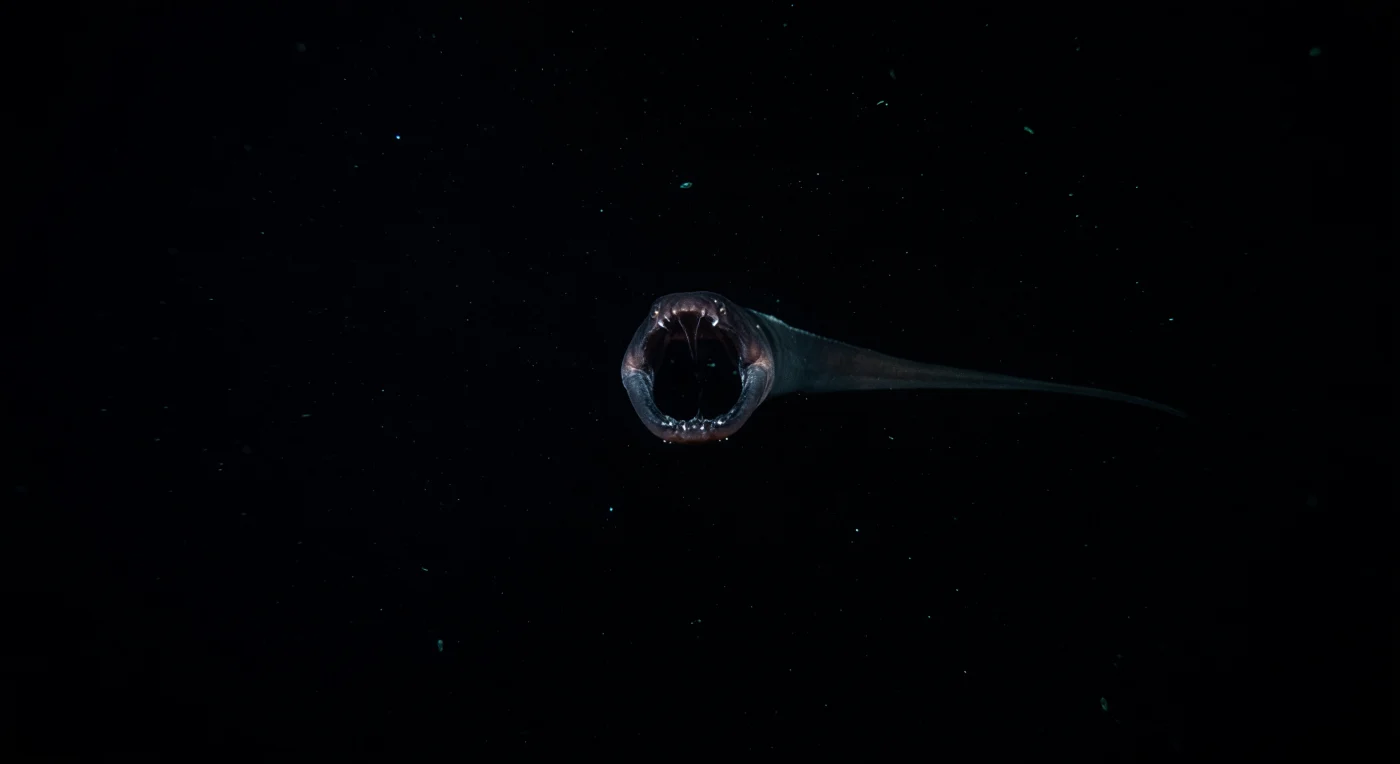
The ROV's lamps carve a brutal cone of cold white light from total nothingness, and suspended within that cone — motionless for a fraction of a second before everything changes — is a gulper eel in the act of its most extraordinary performance: the great inflation, its disproportionate mouth ballooning open toward the camera like a black parachute deploying in slow motion, the circular rim catching sharp pinprick reflections from the lights while the interior remains a cavity of absolute darkness that seems to swallow the beam itself. At roughly 2,500 to 3,000 metres, *Eurypharynx pelecanoides* exists in a world where pressure exceeds 250 atmospheres, ambient temperature hovers near 2–4°C, and not a single photon of solar radiation has penetrated for hundreds of metres above; the gulper's enormous gape is not aggression but adaptation, an evolutionary solution to the problem of encountering prey infrequently in sparse open water and needing to engulf whatever arrives regardless of size. Its slick body, rendered a muted charcoal-violet under the lamps, narrows almost immediately behind the head into the signature filiform tail that dissolves into the negative space surrounding the light cone — a structure whose exact function remains debated, possibly used to lure prey with a luminescent tip. Beyond the beam's reach, faint sparks of blue-green bioluminescence blink once and vanish, the only light that exists here without human intervention, produced by organisms communicating, hunting, and deceiving one another in a darkness that is less an absence and more a physical presence, dense and total and ancient.
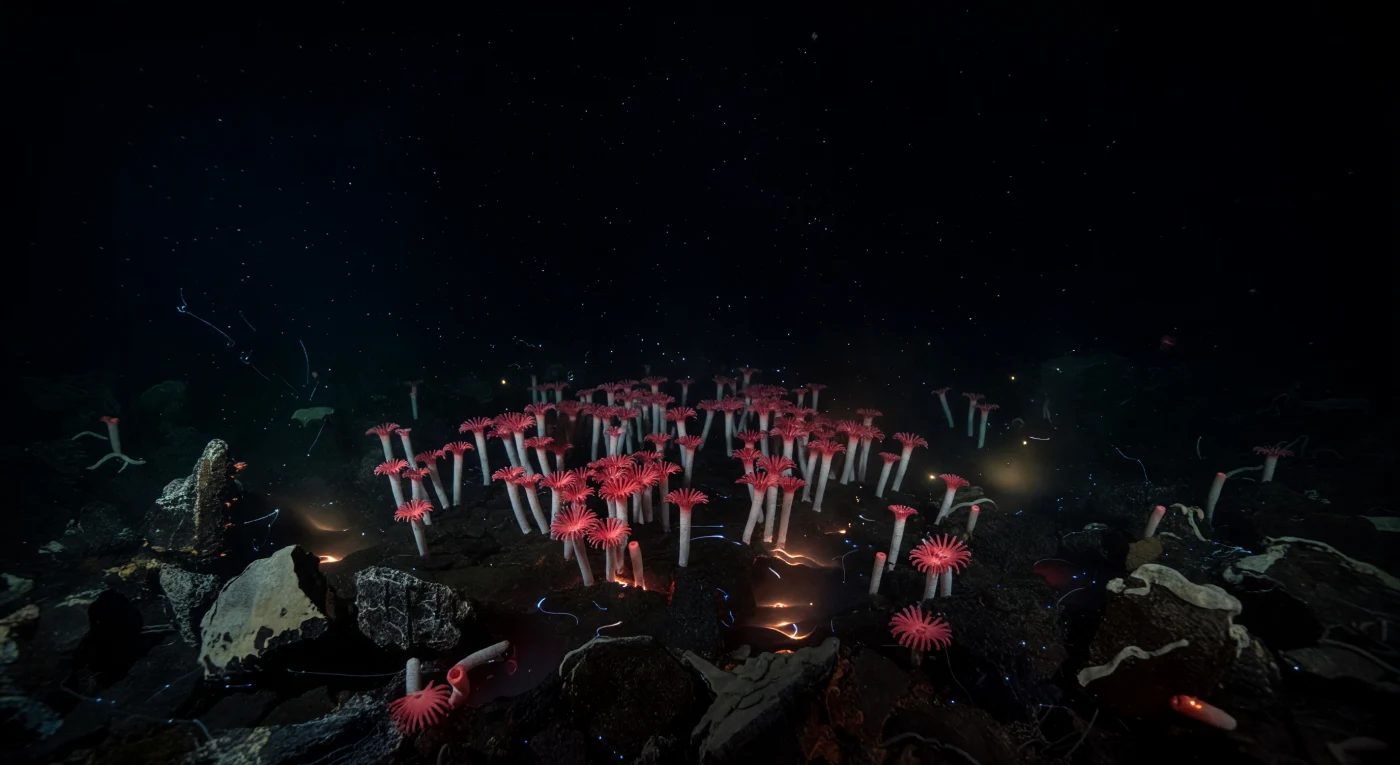
The submersible creeps forward on thruster whisper alone, its twin lamps carving a hard-edged cone of white light out of absolute darkness, and suddenly the seafloor resolves into something almost impossibly alive: dense ranks of *Riftia pachyptila* tubes, chalky and rigid as ceramic, each one crowned with a feathery crimson plume that flickers in the barely perceptible current stirred by diffuse hydrothermal flow seeping invisibly from fractures in the fresh basalt beneath. At this depth — somewhere between two and three kilometres down — pressure exceeds 250 atmospheres, no photon of sunlight has ever reached this water, and the near-freezing ambient temperature makes the warmth bleeding up through those cracks all the more extraordinary; the refractive shimmer of the rising fluid bends the lamplight like a desert mirage, betraying chemistry that sustains an entire ecosystem without a single ray of solar energy. These worms carry no digestive tract; instead they are biological reactors, housing chemoautotrophic bacteria in a specialised organ called the trophosome that oxidises hydrogen sulphide into the organic carbon that feeds the colony. Beyond the tight illumination cone, marine snow drifts through blue-grey half-shadow before the scene collapses entirely into a void so complete that the occasional cold flash of bioluminescence at its edge feels less like life and more like a rumour of it.
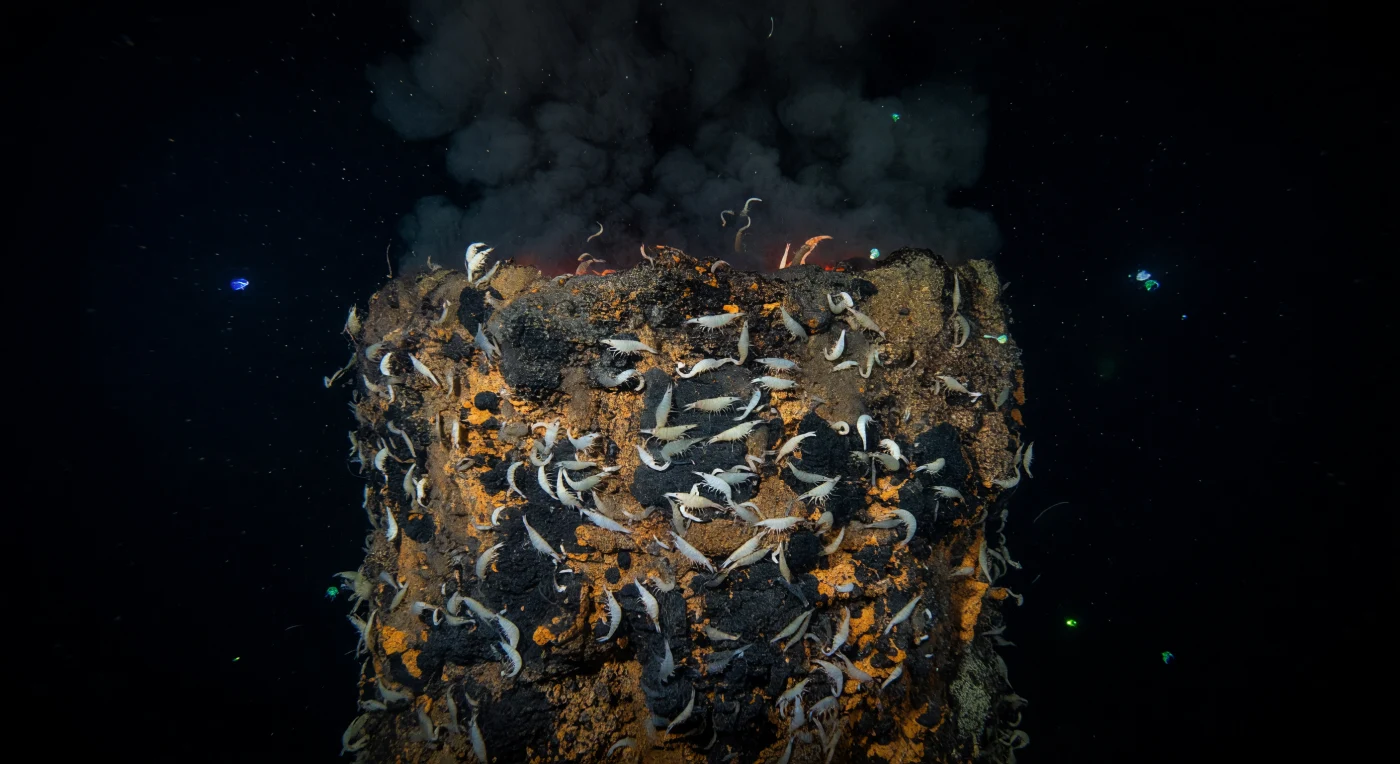
The ROV hangs less than a meter from the chimney face, its twin lamps slicing a cold white cone out of absolute, pressurized blackness — and the wall that fills the frame is alive. Every centimeter of orange-brown sulfide crust and fresh black mineral deposit is packed with blind alvinocarid shrimp, *Rimicaris*-like in form, their pale translucent bodies catching the light in tiny wet highlights as they jostle across ledges and crowd into every crack, grazing on the chemolithotrophic bacteria that coat the mineral surface in thin microbial films. At roughly 2,500 meters, no photon of sunlight has ever reached this place; water pressure bears down at approximately 250 atmospheres, and the near-freezing ambient seawater — close to 2 °C — meets superheated vent fluid venting at several hundred degrees, creating the faint refractive shimmer visible just above the swarm where the two fluid masses collide in a steep thermal gradient. These shrimp have sacrificed functional eyes entirely, navigating instead by modified dorsal photoreceptors thought to detect the faint infrared glow of the vent itself, an evolutionary solution so precise it borders on the uncanny. Fine marine snow and mineral particulates drift through the beam in suspended detail, and beyond the hard falloff of the lamps there is nothing — only crushing cold, silence, and the occasional ghost-light of something bioluminescent passing unseen in the dark.
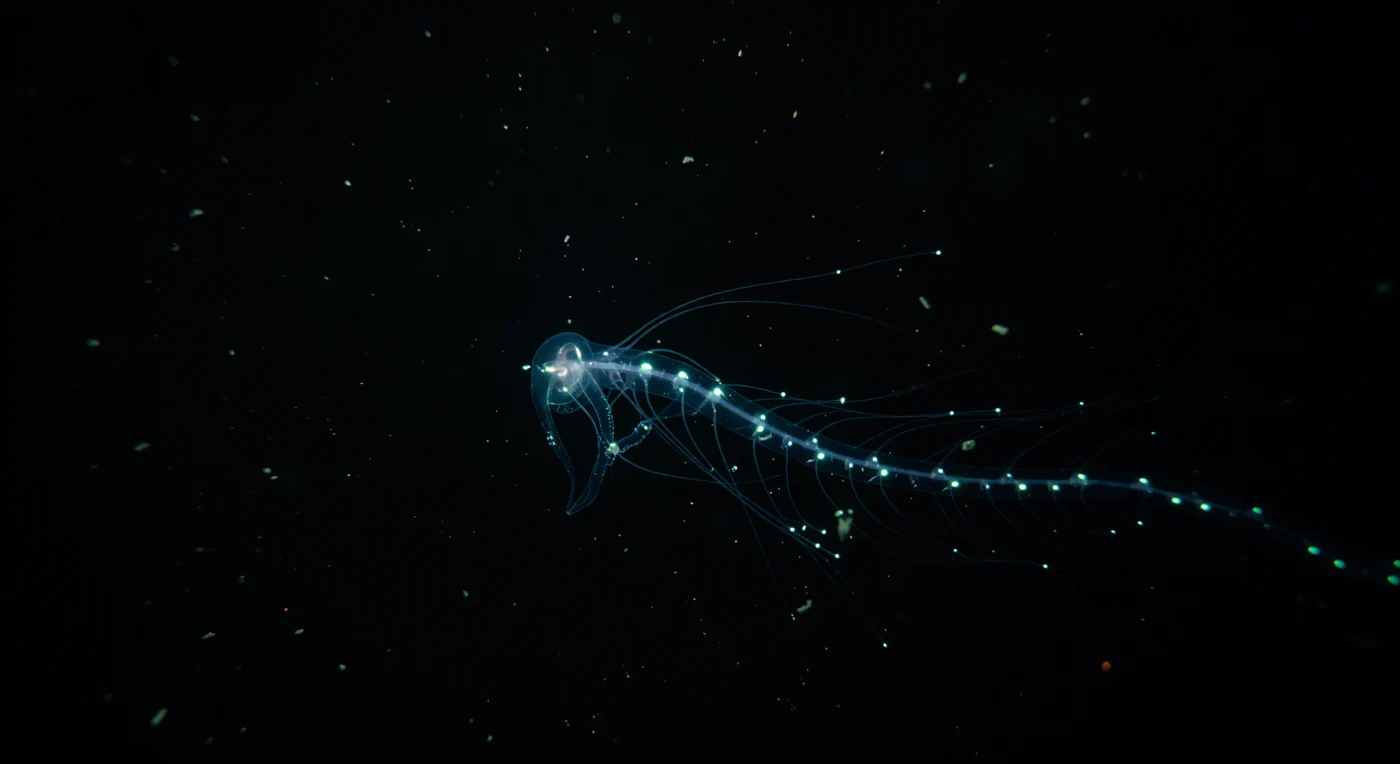
The submersible lamps reach perhaps three meters before the black swallows them whole, and in that narrow cone every mote of marine snow hangs suspended like ash in still air — then, without warning, something far larger ignites just beyond the glass. A siphonophore colony, colonial and technically not a single animal but a superorganism of specialized zooids working in near-perfect physiological concert, sends traveling pulses of blue-green bioluminescence cascading down its length, briefly overwhelming the vessel's own lights and revealing gelatinous bell-shaped nectophores, thread-fine dactylozooids, and trailing tentacles that extend outward into pressures exceeding 200 atmospheres where no sunlight has ever penetrated. At these depths, bioluminescence is not decoration but language — a startled warning discharge, a lure, a distress signal broadcast into a world where the only illumination is biological — and the colony's cyan glow briefly paints nearby particles in cold spectral light before the pulses decay and the creature dissolves back into absolute darkness. The water here, hovering near two degrees Celsius, carries the density and stillness of geological time, and as the bioluminescence fades the viewport returns to its familiar view of nothing, which is to say everything the midnight ocean chooses to conceal.
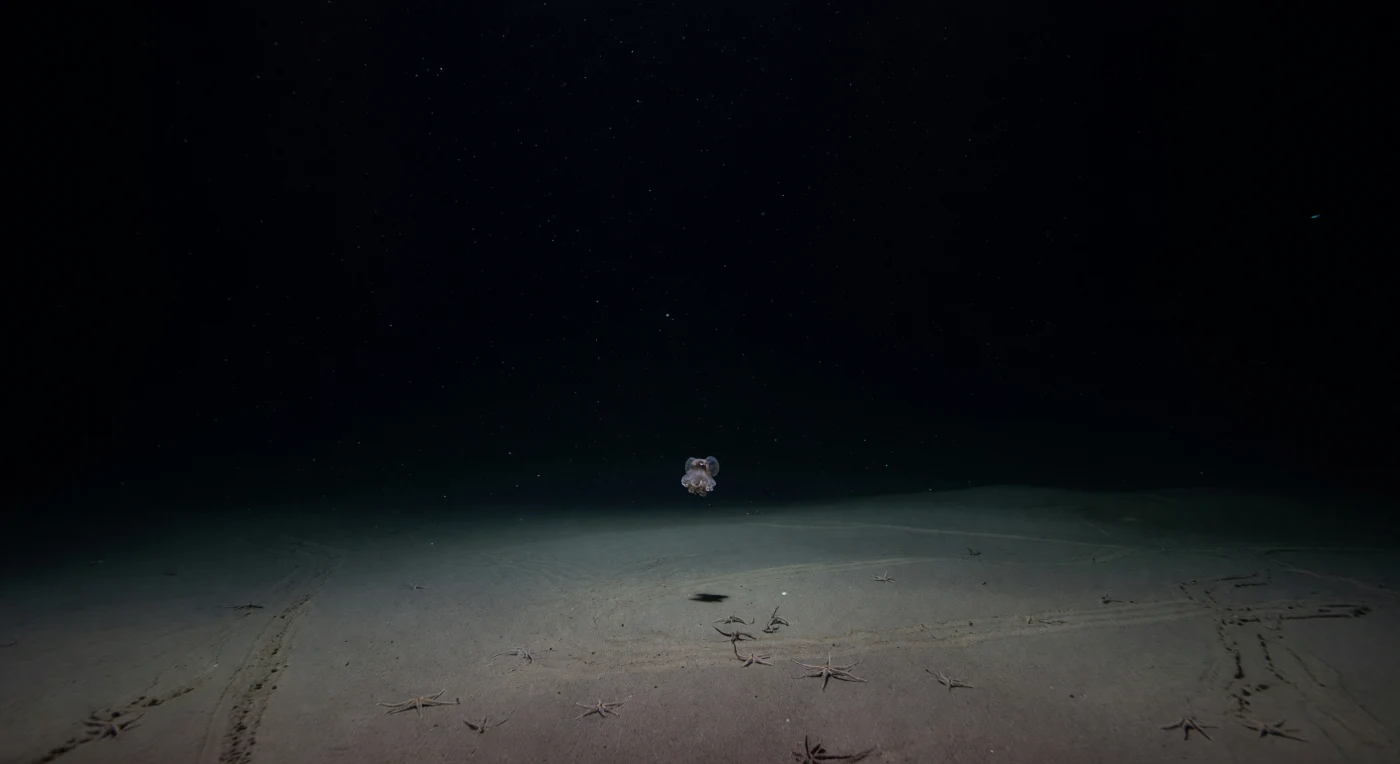
The lander camera rests almost flush with the sediment, its cold LED beam the only light that has touched this seafloor in geological memory, carving a pale circle out of absolute darkness at pressures exceeding 250 atmospheres. Through that narrow cone a dumbo octopus — *Grimpoteuthis* sp. — sculls silently overhead, its paired fins rippling in the unhurried, energy-conserving cadence typical of animals living perpetually on the edge of metabolic possibility, its mantle faintly translucent where the beam grazes the thin tissue adapted to a world where crushing hydrostatic pressure is simply the normal state of matter. The pale gray-brown sediment below it is a slow archive of the ocean above: fine terrigenous and biogenic particles that have drifted down through thousands of meters of open water, now inscribed with the meandering furrows of holothurian passage and punctuated by the splayed arms of brittle stars half-buried at the lit edge. Marine snow drifts lazily through the backscatter, each particle a remnant of surface productivity transformed by the time it reaches this cold, near-freezing stratum where bacterial decomposition barely outpaces deposition. Beyond the lander's reach the water column is featureless void save for an occasional cold blue-green bioluminescent flash — the only light these animals have ever produced or received entirely on their own terms.
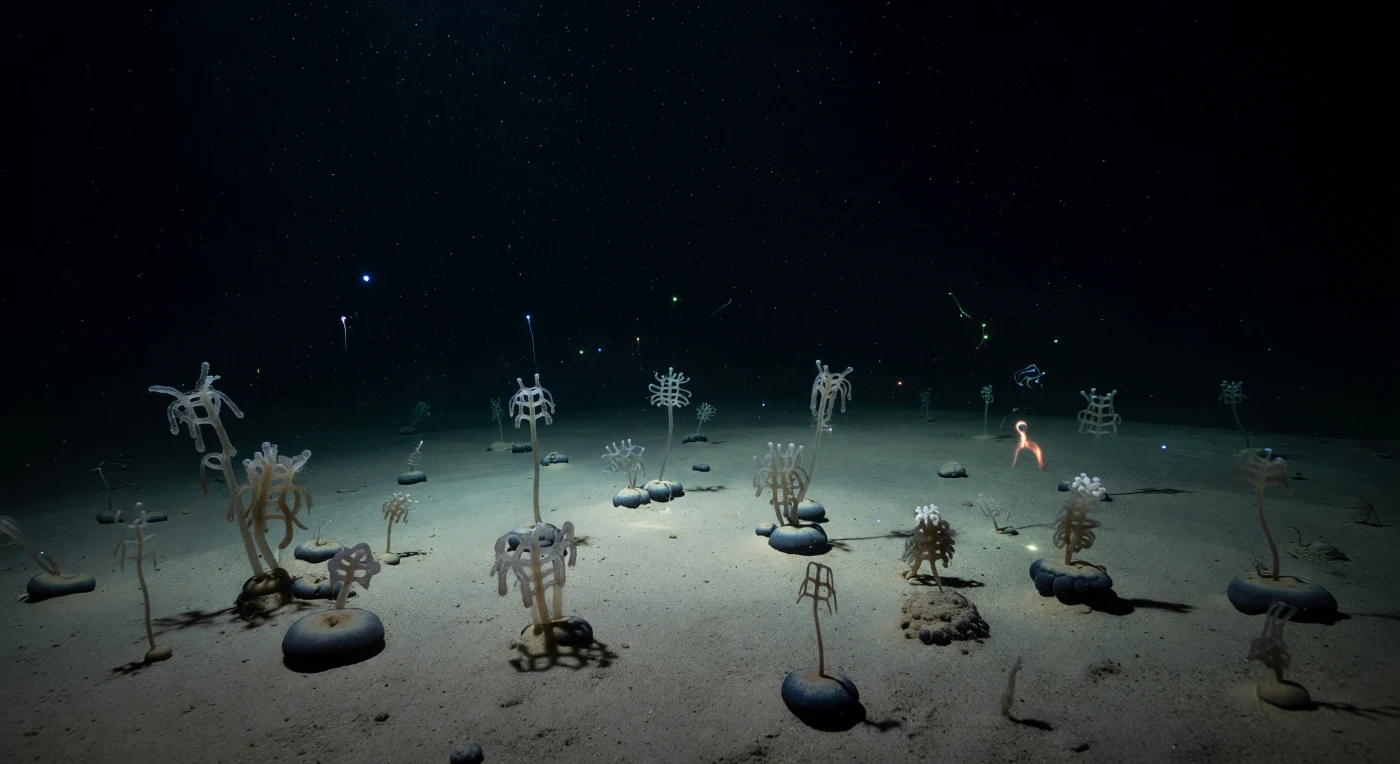
The ROV hangs motionless just above the silt, its twin side-mounted lamps skimming the bottom at a shallow angle that transforms every object into a source of dramatic shadow — glass sponge lattices project knife-sharp silhouettes across the pale seafloor while xenophyophore mounds, some of the largest single-celled organisms on Earth, squat half-buried in sediment, their rounded forms throwing dark wedges upward through particle-laden water. At pressures exceeding 250 atmospheres and temperatures hovering near 2°C, this silt plain exists in a state of near-geological stillness, accumulating fine marine snow — the slow rain of organic detritus from the sunlit world far above — at rates measured in millimeters per millennium. The silica lattices of the hexactinellid sponges, assembled without a nervous system from dissolved silicate ions, appear almost luminous under the raking beams, their intricate geometry a product of biomineralization rather than any encounter with light. Beyond the narrow cone of illumination, the water column rises as an unbroken black void, crushing and absolute, punctuated only by the cold spark of a distant bioluminescent organism drifting through the frame. Here, all energy for life flows downward from above or sideways from chemistry, never from a sun that has not touched this place in the entire history of the seafloor.
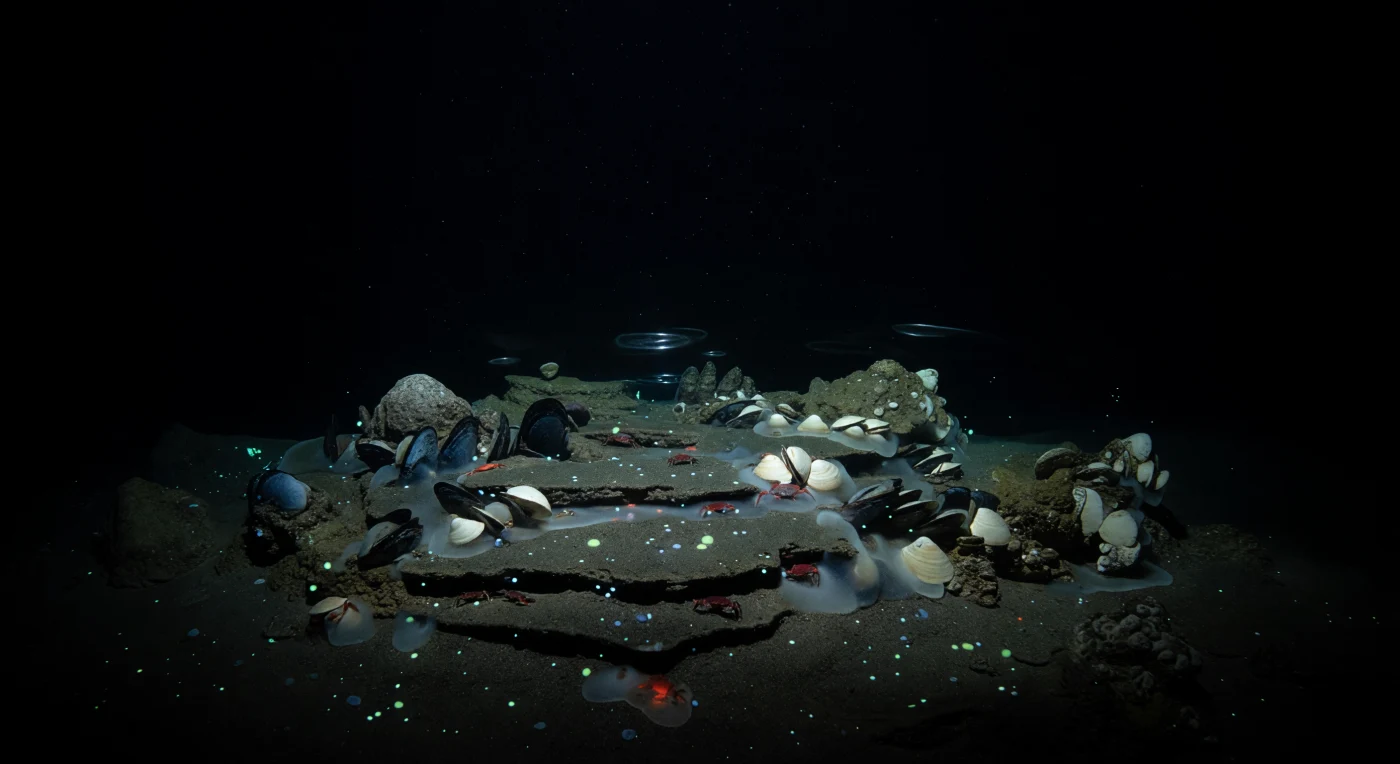
The submersible hangs motionless in absolute darkness, its lamps carving a tight cone of white light down onto a terraced bed of giant mussels and pale clams that seems to materialize from nothing — an island of life suspended in an otherwise infinite void. At pressures exceeding 200 atmospheres and temperatures hovering near freezing, these organisms survive not on sunlight but on chemosynthesis, their tissues and the dense white bacterial mats ringing their shells sustained entirely by methane and hydrogen sulfide seeping up through fractured carbonate crust far beneath the sediment surface. Above the shell beds, methane-saturated fluids shimmer upward in refractive columns, bending the light like trapped heat haze and betraying the slow, invisible chemistry that powers this entire ecosystem. Marine snow drifts through the beam in sharp suspension — organic detritus from a sunlit surface world thousands of meters overhead, a reminder that even here, the deep is loosely tethered to the photic zone above. A handful of small red crabs move with deliberate, unhurried purpose between the mussel ridges, their crimson pigmentation rendered vivid by the lamps before the darkness beyond the beam's edge swallows everything else completely.
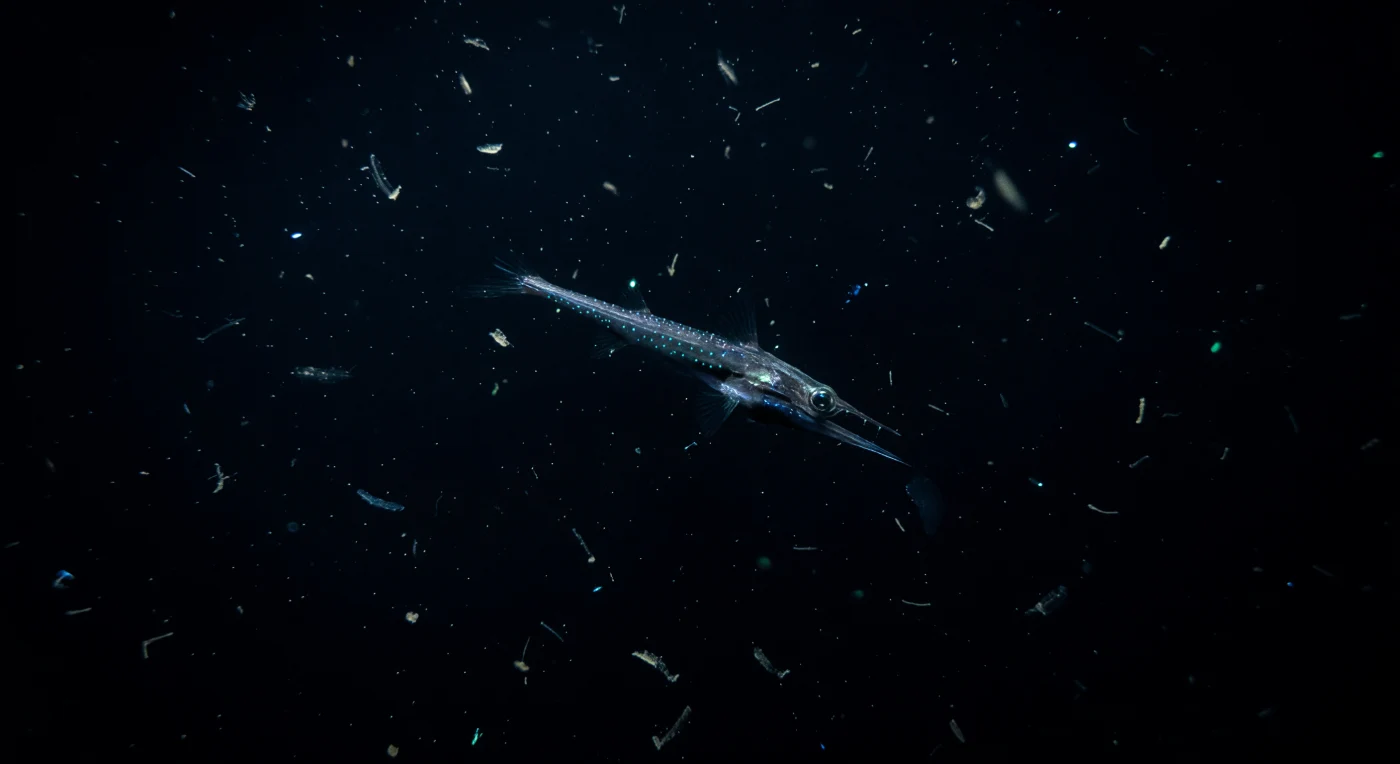
Between one thousand and two thousand five hundred metres below the surface, where pressure exceeds two hundred atmospheres and the last photon of sunlight dissolved kilometres above, a viperfish — Chauliodus sloani — materialises out of the absolute dark in a single predatory instant. Its needle-slim body, no longer than a human forearm, is armoured in scales that shift from charcoal to cold steel, while a precise row of ventral photophores fires a measured pulse of blue-green bioluminescence along its underside — a lure, a signal, or perhaps a form of counter-illumination against the faint biological glow drifting down from shallower water. Around it, marine snow descends in near-weightless suspension: fragmented fecal pellets, collapsed gelatinous bodies, mineral grains, and the shed mucus webs of filter feeders, each particle the slow currency of carbon falling from a sunlit world that might as well not exist from here. The water itself is within a degree or two of freezing, almost entirely still, and carries no sound beyond the occasional soft implosion of a pressure-adapted body moving through it. This is an ocean interior that has always been precisely this dark, this cold, and this indifferent — a realm that requires no witness, that has never needed one.