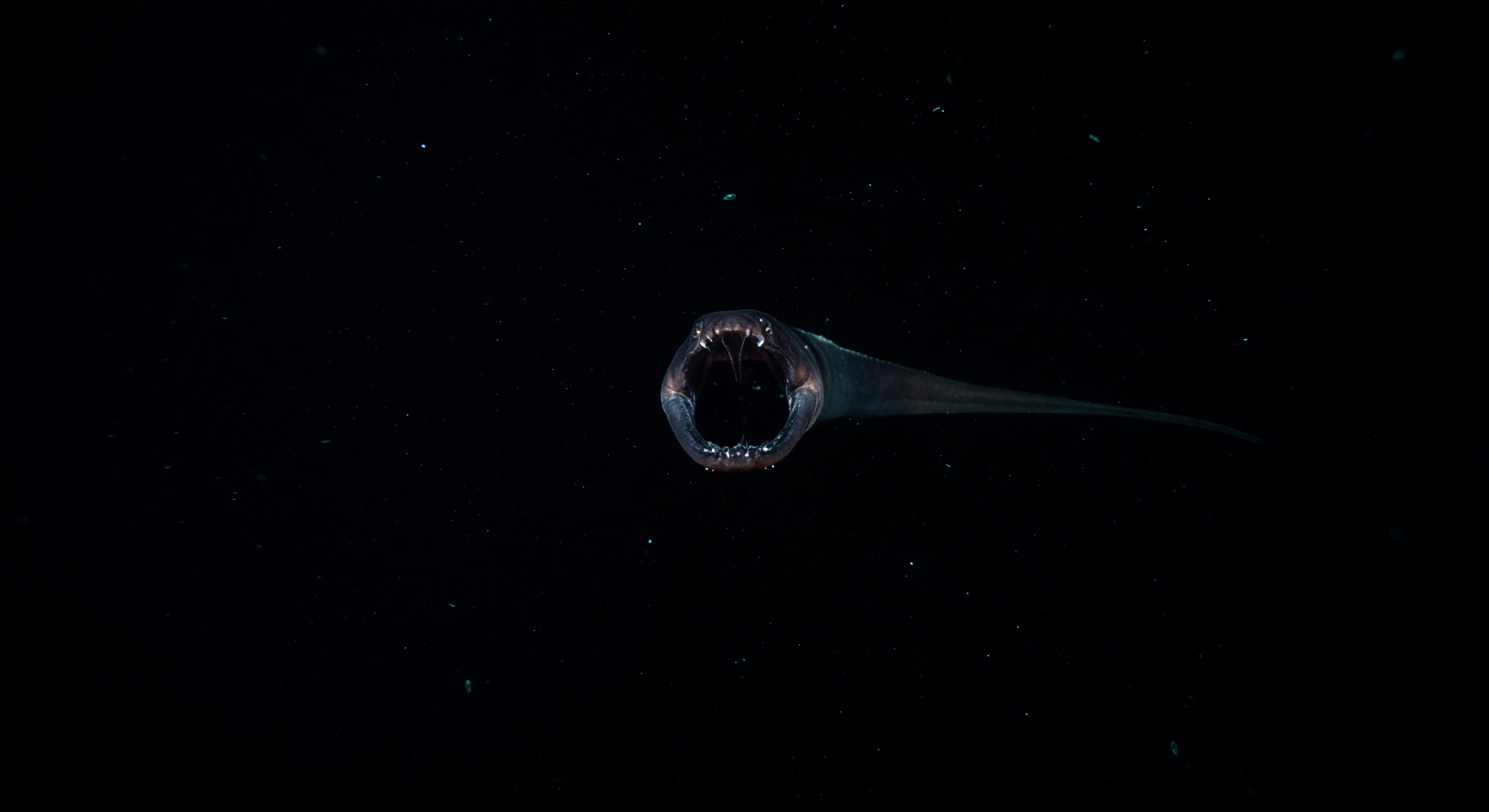
The ROV's lamps carve a brutal cone of cold white light from total nothingness, and suspended within that cone — motionless for a fraction of a second before everything changes — is a gulper eel in the act of its most extraordinary performance: the great inflation, its disproportionate mouth ballooning open toward the camera like a black parachute deploying in slow motion, the circular rim catching sharp pinprick reflections from the lights while the interior remains a cavity of absolute darkness that seems to swallow the beam itself. At roughly 2,500 to 3,000 metres, *Eurypharynx pelecanoides* exists in a world where pressure exceeds 250 atmospheres, ambient temperature hovers near 2–4°C, and not a single photon of solar radiation has penetrated for hundreds of metres above; the gulper's enormous gape is not aggression but adaptation, an evolutionary solution to the problem of encountering prey infrequently in sparse open water and needing to engulf whatever arrives regardless of size. Its slick body, rendered a muted charcoal-violet under the lamps, narrows almost immediately behind the head into the signature filiform tail that dissolves into the negative space surrounding the light cone — a structure whose exact function remains debated, possibly used to lure prey with a luminescent tip. Beyond the beam's reach, faint sparks of blue-green bioluminescence blink once and vanish, the only light that exists here without human intervention, produced by organisms communicating, hunting, and deceiving one another in a darkness that is less an absence and more a physical presence, dense and total and ancient.
Perpetual night