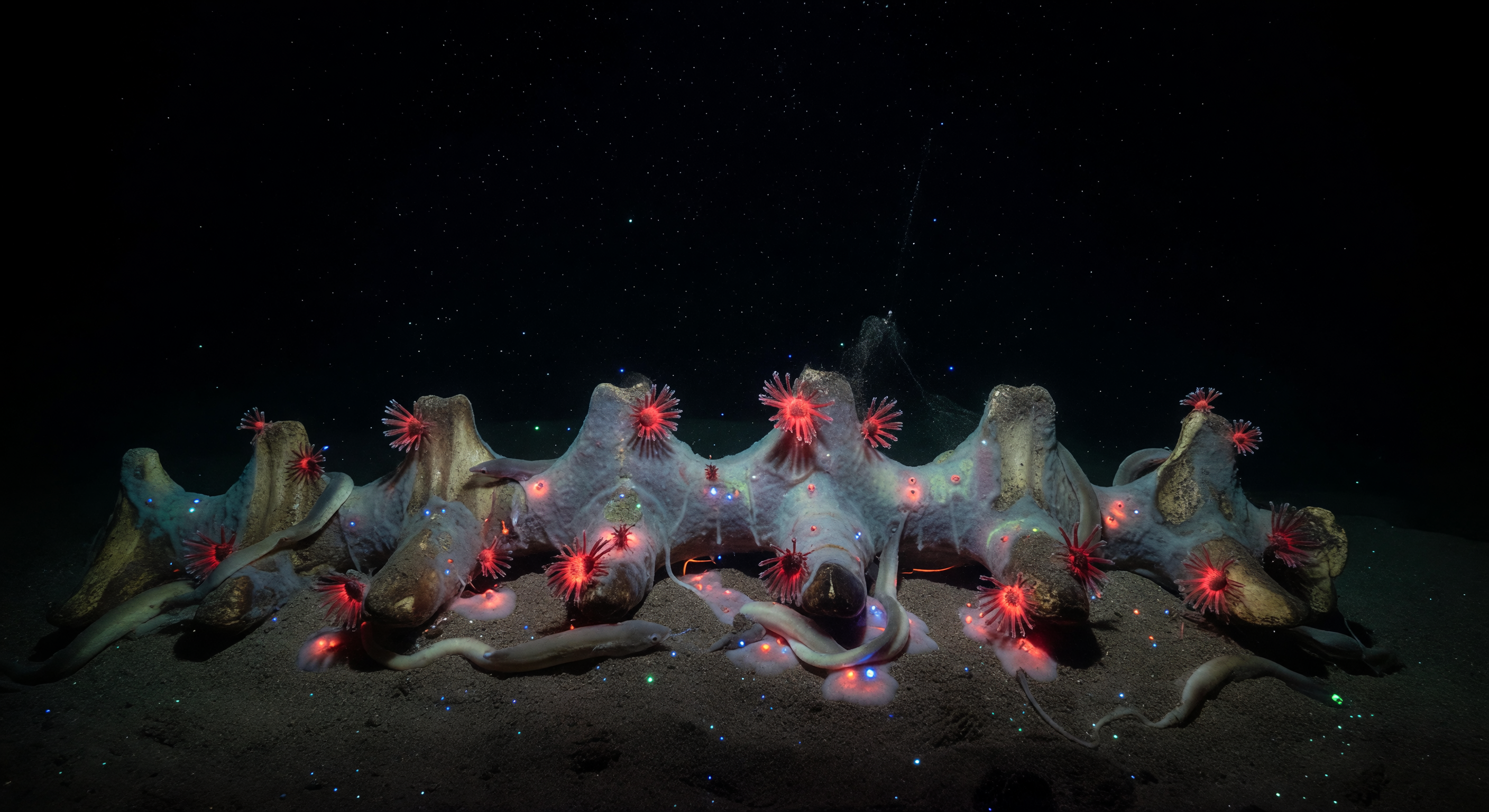
The ROV glides forward on thruster whispers, its twin lamps carving cold blue cones through water that has never known sunlight — only the faint, drifting confetti of marine snow suspended in near-freezing stillness. Ahead, exposed whale vertebrae emerge from fine dark sediment like monuments, their surfaces blanketed in thick white bacterial mats fueled not by photosynthesis but by the slow anaerobic oxidation of lipids still seeping from within the bone itself — a chemosynthetic oasis that can sustain distinct ecological succession stages for decades after a carcass settles. At this depth, pressure exceeds two hundred atmospheres, compressing every material and slowing every biological process, yet concentrated around these remains is a rare explosion of activity: clusters of *Osedax* worms — bone-eating annelids with no mouth or gut, relying entirely on symbiotic bacteria housed in their roots — project vivid crimson plumes that saturate only at the very center of the lamp beams before bleeding into cold grey at the margins. Hagfish weave through the sediment in slow, muscular coils, their slick bodies catching blue highlights as they disturb translucent wisps of silt, drawn by chemoreception to oils no eye would ever have found. Beyond the reach of the ROV's lamps there is nothing — not dim, not dark, but a pure and total black that presses against the light like a physical wall, punctuated only by the occasional cold pinprick of bioluminescence drifting past, indifferent and ancient.
Other languages
- Français: Jardin Soufré d'Os de Baleine
- Español: Jardín Sulfúrico de Huesos
- Português: Jardim de Enxofre Ósseo
- Deutsch: Schwefelgarten der Walknochen
- العربية: حديقة كبريت عظام الحوت
- हिन्दी: व्हेल अस्थि गंधक उद्यान
- 日本語: 鯨骨硫黄の庭
- 한국어: 고래뼈 유황 정원
- Italiano: Giardino di Zolfo e Ossa
- Nederlands: Zwaveltuinen van Walvisbotten