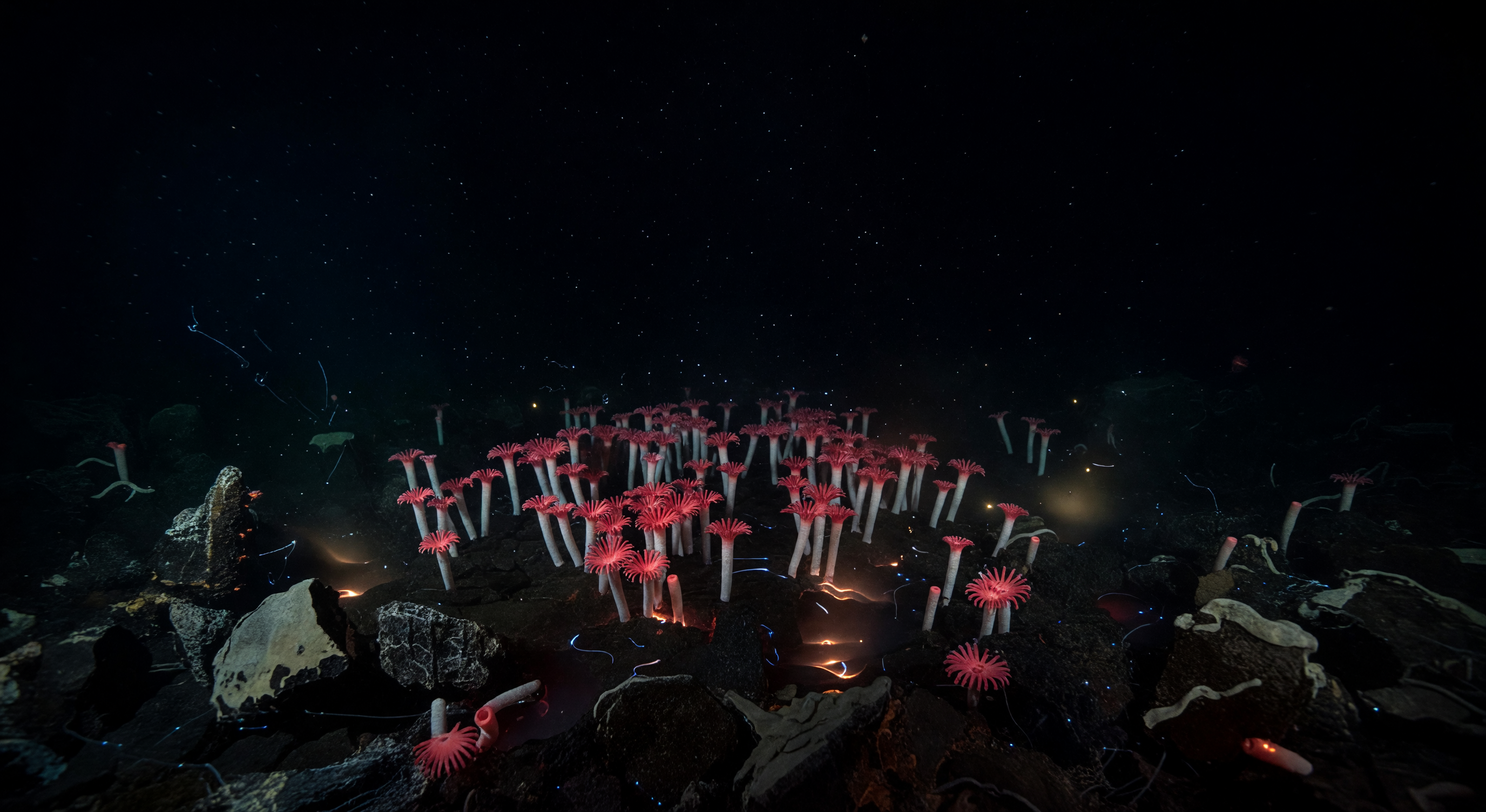
The submersible creeps forward on thruster whisper alone, its twin lamps carving a hard-edged cone of white light out of absolute darkness, and suddenly the seafloor resolves into something almost impossibly alive: dense ranks of *Riftia pachyptila* tubes, chalky and rigid as ceramic, each one crowned with a feathery crimson plume that flickers in the barely perceptible current stirred by diffuse hydrothermal flow seeping invisibly from fractures in the fresh basalt beneath. At this depth — somewhere between two and three kilometres down — pressure exceeds 250 atmospheres, no photon of sunlight has ever reached this water, and the near-freezing ambient temperature makes the warmth bleeding up through those cracks all the more extraordinary; the refractive shimmer of the rising fluid bends the lamplight like a desert mirage, betraying chemistry that sustains an entire ecosystem without a single ray of solar energy. These worms carry no digestive tract; instead they are biological reactors, housing chemoautotrophic bacteria in a specialised organ called the trophosome that oxidises hydrogen sulphide into the organic carbon that feeds the colony. Beyond the tight illumination cone, marine snow drifts through blue-grey half-shadow before the scene collapses entirely into a void so complete that the occasional cold flash of bioluminescence at its edge feels less like life and more like a rumour of it.
Other languages
- Français: Vers tubicoles aux suintements
- Español: Gusanos tubulares en flujo difuso
- Português: Vermes tubulares em fluxo difuso
- Deutsch: Röhrenwürmer am Diffusfeld
- العربية: ديدان أنبوبية عند التدفق
- हिन्दी: नलीकृमि विसरित प्रवाह में
- 日本語: 拡散流の管虫たち
- 한국어: 열수 분출의 관벌레
- Italiano: Vermi tubo al flusso diffuso
- Nederlands: Buiswwormen bij diffuse stroming