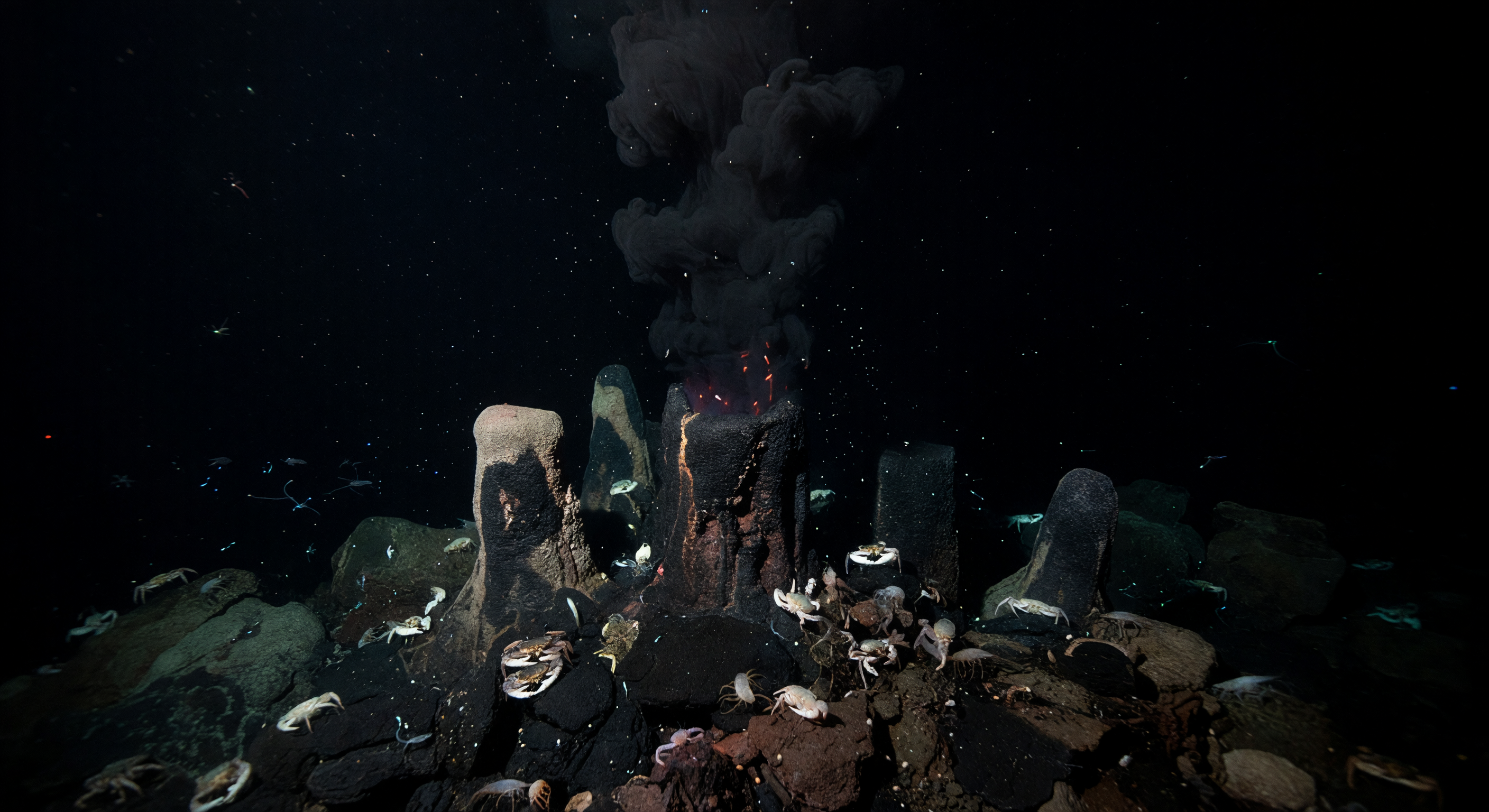
The submersible drifts to a near-halt as its twin lamps sweep across the field of sulfide towers, each chimney's mineral surface catching the amber beam in a brief hard glint before the darkness reclaims it—here, at pressures exceeding 200 to 400 atmospheres, the viewport glass transmits a world that no sunlight has ever touched. The dominant spire vents a dense black plume of superheated, metal-rich fluid reaching upward of 350 °C, the effluent laced with iron sulfide nanoparticles that render it opaque as ink; around its base, the surrounding seawater hovers just above freezing, a thermal boundary so sharp the lamps reveal faint schlieren distortion where the two regimes collide. Clustered along the fractured basalt apron, colonies of Munida-type squat lobsters and alvinocaridid shrimp—many of them bearing chemosynthetic episymbionts on their gill chambers and backs—feed on microbial mats sustained entirely by hydrogen sulfide oxidation, a food web that owes nothing to photosynthesis or the sunlit ocean above. Fine marine snow, a perpetual slow rain of organic aggregates descending from the productive surface layers a kilometer or more overhead, drifts luminous and momentary through the cone of light before dissolving back into the absolute black that presses in on every side. Beyond the reach of the lamps there is nothing—no gradient, no horizon, no blue—only the void that reminds every observer that this is the ocean's true interior, and that the vehicle's hull is the only barrier between a human body and a pressure that would collapse it in an instant.
Other languages
- Français: Fumeurs sous les phares
- Español: Chimeneas en luz ámbar
- Português: Fumadores no brilho dos faróis
- Deutsch: Schlote im Scheinwerferlicht
- العربية: مداخن في وهج الأضواء
- हिन्दी: रोशनी में धूम्र चिमनियाँ
- 日本語: 灯りに浮かぶ熱水噴出口
- 한국어: 탐조등 속 열수분출공
- Italiano: Fumatori nel bagliore dei fari
- Nederlands: Schoorstenen in koplampgloed