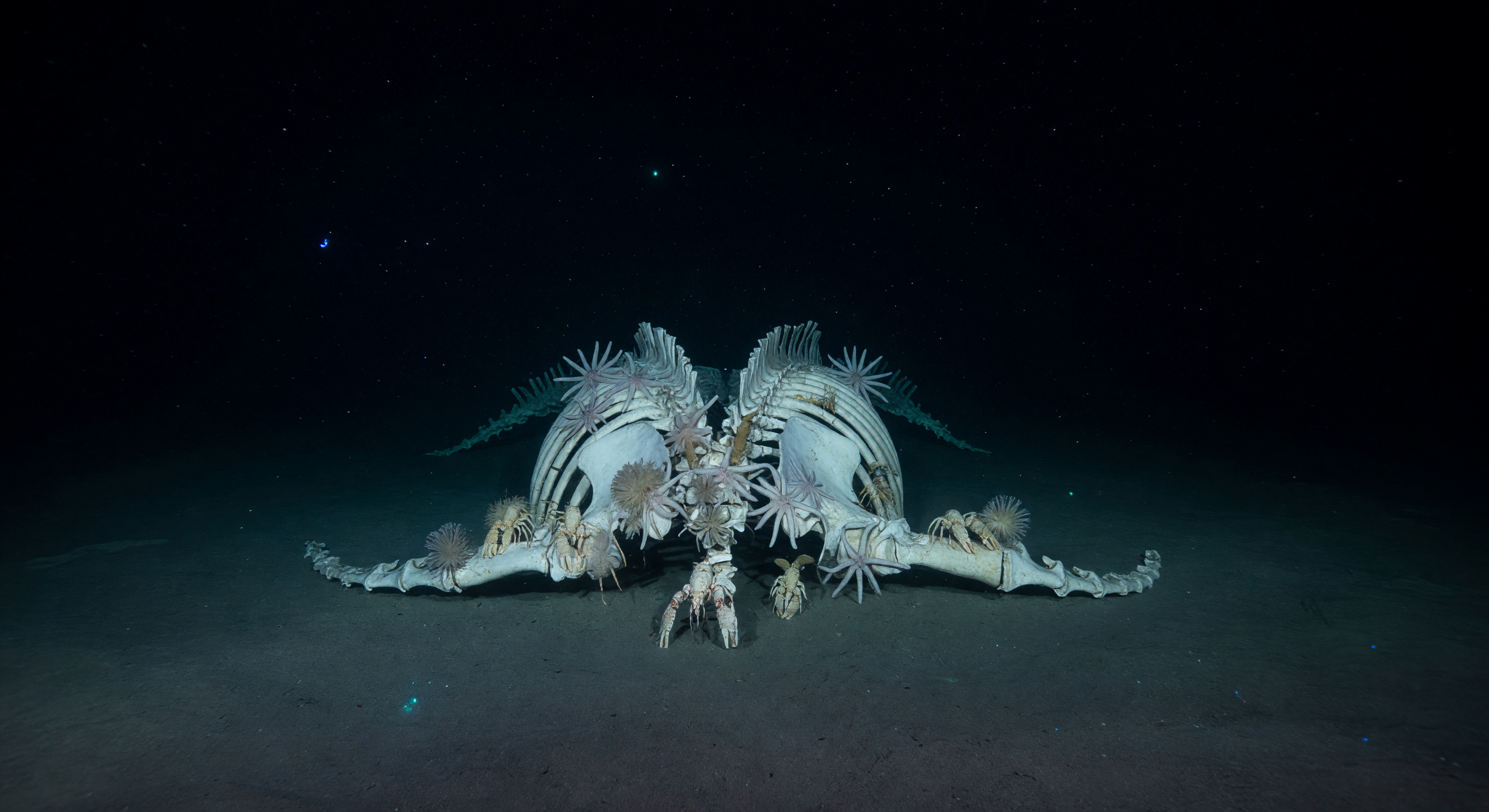
The ROV's lamps sweep across what appears, at first, to be a pale architectural ruin rising from the sediment — then the geometry resolves: ribs, vertebrae, the unmistakable scaffold of a great whale, stripped clean and colonized into something entirely new. At pressures exceeding 250 atmospheres and temperatures hovering near 2°C, this skeleton has become the sole hard substrate for kilometers in any direction, and the community clinging to it reflects that scarcity with extraordinary density — brisingid sea stars drape their elongated arms across the uppermost ribs like sentinels, anemones crowd every articular surface of the vertebrae, and squat lobsters wedge themselves into the osseous gaps, their chelae barely moving in the near-motionless water. This is the whale-fall reef stage, the final chapter of a succession that began when the carcass first sank, progressed through mobile scavengers and enrichment opportunists, and arrives here at a low-sulfur, carbonate-hardground community that may persist for decades sustained by the last organic compounds leaching from the bone matrix itself. Beyond the tight cone of the ROV's cold-white lamps, where the light gradient collapses into pure black within a body-length, faint bioluminescent sparks drift past like slowly cooling embers — the only evidence that the surrounding water column, featureless and immense, is anything other than void.
Perpetual night