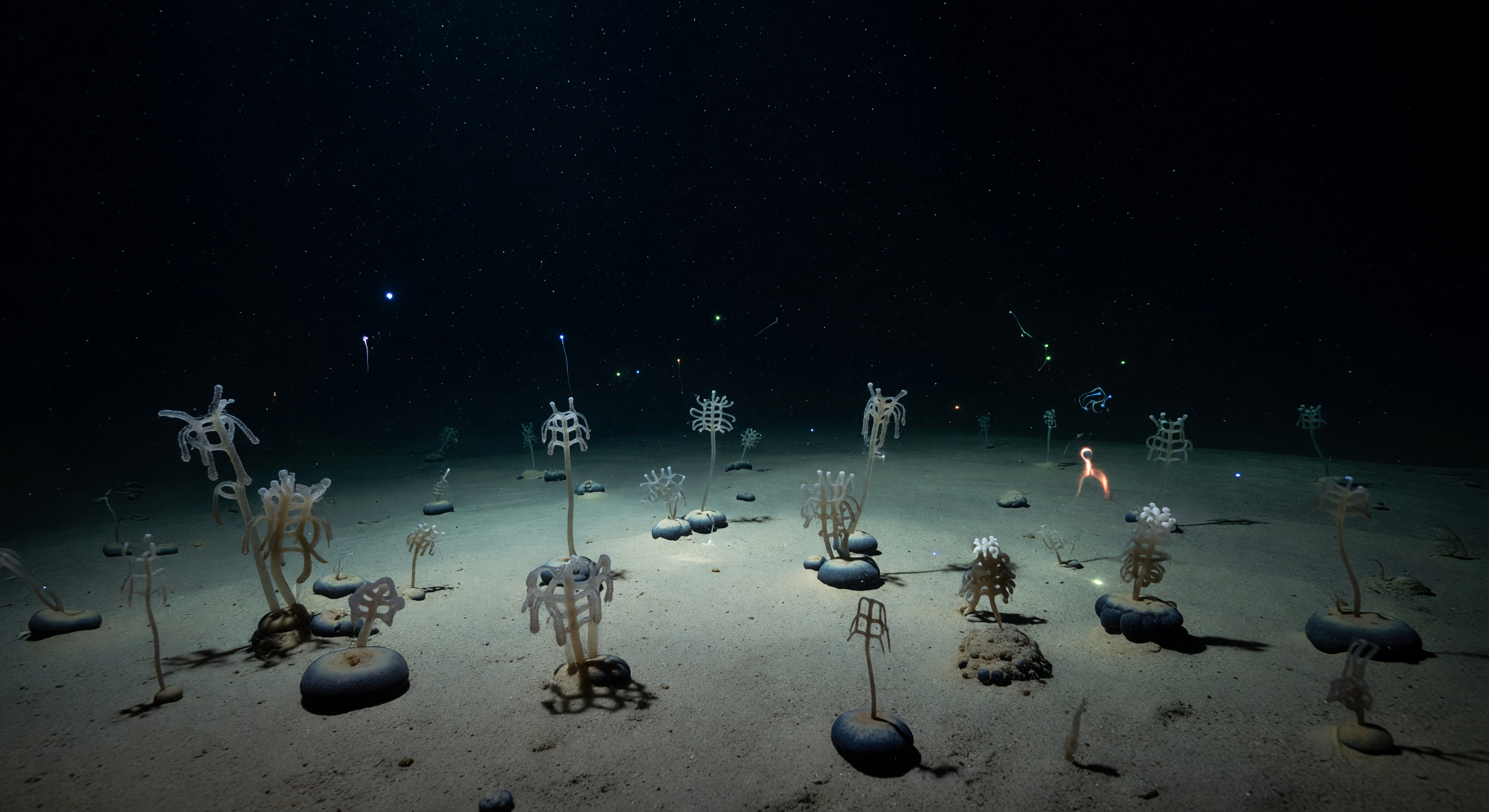
The ROV hangs motionless just above the silt, its twin side-mounted lamps skimming the bottom at a shallow angle that transforms every object into a source of dramatic shadow — glass sponge lattices project knife-sharp silhouettes across the pale seafloor while xenophyophore mounds, some of the largest single-celled organisms on Earth, squat half-buried in sediment, their rounded forms throwing dark wedges upward through particle-laden water. At pressures exceeding 250 atmospheres and temperatures hovering near 2°C, this silt plain exists in a state of near-geological stillness, accumulating fine marine snow — the slow rain of organic detritus from the sunlit world far above — at rates measured in millimeters per millennium. The silica lattices of the hexactinellid sponges, assembled without a nervous system from dissolved silicate ions, appear almost luminous under the raking beams, their intricate geometry a product of biomineralization rather than any encounter with light. Beyond the narrow cone of illumination, the water column rises as an unbroken black void, crushing and absolute, punctuated only by the cold spark of a distant bioluminescent organism drifting through the frame. Here, all energy for life flows downward from above or sideways from chemistry, never from a sun that has not touched this place in the entire history of the seafloor.
Other languages
- Français: Plaine d'Éponges Siliceuses
- Español: Llanura de Esponjas Vítreas
- Português: Planície de Esponjas de Vidro
- Deutsch: Glasschwamm Schattenebene
- العربية: سهل الإسفنج الزجاجي
- हिन्दी: कांच स्पंज छाया मैदान
- 日本語: ガラス海綿の影の平原
- 한국어: 유리해면 그림자 평원
- Italiano: Pianura delle Spugne di Vetro
- Nederlands: Glazen Spons Schaduwvlakte