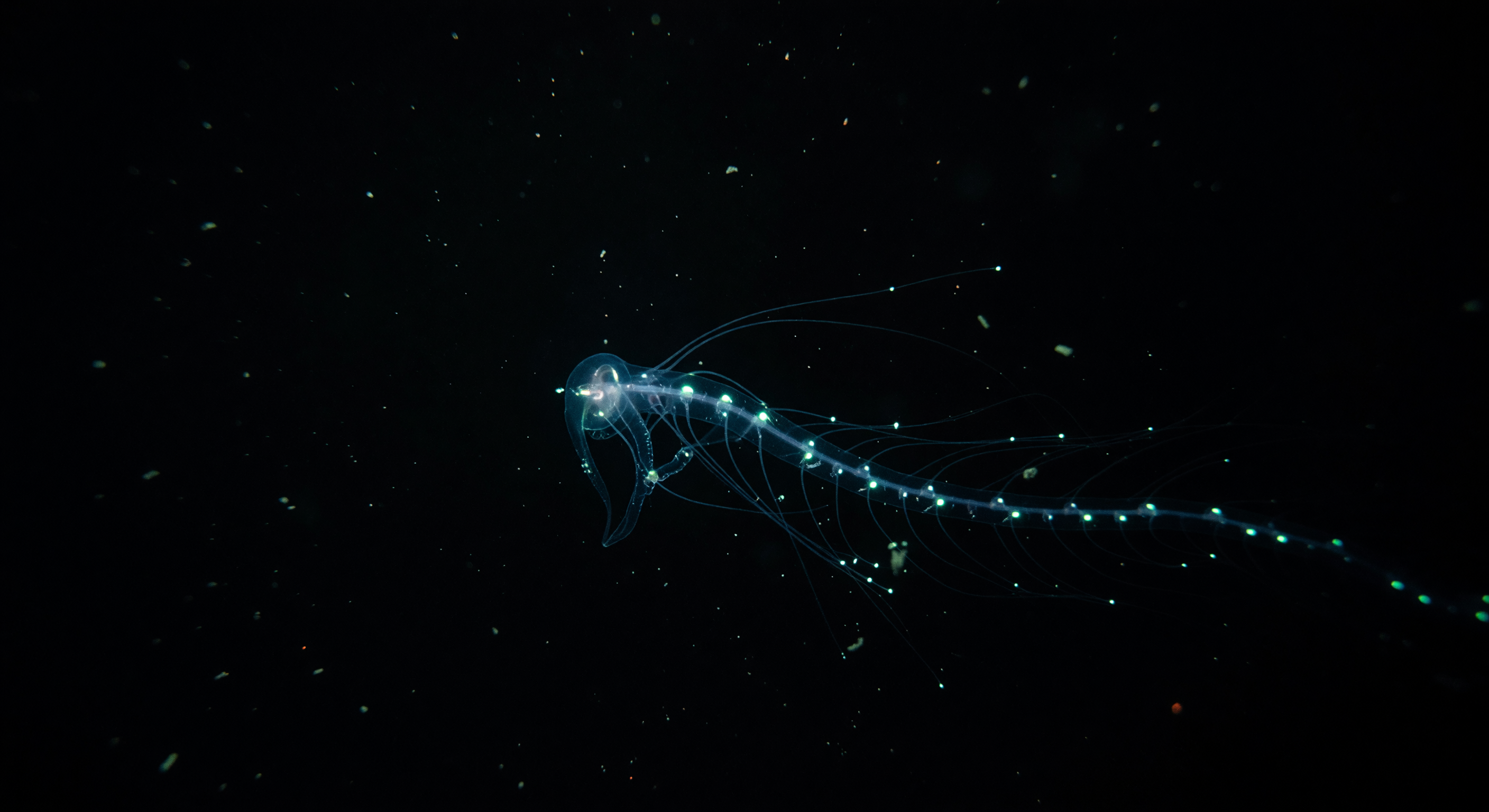
The submersible lamps reach perhaps three meters before the black swallows them whole, and in that narrow cone every mote of marine snow hangs suspended like ash in still air — then, without warning, something far larger ignites just beyond the glass. A siphonophore colony, colonial and technically not a single animal but a superorganism of specialized zooids working in near-perfect physiological concert, sends traveling pulses of blue-green bioluminescence cascading down its length, briefly overwhelming the vessel's own lights and revealing gelatinous bell-shaped nectophores, thread-fine dactylozooids, and trailing tentacles that extend outward into pressures exceeding 200 atmospheres where no sunlight has ever penetrated. At these depths, bioluminescence is not decoration but language — a startled warning discharge, a lure, a distress signal broadcast into a world where the only illumination is biological — and the colony's cyan glow briefly paints nearby particles in cold spectral light before the pulses decay and the creature dissolves back into absolute darkness. The water here, hovering near two degrees Celsius, carries the density and stillness of geological time, and as the bioluminescence fades the viewport returns to its familiar view of nothing, which is to say everything the midnight ocean chooses to conceal.
Other languages
- Français: Signal Méduse en Profondeur
- Español: Señal Medusa Muy Abajo
- Português: Sinal Água-Viva Lá Embaixo
- Deutsch: Quallen Signal Tief Unten
- العربية: إشارة قنديل البحر البعيد
- हिन्दी: जेली संकेत गहराई में
- 日本語: 深海クラゲの信号
- 한국어: 심해 해파리 신호
- Italiano: Segnale Medusa nel Profondo
- Nederlands: Kwal Signaal Ver Beneden