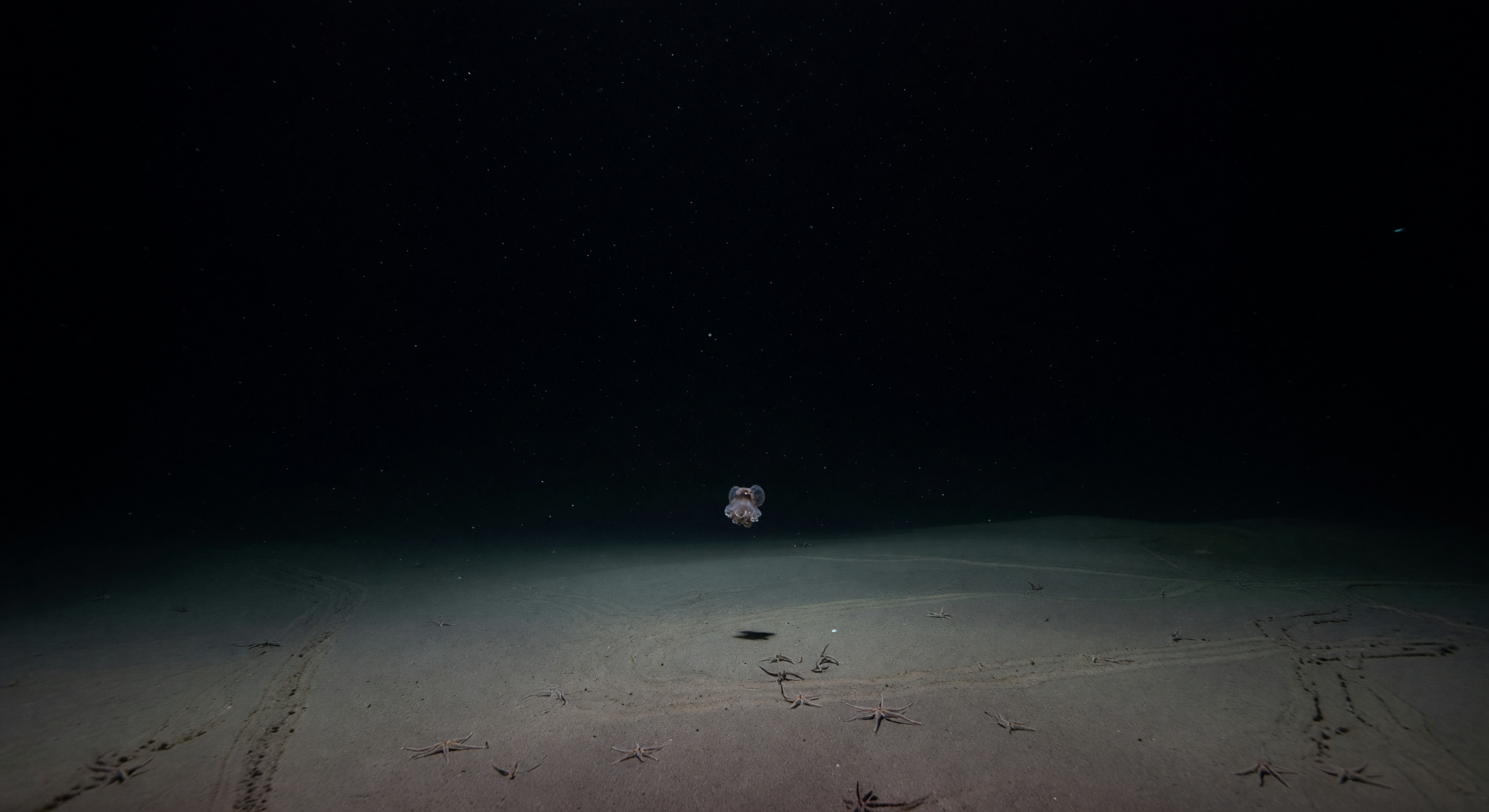
The lander camera rests almost flush with the sediment, its cold LED beam the only light that has touched this seafloor in geological memory, carving a pale circle out of absolute darkness at pressures exceeding 250 atmospheres. Through that narrow cone a dumbo octopus — *Grimpoteuthis* sp. — sculls silently overhead, its paired fins rippling in the unhurried, energy-conserving cadence typical of animals living perpetually on the edge of metabolic possibility, its mantle faintly translucent where the beam grazes the thin tissue adapted to a world where crushing hydrostatic pressure is simply the normal state of matter. The pale gray-brown sediment below it is a slow archive of the ocean above: fine terrigenous and biogenic particles that have drifted down through thousands of meters of open water, now inscribed with the meandering furrows of holothurian passage and punctuated by the splayed arms of brittle stars half-buried at the lit edge. Marine snow drifts lazily through the backscatter, each particle a remnant of surface productivity transformed by the time it reaches this cold, near-freezing stratum where bacterial decomposition barely outpaces deposition. Beyond the lander's reach the water column is featureless void save for an occasional cold blue-green bioluminescent flash — the only light these animals have ever produced or received entirely on their own terms.
Perpetual night