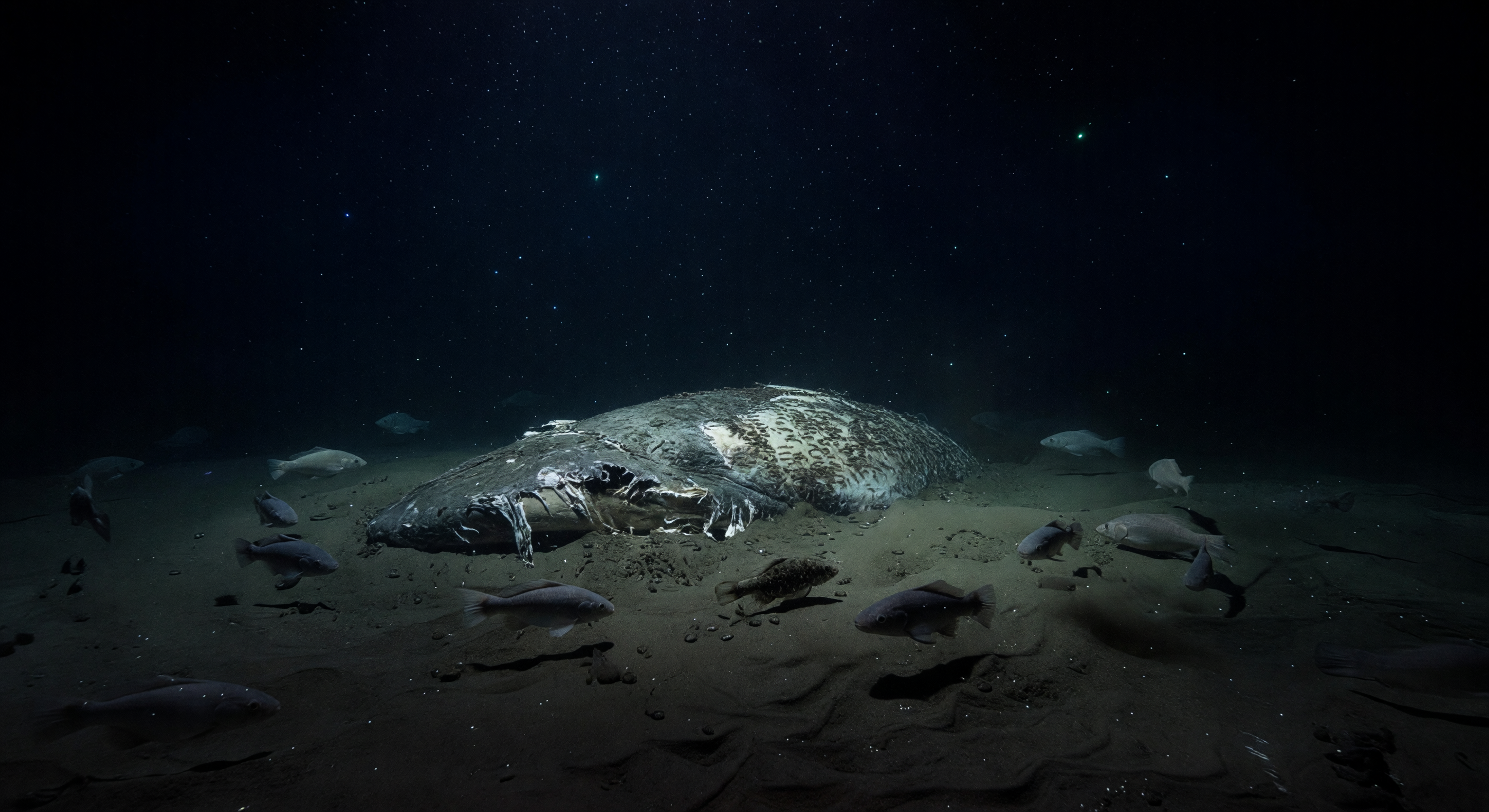
The lander's beam cuts a hard circle into absolute blackness, revealing a sperm whale carcass sprawled across flat abyssal mud as though dropped from a world that no longer exists above — at these depths, between one thousand and four thousand metres, no photon of sunlight has ever reached, and the pressure alone exceeds one hundred atmospheres, enough to crush unprotected tissue in an instant. Inside that cold white cone of LED light, dense carpets of amphipods surge across torn blubber and exposed pale fatty tissue, their bodies so numerous they give the wounds a trembling, almost liquid quality, while grenadiers — rattails, with their great heavy heads and tapering ghost tails — wheel slowly at the edge of illumination, sliding in and out of darkness as though testing the boundary between the known and the void. Marine snow drifts steadily through the beam, each particle a fragment of the surface world sinking for weeks to reach this point, and the disturbed sediment around the carcass shows shallow pits and furrows where scavengers have already dragged and foraged, the soft abyssal mud recording every visitation like slow memory. Beyond the lander's reach, faint blue-green bioluminescent pulses flicker in the darkness — organisms drawn by chemical plumes already diffusing outward through cold still water — and for the creatures gathering here, this fallen giant represents not death but an extraordinary eruption of energy into an otherwise near-barren plain, a food source so vast it will restructure this small patch of seafloor for decades to come.
Perpetual night