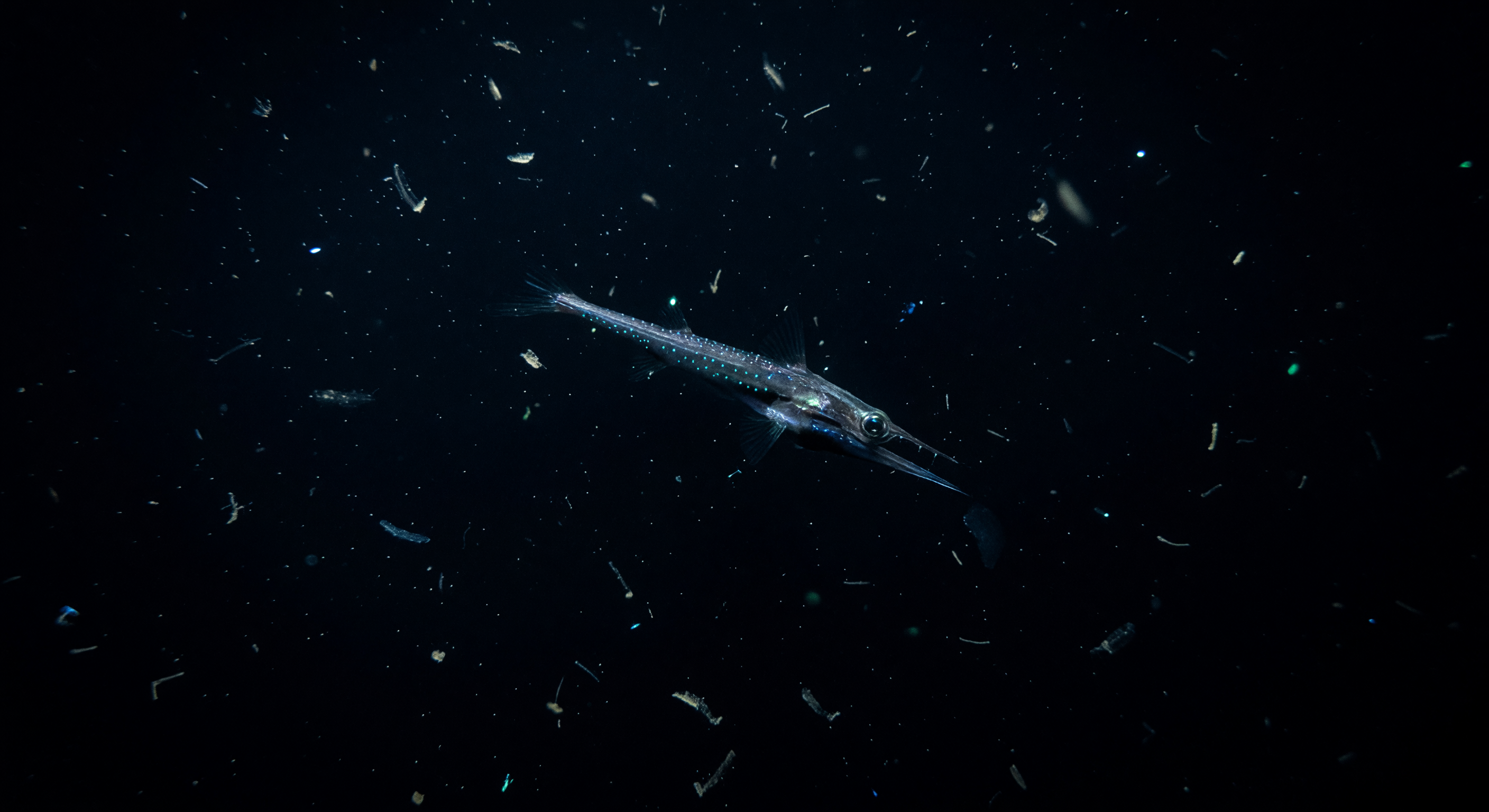
Between one thousand and two thousand five hundred metres below the surface, where pressure exceeds two hundred atmospheres and the last photon of sunlight dissolved kilometres above, a viperfish — Chauliodus sloani — materialises out of the absolute dark in a single predatory instant. Its needle-slim body, no longer than a human forearm, is armoured in scales that shift from charcoal to cold steel, while a precise row of ventral photophores fires a measured pulse of blue-green bioluminescence along its underside — a lure, a signal, or perhaps a form of counter-illumination against the faint biological glow drifting down from shallower water. Around it, marine snow descends in near-weightless suspension: fragmented fecal pellets, collapsed gelatinous bodies, mineral grains, and the shed mucus webs of filter feeders, each particle the slow currency of carbon falling from a sunlit world that might as well not exist from here. The water itself is within a degree or two of freezing, almost entirely still, and carries no sound beyond the occasional soft implosion of a pressure-adapted body moving through it. This is an ocean interior that has always been precisely this dark, this cold, and this indifferent — a realm that requires no witness, that has never needed one.
Other languages
- Français: Vipérine dans la Neige Marine
- Español: Víbora entre Nieve Marina
- Português: Peixe-víbora na Neve Marinha
- Deutsch: Vipernfisch durch Meeresschnee
- العربية: سمكة الأفعى في الثلج البحري
- हिन्दी: कण हिम में विषधर मछली
- 日本語: 海雪を切るバイパーフィッシュ
- 한국어: 해양 눈 속 독사물고기
- Italiano: Pesce Vipera tra Neve Marina
- Nederlands: Slangvis door Marineesneeuw