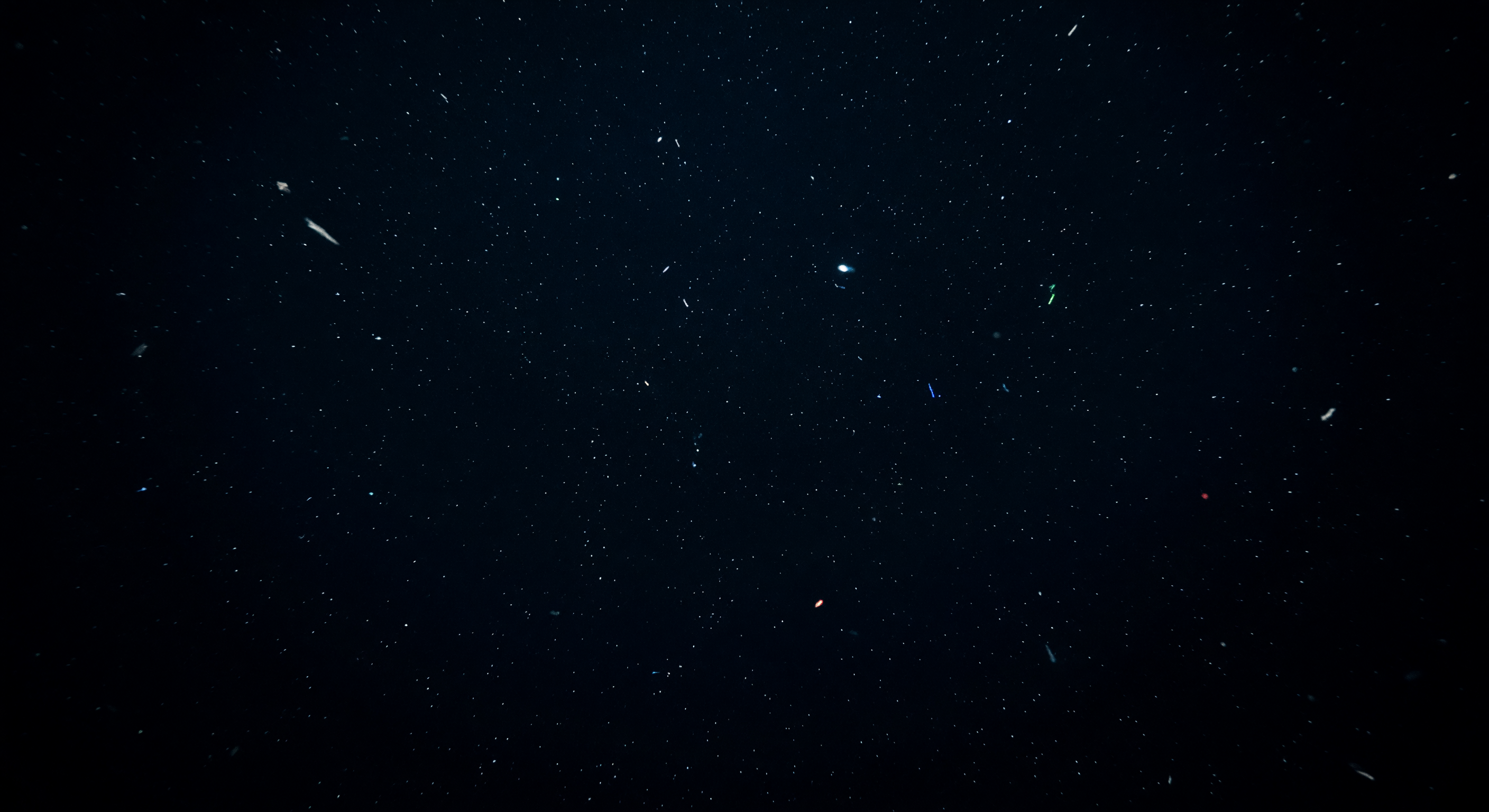
The ROV drifts motionless in an absolute void, suspended somewhere between a seafloor it cannot see and a surface that ceased to exist kilometers above — its paired lamps carving a narrow cone of cold light into water that swallows every photon within a few meters. Through that cone, marine snow streams in slow diagonal curtains: the perpetual gentle rain of dead cells, fecal pellets, molted exoskeletons, and aggregated mucus that carries fixed carbon from the sunlit world down into permanent darkness, sustaining a sparse community of organisms that the cameras cannot yet find. At this depth, pressure exceeds 200 atmospheres, temperature hovers near 2–4 °C, and the water column is so acoustically and visually isolated from the surface that the ROV's instrument LEDs — amber, red, a flicker of green at the frame edge — constitute the only artificial light in every direction for what may be hundreds of meters. Without a seafloor, a wall, or a single animal to anchor scale, the marine snow becomes the only reference for distance and motion, each mote drifting past the lens a ghost of photosynthesis conducted weeks or months ago in a world of sunlight that feels, from here, entirely theoretical.
Perpetual night