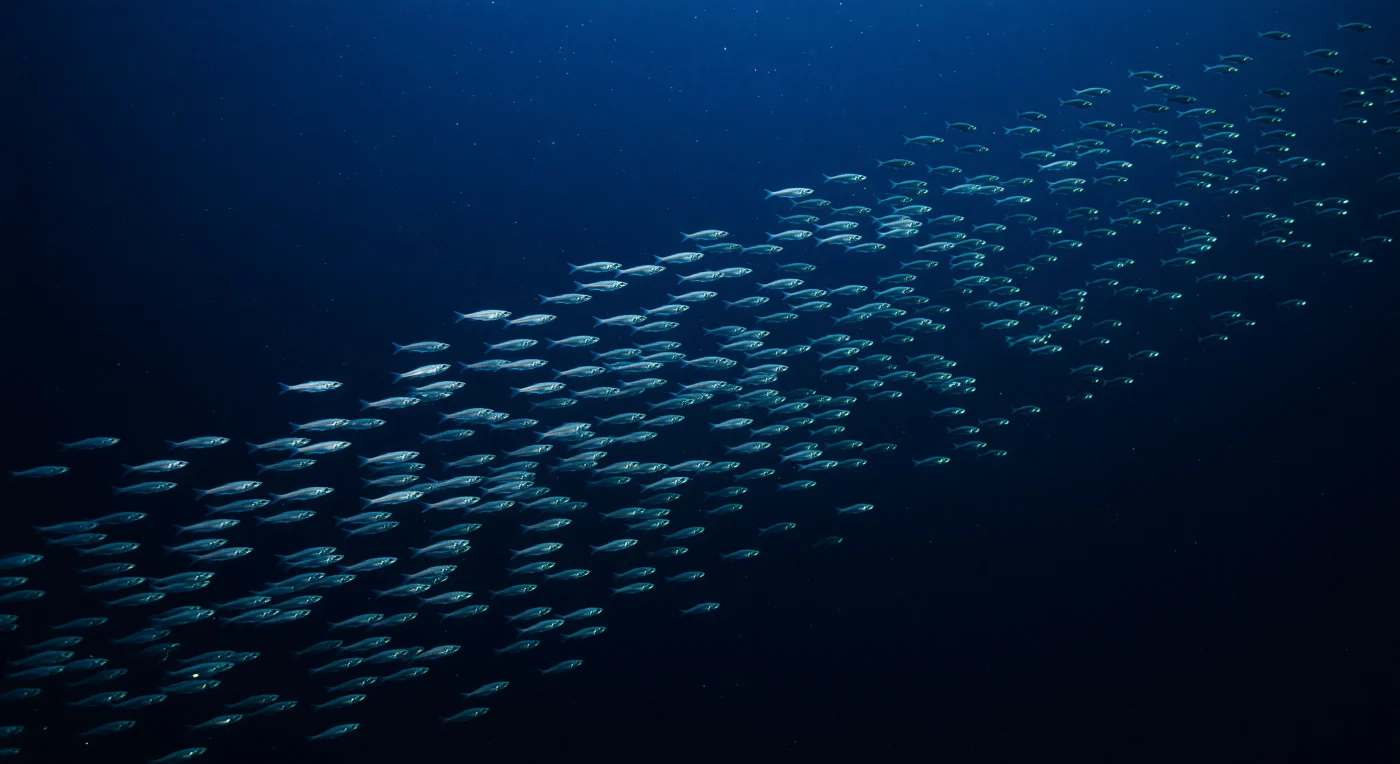
Between roughly 200 and 1,000 metres below the surface, sunlight surrenders its full spectrum to the sea, leaving only a residual cobalt frequency that grows fainter with every metre of descent — a monochromatic twilight that the mesopelagic zone wears like a permanent dusk. Through this attenuated glow, a vast ascending sheet of myctophid lanternfish — among the most numerically abundant vertebrates on Earth — rises through the open water column in a broad, layered migration, each small silvery body no longer than a finger yet carrying along its flanks and belly a precise arrangement of photophores that fire blue-green light in species-specific geometric patterns. At this depth, atmospheric pressure has been multiplied dozens of times over, the cold intensifies, and the faint marine snow of organic particles drifts in every direction through water that is neither dark nor lit but suspended in an intermediate state the ocean sustains without interruption. The collective bioluminescence of the school transforms the surrounding volume into a trembling lattice of living points, individual glows close enough to faintly illuminate neighbouring scales, translucent fins, and dark glassy eyes, the photophores functioning simultaneously as camouflage against the residual downwelling light and as recognition signals within the school. This world of orchestrated light and silent vertical motion has persisted across geological time, entirely indifferent to observation, a breathing architecture of biology and physics that the ocean enacts each day and night on its own terms.
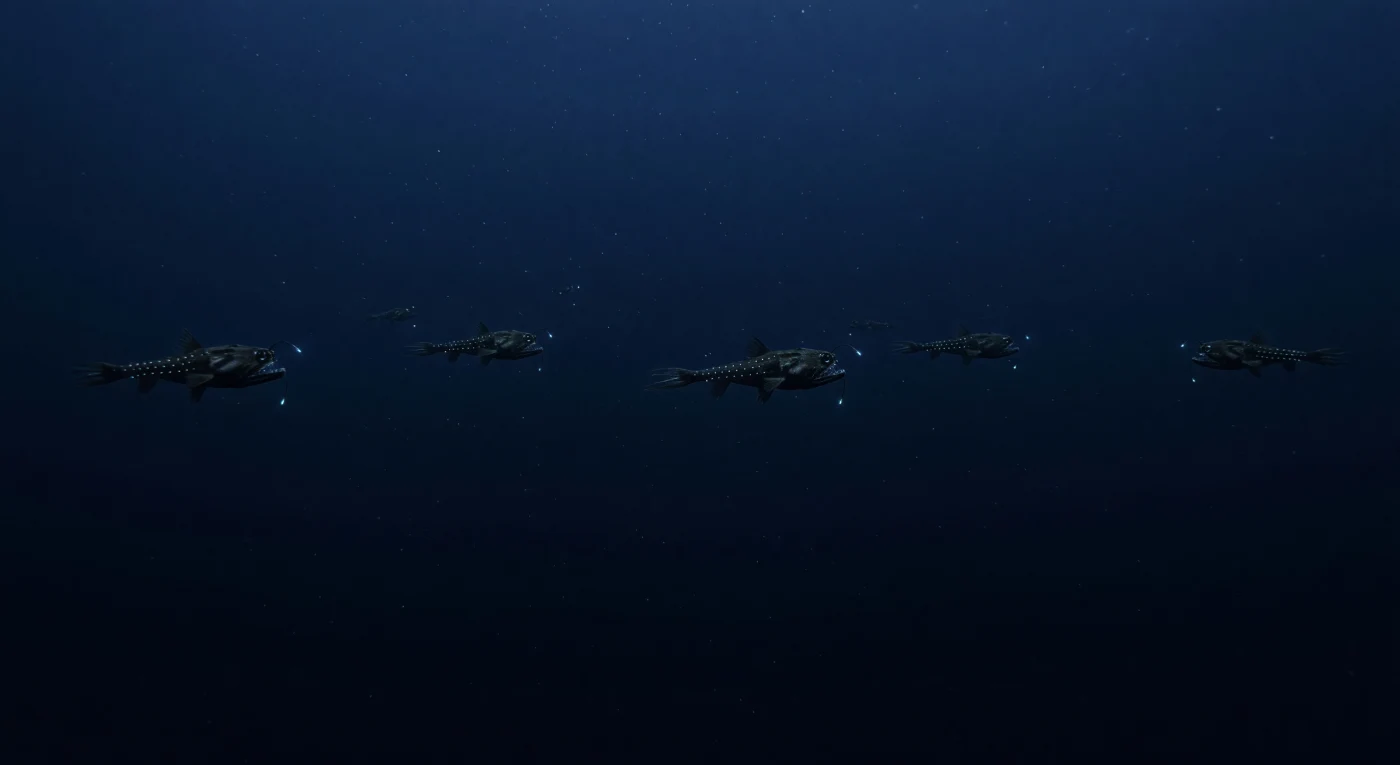
Between 500 and 700 meters, the last traces of solar energy arrive not as warmth or color but as a faint cobalt stain dissolving into absolute black, a threshold where photosynthesis is impossible and pressure already exceeds fifty atmospheres. Here, Chauliodus sloani — the viperfish — suspends itself in the water column with near-perfect stillness, its fang-lined jaws held slightly agape, waiting; the chin barbel trails below the head like a fishing line tipped with living fire, its cold blue-green photophore producing light through luciferin oxidation rather than any external source, a biochemical lantern refined across hundreds of millions of years. Along each flank, rows of ventral photophores form dim dotted constellations that break the fish's silhouette when viewed from below against whatever residual downwelling light remains — a phenomenon known as counter-illumination, a survival strategy written in light. Marine snow drifts freely through the corridor, a slow rain of organic particles descending from the productive surface far above, carrying energy downward into this sparse and pressurized world. Nothing here glows for any witness; the light exists entirely within its own logic, a language of predation and concealment spoken in the dark.
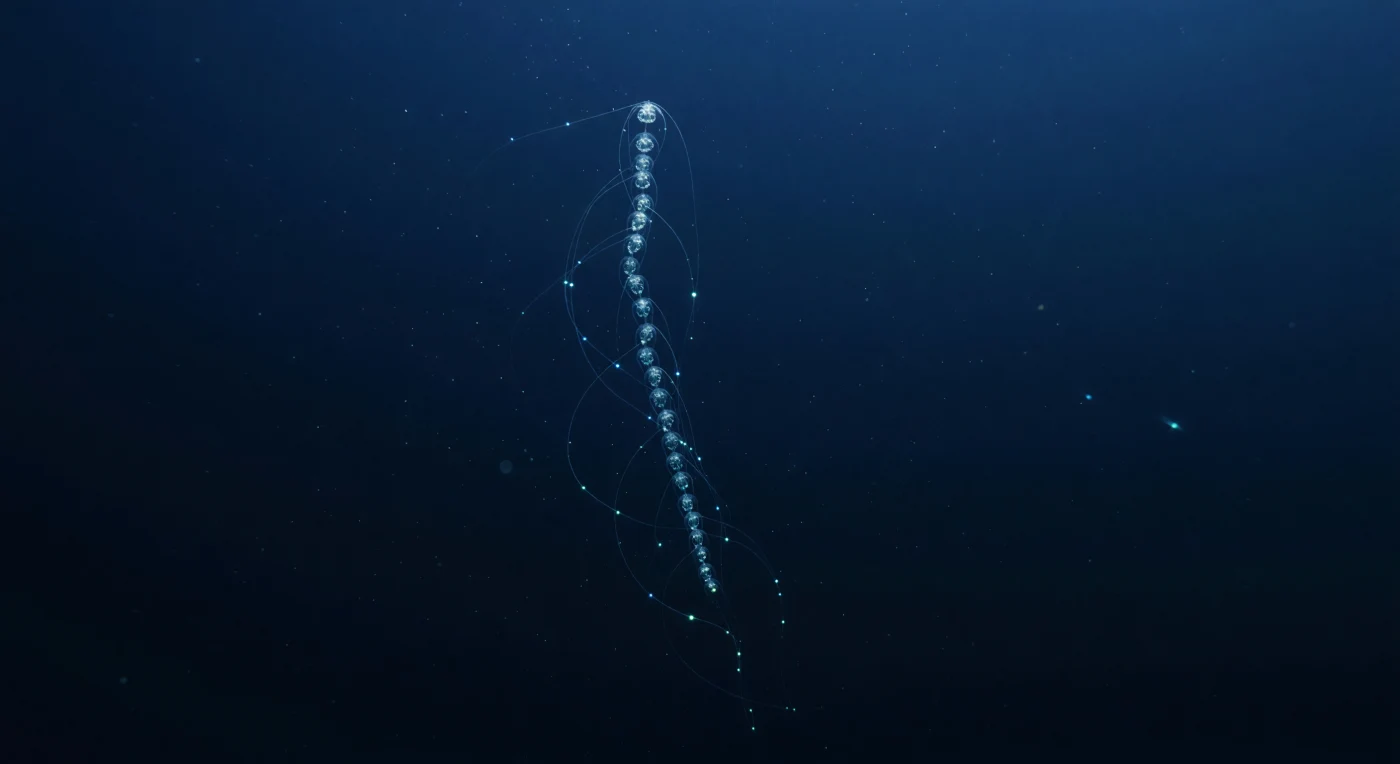
Between roughly 200 and 1,000 metres below the surface, sunlight surrenders its warmth and colour, leaving only a residual cobalt twilight that fades imperceptibly into permanent black — a realm where pressure climbs into the dozens of atmospheres and the water column becomes the only architecture. Here, a crystal-chain siphonophore — almost certainly a member of the order Calycophorae — suspends itself in near-perfect vertical alignment, its colony not a single organism but a superorganism of specialised zooids, each performing a distinct physiological role: swimming, feeding, reproduction, defence. The colony's gelatinous tissues are so optically close to seawater that it registers less as a body than as an organised absence, betrayed only where faint turquoise bioluminescent pulses shimmer along its length, likely propagating as coordinated electrochemical signals across the entire chain. Hair-thin dactylozooids and trailing tentacles extend outward into the water column as near-invisible snares, occasionally illuminated by their own blue-green sparks — a strategy that may simultaneously attract prey and deter predators in a world where producing one's own light is not spectacle but survival. Around it, marine snow drifts downward in slow uncountable particles, carrying organic carbon toward the abyss, and distant isolated bioluminescent points pulse in the dark midwater, each one a life form navigating depth, pressure, and darkness entirely on its own terms, indifferent and complete.
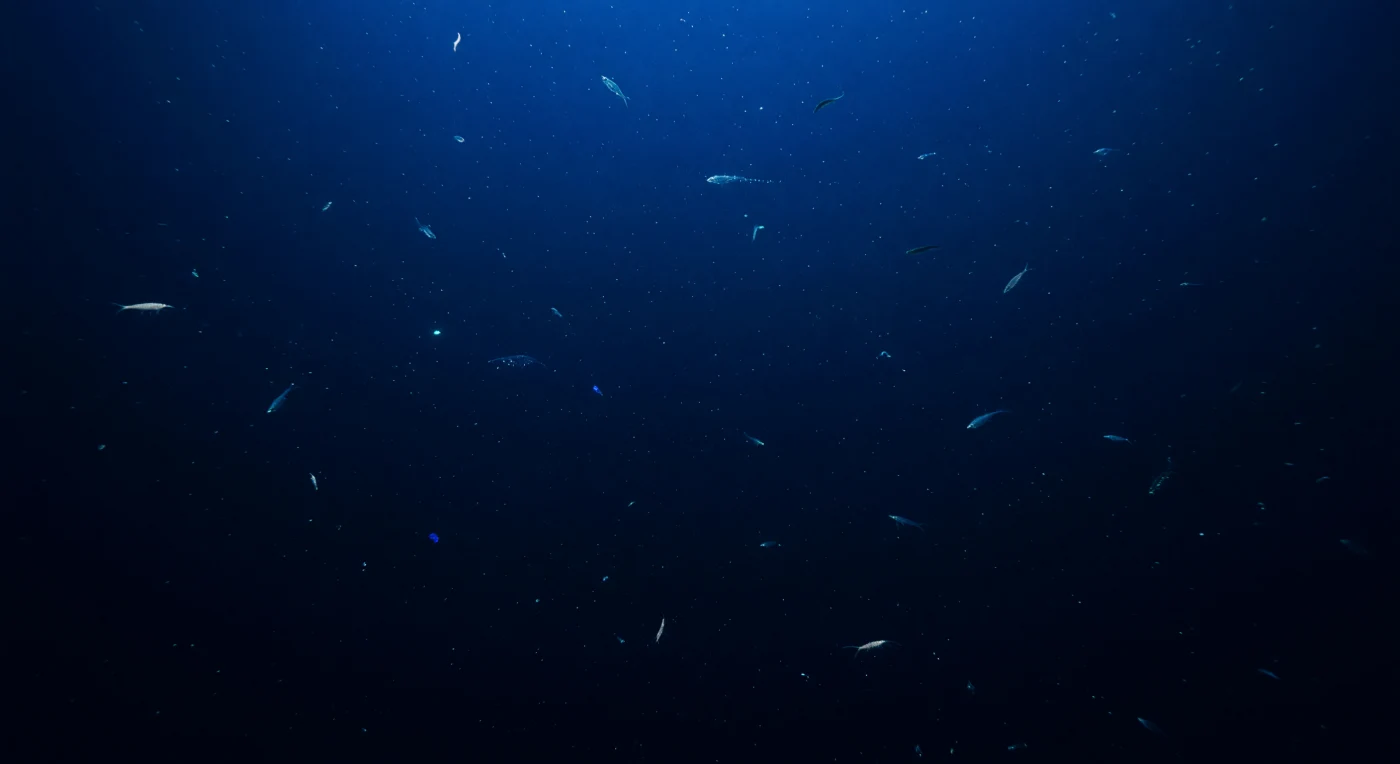
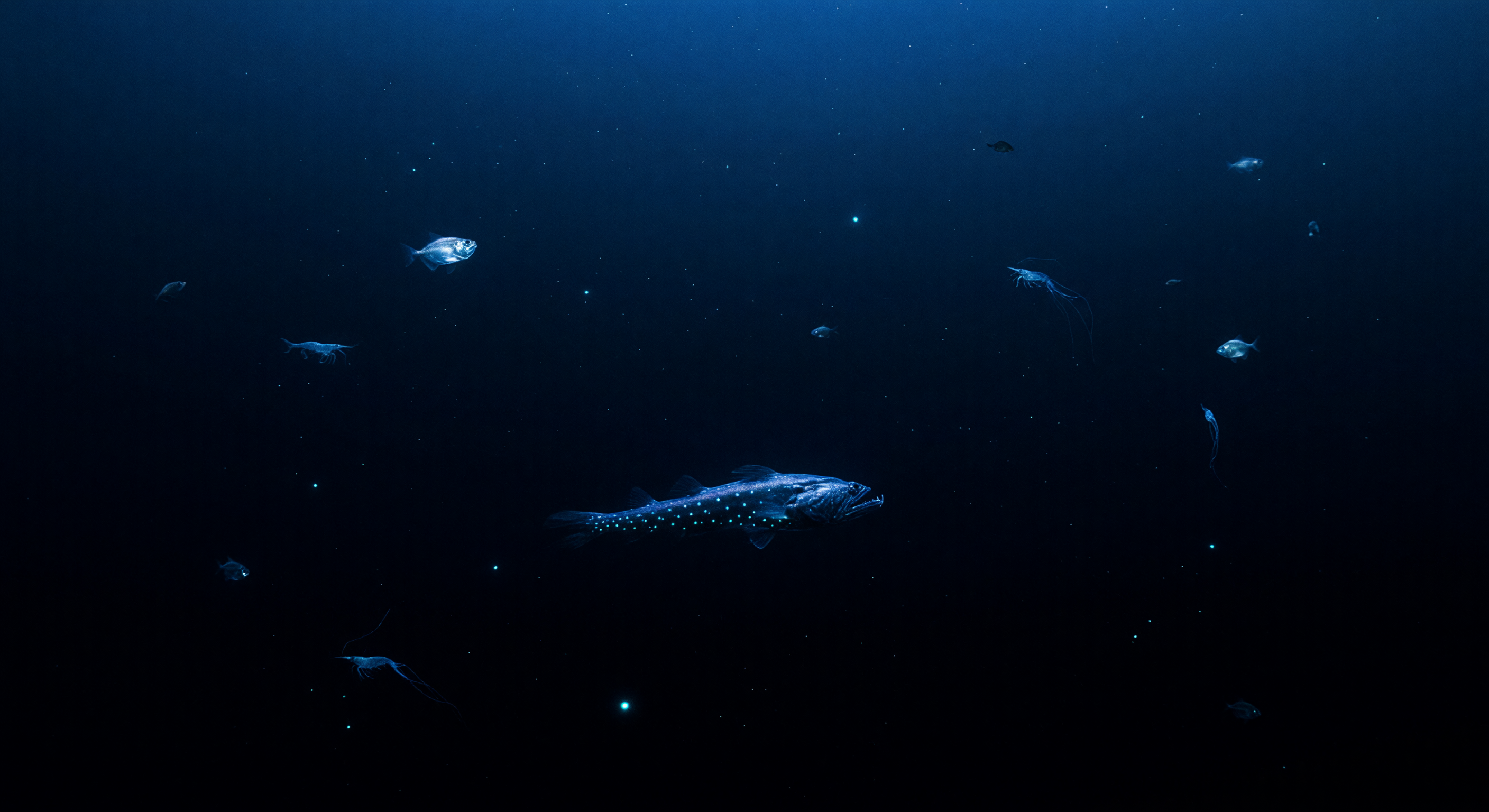
Between roughly 200 and 1,000 metres below the surface, sunlight surrenders its last coherent wavelengths, and what remains is a fading cobalt wash that deepens, metre by metre, into pure midnight blue and then into nothing at all. Here, at this luminous threshold, the water itself becomes the medium of an ancient dialogue between residual photons from the world above and the cold chemical fire produced by the organisms that inhabit the column below — sergestid shrimp trailing ghostly blue-green sparks from rows of photophores, siphonophores barely distinguishable from the surrounding water except for the intermittent chemical flashes that pulse along their trailing filaments, and the distant silhouette of a viperfish, its ventral lanterns mimicking the dim skylight overhead in a strategy of counter-illumination refined across hundreds of millions of years. The pressure here — tens of atmospheres pressing equally from every direction — imposes a physical discipline on all life: bodies are reduced to the barest necessary architecture, transparent, compressible, and almost weightless, drifting within a slow rain of marine snow that carries the fragmented remains of the sunlit world down toward the abyss. No current announces itself, no surface intrudes; there is only the immense, pressurized silence of open water and the sparse, cold light that organisms make for themselves in the dark.
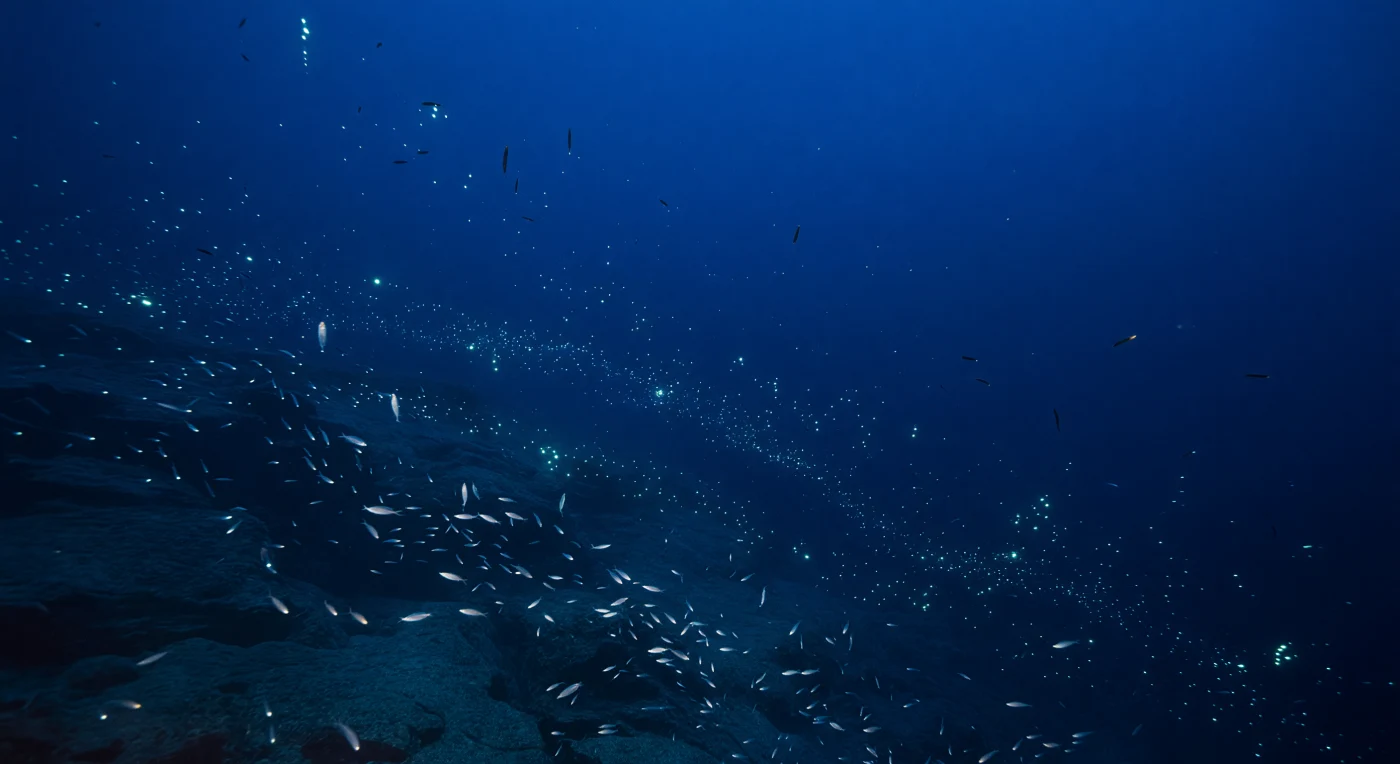
Each day, as the last traces of filtered sunlight fade to near-extinction somewhere between two hundred and one thousand metres depth, the continental slope wall rises through the darkness like a drowned escarpment, its indigo mass softened by cold water and immense pressure into something geological and ancient. Against this backdrop, the deep scattering layer performs its nightly vertical migration — a biomass event so vast it registers on ship echosounders as a false seafloor rising — as myriads of lanternfishes, bristlemouths, sergestid shrimps, and gelatinous zooplankton ascend toward the surface's faint residual cobalt glow to feed. Their bodies betray themselves only in fragments: glassy slivers of transparency, mirror-flashes from silvered swim bladders, and the precise photophore rows of viperfish stitched like cold blue-green circuitry through the dark, each bioluminescent pulse a defensive startle response or a species-recognition signal evolved across millions of years of lightless coevolution. Marine snow — the constant slow rain of organic particles from above — drifts freely through the water column, momentarily illuminated by each bioluminescent spark before dissolving back into the pressure haze, reminding us that this twilight world is not empty but profoundly alive, cycling carbon and energy through a silent biosphere that has never required a witness.
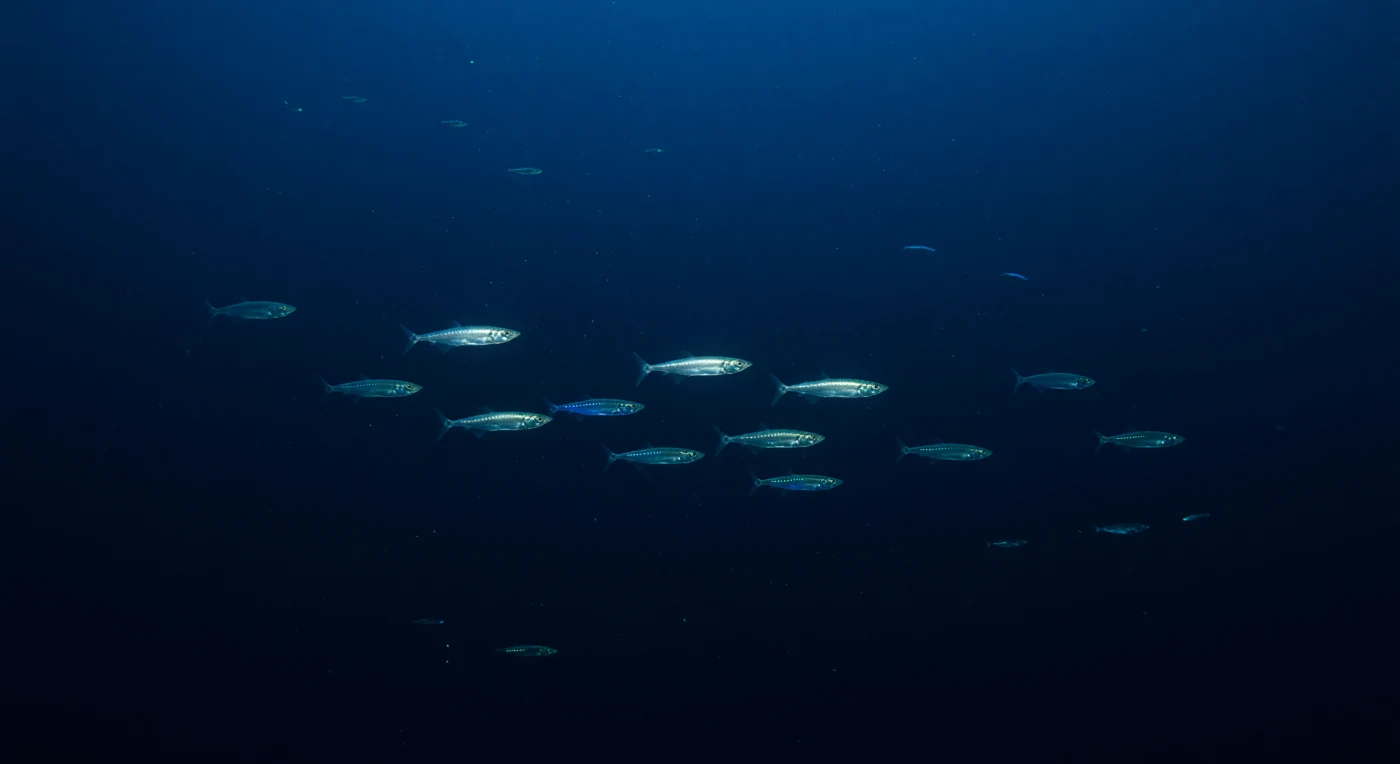
Between roughly 200 and 1,000 metres below the surface, sunlight surrenders its warmth and colour, leaving only a residual cobalt twilight that dims with every metre of descent — a gradient the eye can barely register but that governs the survival strategies of everything living here. In this vast midwater realm, pressure exceeds twenty atmospheres, temperatures hover just above freezing, and the water column stretches unbroken for hundreds of metres in every direction, populated not by seafloor or reef but by open space and its extraordinary inhabitants. Sternoptychid hatchetfish are among the most specialised products of this environment: their bodies are laterally compressed to near-transparency, their flanks silvered like polished metal to scatter and diffuse any ambient light and dissolve their silhouette against the dim ceiling above, and along their ventral edges a precise row of photophores emits soft blue-green light tuned almost exactly to the residual wavelengths still penetrating from the surface — a phenomenon called counterillumination, which erases their shadow from the perspective of predators hunting from below. Scattered through the surrounding water column, other mesopelagic organisms contribute their own cold sparks of bioluminescence, so that this zone, far from being dark and inert, pulses with a quiet, distributed living light that no surface dweller ever sees. Marine snow — the slow drift of organic particles from the productive surface layers — drifts among them, carrying carbon downward into the deep in a flux that links the sunlit ocean above to the abyssal darkness still far below.
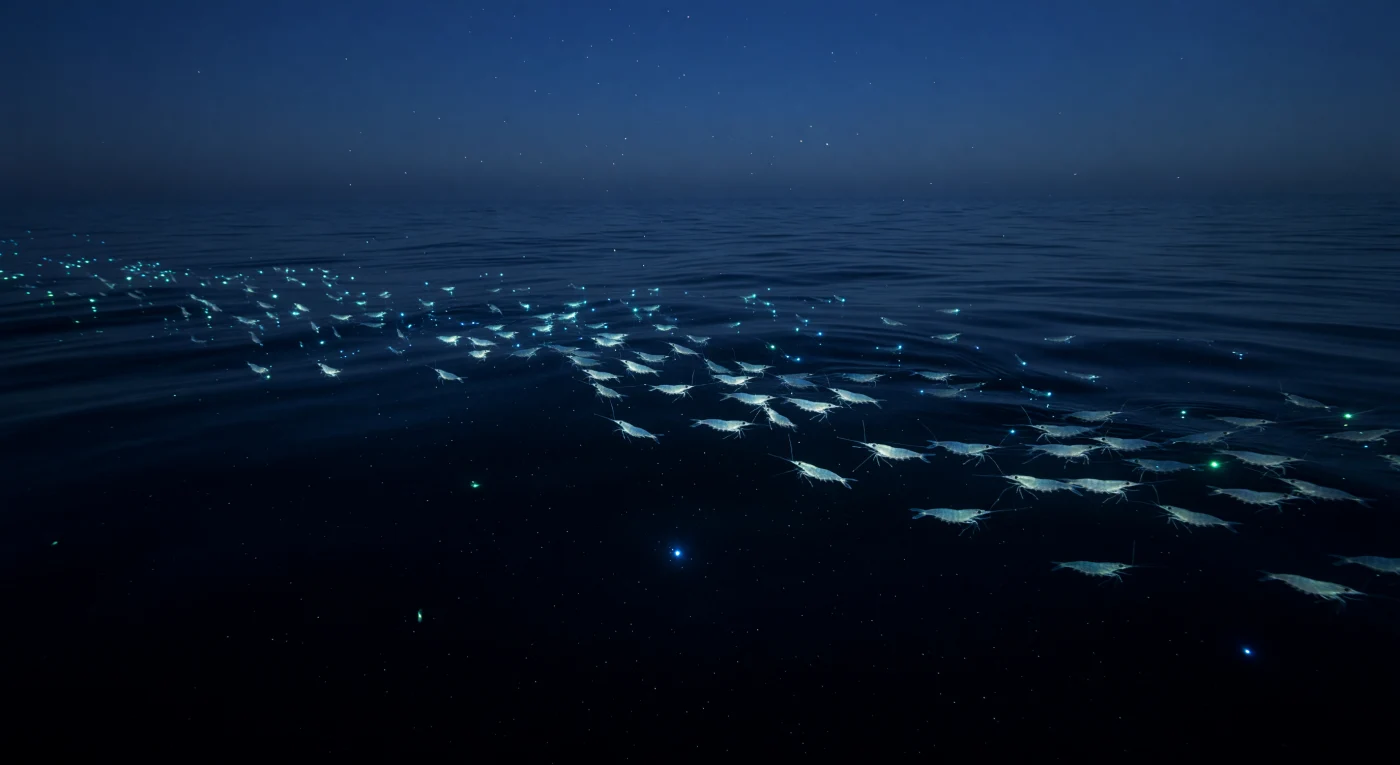
Between roughly 200 and 1,000 metres beneath the surface, the last residual photons of sunlight fade from dim blue to near-extinction, and yet the ocean here is not dark in any simple sense. A band of mesopelagic shrimp — likely sergestids or euphausiid-relatives — arcs through the water column on an invisible current, their translucent bodies almost indistinguishable from the surrounding blue-black until, triggered by some chemical or mechanical cue, their ventral photophores and luminous secretions detonate in asynchronous bursts of cold blue-green light, stitching a trembling seam across the void. At this depth, ambient pressure exceeds twenty atmospheres, marine snow drifts perpetually downward, and bioluminescence is the dominant form of illumination — produced not by any external source but by the organisms themselves through luciferin-luciferase reactions, used variously for counterillumination camouflage, predator deterrence, and intraspecific signalling. The sparse, glinting particles suspended in the water column are testimony to the biological pump, the slow rain of organic matter that connects this twilight world to the sunlit layers far above. Here, in total solitude, the ocean generates its own constellations — brief, purposeful, and utterly indifferent to any witness.
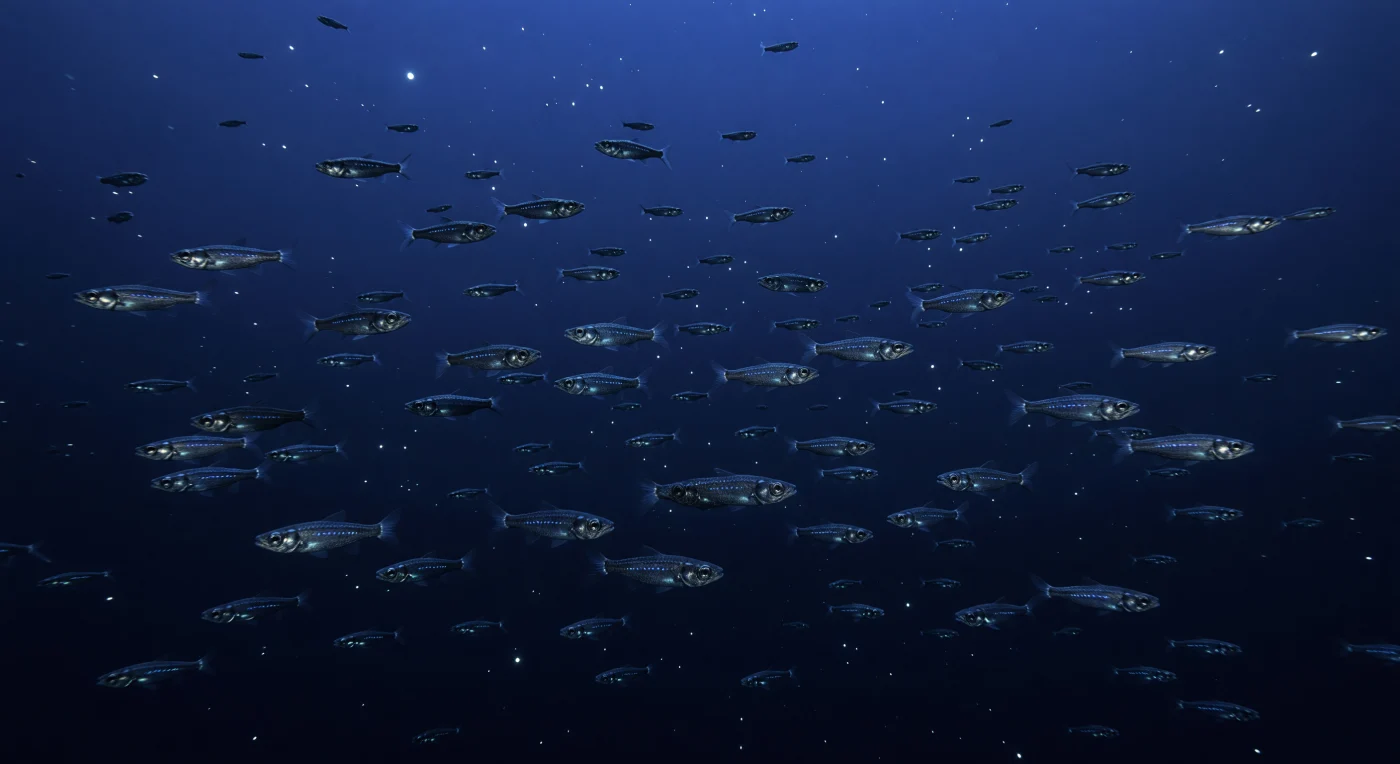
Between roughly 200 and 1,000 metres below the surface, sunlight surrenders its warmth and colour until only a last bruised cobalt persists, too faint to support photosynthesis yet just sufficient to silhouette the bodies of creatures that have learned to carry their own stars. Here, bristlemouths — genus *Cyclothone* and their kin, almost certainly the most numerically abundant vertebrates on Earth — hang suspended in midwater by the hundreds of millions, their slender silver-black bodies so slight they seem drawn in pencil against the indigo void. Along each belly runs a precise cadastral survey of photophores, organelles packed with luciferin and luciferase that fire cold blue-green light: a counter-illumination strategy that erases their own shadows when viewed from below by a predator scanning upward toward the faint remnant sky. At these pressures — twenty to one hundred atmospheres — water is not empty but structured, a medium threaded with marine snow, the slow confetti of organic detritus sinking from the sunlit world above, each particle drifting through the ambient blue as though time itself has thickened. Seen together, the dispersed school achieves an accidental astronomy, each photophore a point of slightly different brightness and spacing, composing a living constellation that tilts and recedes into darkness with no witness, no boundary, and no knowledge that it is observed.
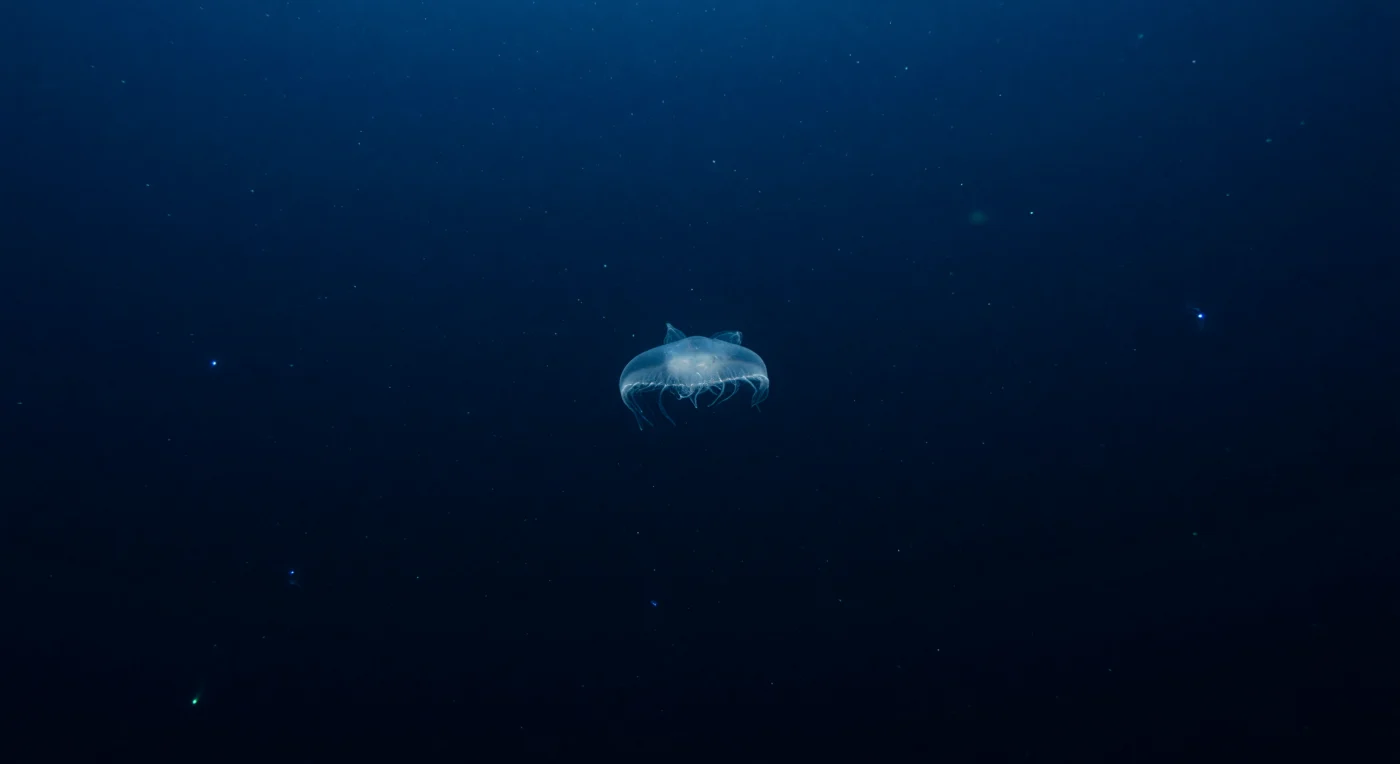
At roughly 400 to 600 metres below the surface, the last traces of sunlight arrive as a cold, attenuated cobalt wash — monochromatic, dimensionless, and so faint that it barely defines the water itself. Within this twilight column, a lobate ctenophore drifts in perfect suspension, its body a near-invisible architecture of gelatinous tissue: broad oral lobes unfurled like soft petals, fine auricles trailing behind, and eight comb rows arrayed along its flanks as delicate pearly ribs that catch the residual downwelling blue with the quietest possible luminosity, not glowing so much as simply being revealed. At these depths, pressure exceeds 50 atmospheres and temperatures drop toward 4 or 5 degrees Celsius, yet the mesopelagic zone teems with life adapted to this permanent dusk — ctenophores, copepods, lanternfish, siphonophores, and countless organisms capable of producing their own cold light through luciferin-luciferase chemistry. Farther back in the water column, isolated bioluminescent bursts from planktonic organisms punctuate the fading blue-black like brief cold sparks scattered at different depths, each one a flash of chemical light that may serve as a lure, a warning, or a startle defence in a world where visibility itself is a scarce and dangerous resource. Fine marine snow — the slow rain of organic particles descending from the sunlit surface — drifts freely through the scene, and the ctenophore moves among it all without sound, without urgency, in a silence so complete and a darkness so nearly total that this entire living world might as well exist on another planet.
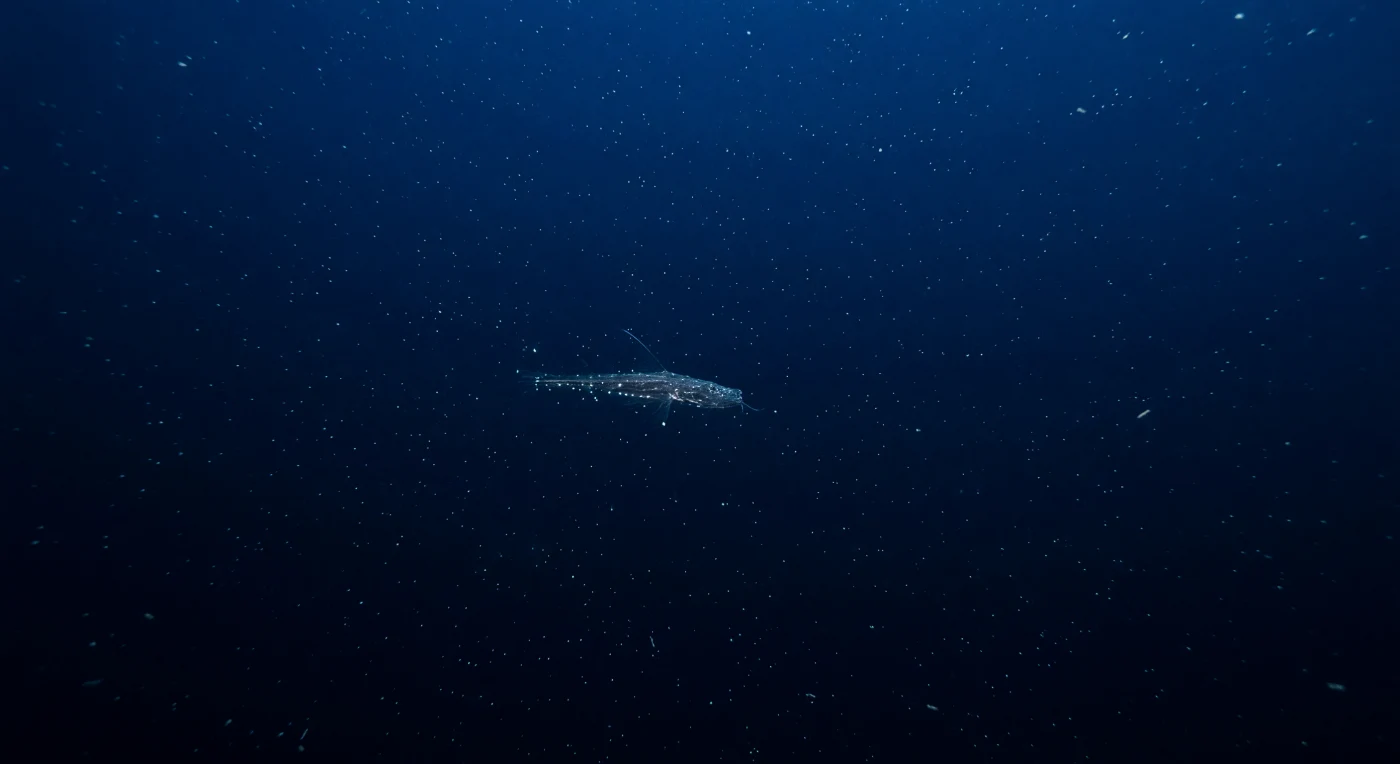
Between roughly 200 and 1,000 metres below the surface, sunlight dwindles to a last blue-grey memory, too faint to sustain photosynthesis yet still sufficient to silhouette a body against the void — a fact that has shaped the predator-prey arms race of the twilight zone for hundreds of millions of years. Here, a single stomiid dragonfish — one of the mesopelagic's most accomplished ambush hunters — hangs in near-perfect suspension, its elongated body tuned by evolution to the crushing pressure of several megapascals and the perpetual cold of water barely above 4 °C. Along its flanks and belly, rows of photophores emit steady blue-green bioluminescence produced by luciferin-luciferase reactions within specialised light organs, each point of living light serving simultaneously as counter-illumination camouflage against the residual downwelling radiance and as potential lure in a world where every photon carries biological consequence. Around it, marine snow descends in an endless slow rain — aggregates of dead cells, faecal pellets, mucus threads, and mineral particles that form the primary carbon conveyor linking the sunlit ocean above to the abyss below, their irregular surfaces catching the faintest ambient blue as they fall. This is a world of immense silence and pressure, governed entirely by biological light and the slow physics of sinking matter, persisting in complete indifference to any surface existence.
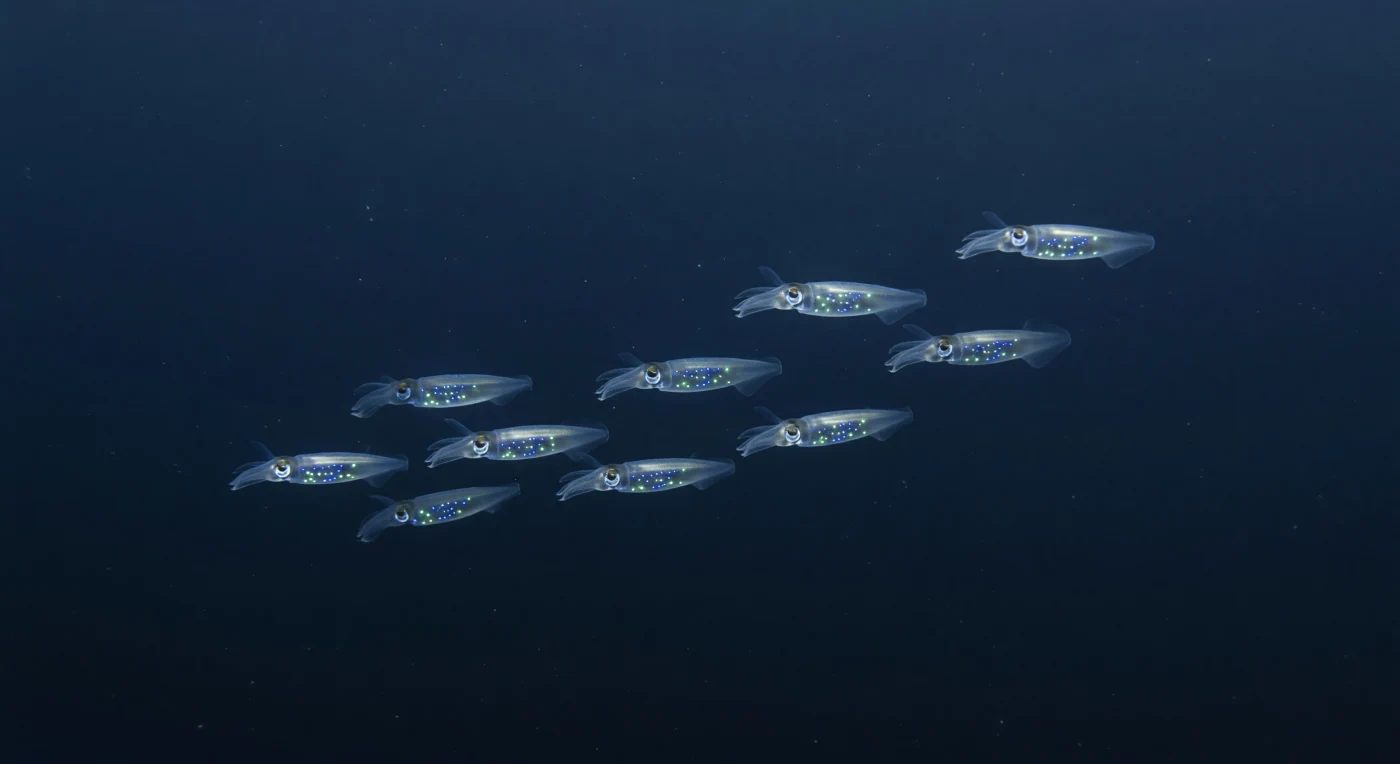
At depths where sunlight dissolves into a dim, diffuse blue and pressure climbs to tens of atmospheres, a small procession of jewel squid — likely *Histioteuthis* or a closely related enoploteuthid — crosses open midwater on a diagonal path through the pelagic void. Each compact animal, no longer than a human hand, carries rows of photophores along its ventral mantle and arm crowns that pulse in crisp blue-green points, some firing in synchrony, others offset in a scattered, asynchronous constellation of living light — a display thought to function in counterillumination, breaking up the squid's silhouette against the faint residual downwelling that still penetrates from far above. That residual light, attenuated to a near-monochromatic twilight blue and carrying only a fraction of a percent of surface intensity, renders the animals as faint glassy silhouettes, their transparent tissues and large dark eyes betraying the visual arms race that has shaped midwater fauna across hundreds of millions of years. Sparse marine snow — disaggregated organic matter sinking from the productive surface — drifts freely between the squid, each particle a reminder that this column of cold, oxygen-minimum water is neither empty nor inert but a living highway of vertical migration and chemical flux. Here, in the absolute silence of the open ocean's interior, bioluminescence is not spectacle but ecology — the primary currency of visibility, predation, and concealment in a world that has never required the sun.
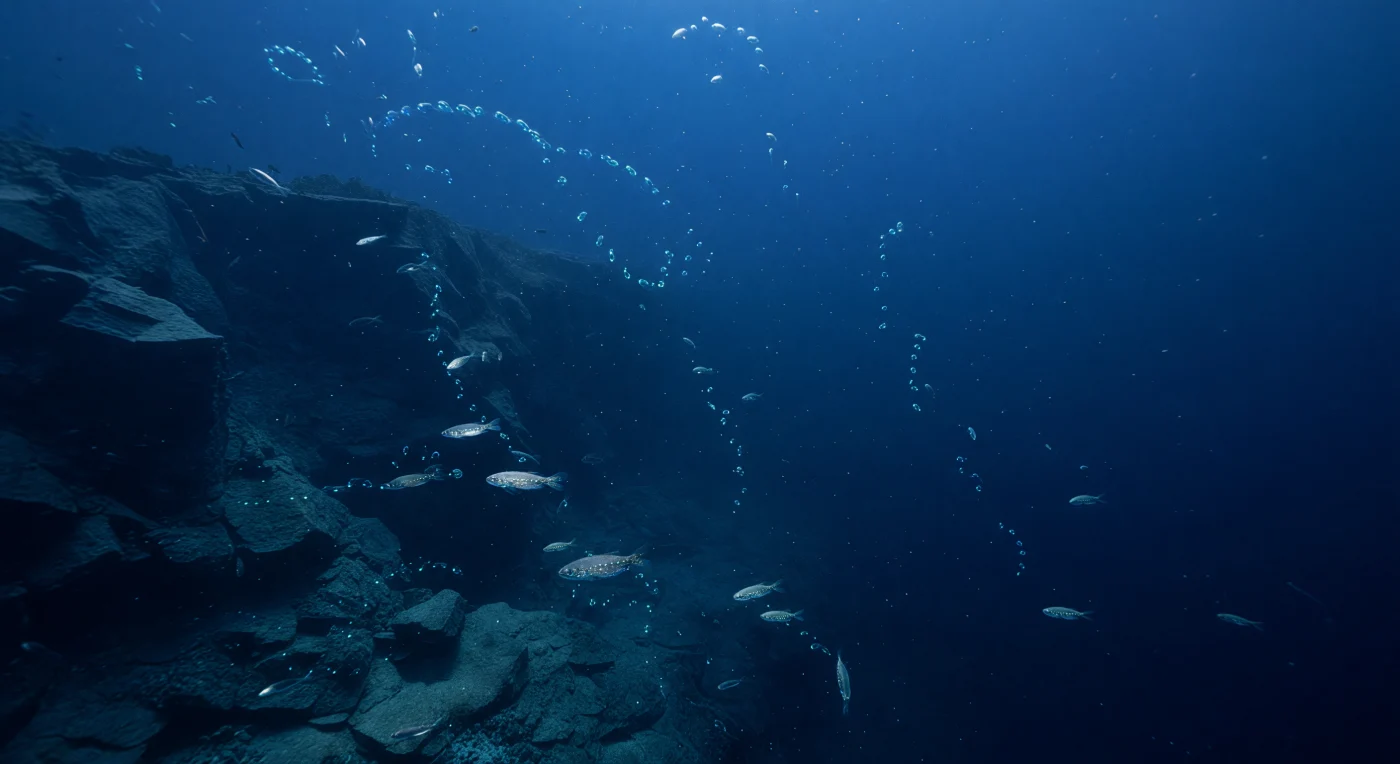
Between roughly 200 and 1,000 metres beneath the surface, sunlight becomes a memory — not yet entirely absent, but attenuated to a cold, directionless cobalt that barely distinguishes rock from water. Here, a submarine canyon wall rises as a looming darker plane, its ledges and sediment-dusted relief only fractionally separable from the surrounding sea, the geology ancient and indifferent beneath a slow rain of marine snow drifting down from the productive waters far above. Into this near-darkness, life has written its own light: siphonophores extend in loose, suspended chains across the open water column, their gelatinous bodies nearly invisible except where bioluminescent photophores punctuate the chain in repeating blue-green sparks, each colony a collaborative organism metres long, trailing through water at pressures exceeding 50 atmospheres. Lanternfish — among the most abundant vertebrates on Earth by biomass — hang as slender silvery silhouettes in the midwater, their ventral photophores arranged in precise taxonomic rows that may serve for counter-illumination, disrupting their own shadows against the faint residual downwelling light. This world turns ceaselessly without witness, its luminous signals exchanged between organisms across distances measured in the silent geometry of the deep, a biosphere operating entirely on its own terms.
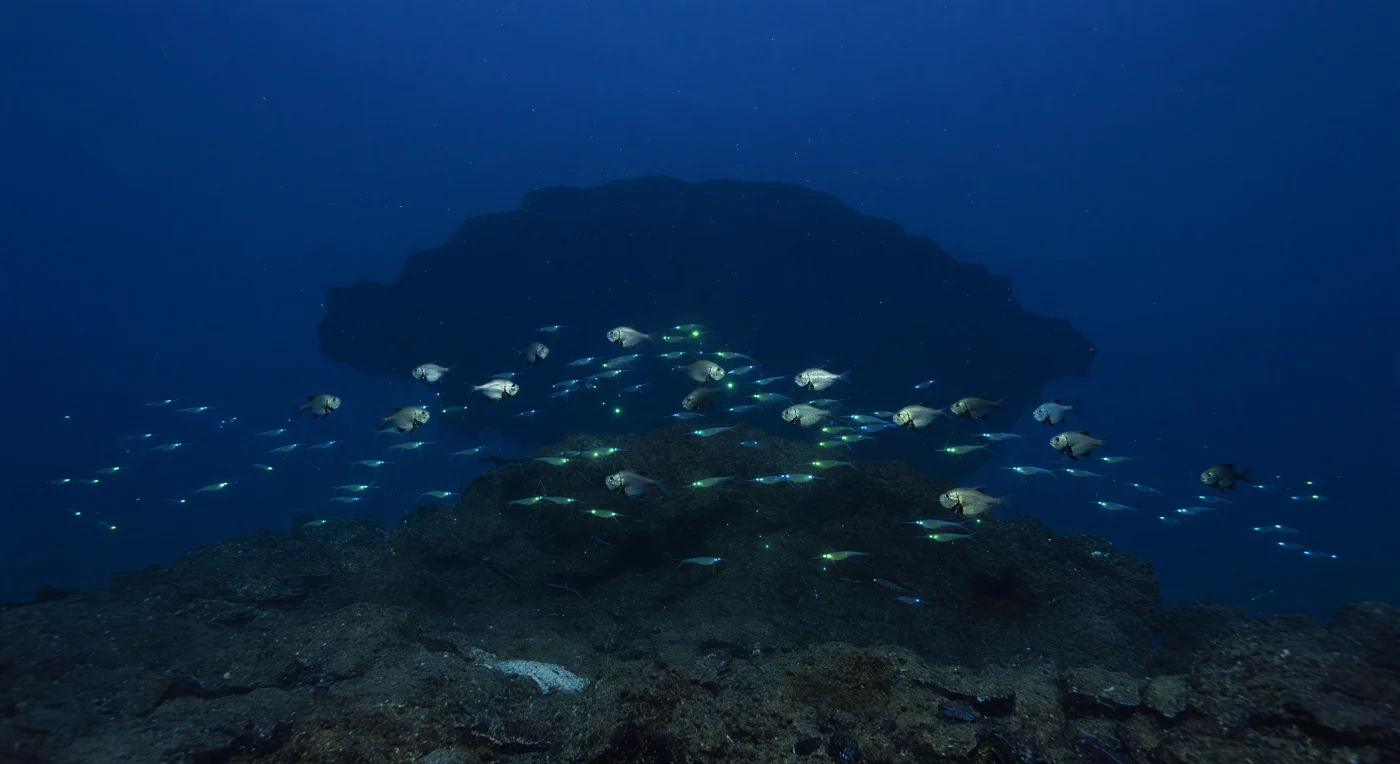
At the edge of a submerged volcanic rise somewhere between two hundred and a thousand metres down, the last vestiges of solar radiation arrive as a cold cobalt veil — attenuated, stripped of every warm wavelength, barely sufficient to trace the seamount's crest against the surrounding darkness. Here, pressure mounts steadily with depth, and the water column holds a permanent chill that borders on freezing, yet this realm pulses with its own quiet light. Lanternfish — myctophids among the most biomass-rich vertebrates on Earth — compress into a denser migratory ribbon along the topographic contour of the rise, their precisely arranged ventral photophores producing ordered constellations of blue-green sparks that collectively dissolve into a diffuse luminous haze hovering just above the rock shadow. Alongside them, nearly transparent mesopelagic shrimp drift on threadlike antennae, their bioluminescent organs flickering with cold cyan light, the entire assembly representing a nightly vertical migration of staggering ecological scale — billions of organisms ascending toward surface productivity under cover of darkness and retreating again before dawn. Marine snow drifts silently through the scene, each particle of sinking organic matter a quiet reminder of the biological pump connecting this dim, pressurized world to the sunlit ocean far above, the seamount itself an ancient volcanic formation deflecting deep currents and concentrating life along its crest as it has done, unseen, for millennia.
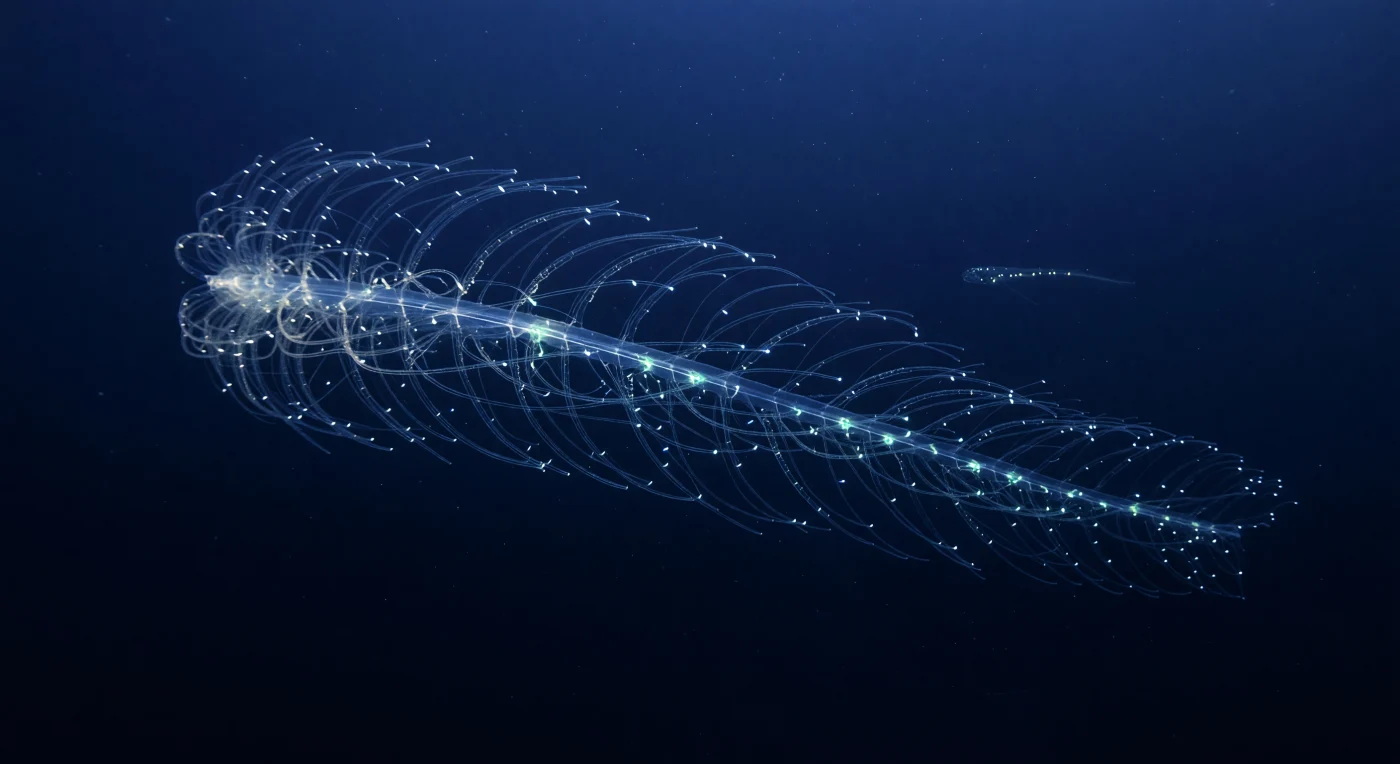
At five hundred to seven hundred meters beneath the surface, the last geometry of sunlight dissolves into a featureless cobalt gradient — not darkness exactly, but a slow erasure of wavelength, pressure mounting to sixty or seventy atmospheres against every transparent body suspended in the column. Here, a giant siphonophore — perhaps forty meters in total extent, one of the longest organisms on Earth — has deployed its feeding curtain across the open water, a colonial superorganism whose individual zooids are so optically clear that the entire structure exists as negative space until bioluminescence betrays it: turquoise pulses travel along the pneumatophore stem and thread outward through a vast lattice of hair-fine tentilla, each pulse a coordinated electrochemical signal propagating through shared tissue, briefly illuminating nodes and gelatinous nectophores like cold fire moving through glass. Where microscopic copepods and larval fish brush the nearly invisible tentilla, the contact triggers tiny blue-green sparks — defensive and predatory photochemistry firing simultaneously, luciferin oxidizing in milliseconds, the prey's own disturbance becoming the mechanism of its capture. Marine snow drifts slowly downward through the scene, particles of aggregated organic matter descending at centimeters per minute, and somewhere in the middle distance a viperfish traces its own quiet arc, its ventral photophores forming a dim constellation that mimics the downwelling light, a counter-illumination strategy perfected across millions of years in a world that has always been exactly this dark, this pressured, and this entirely its own.
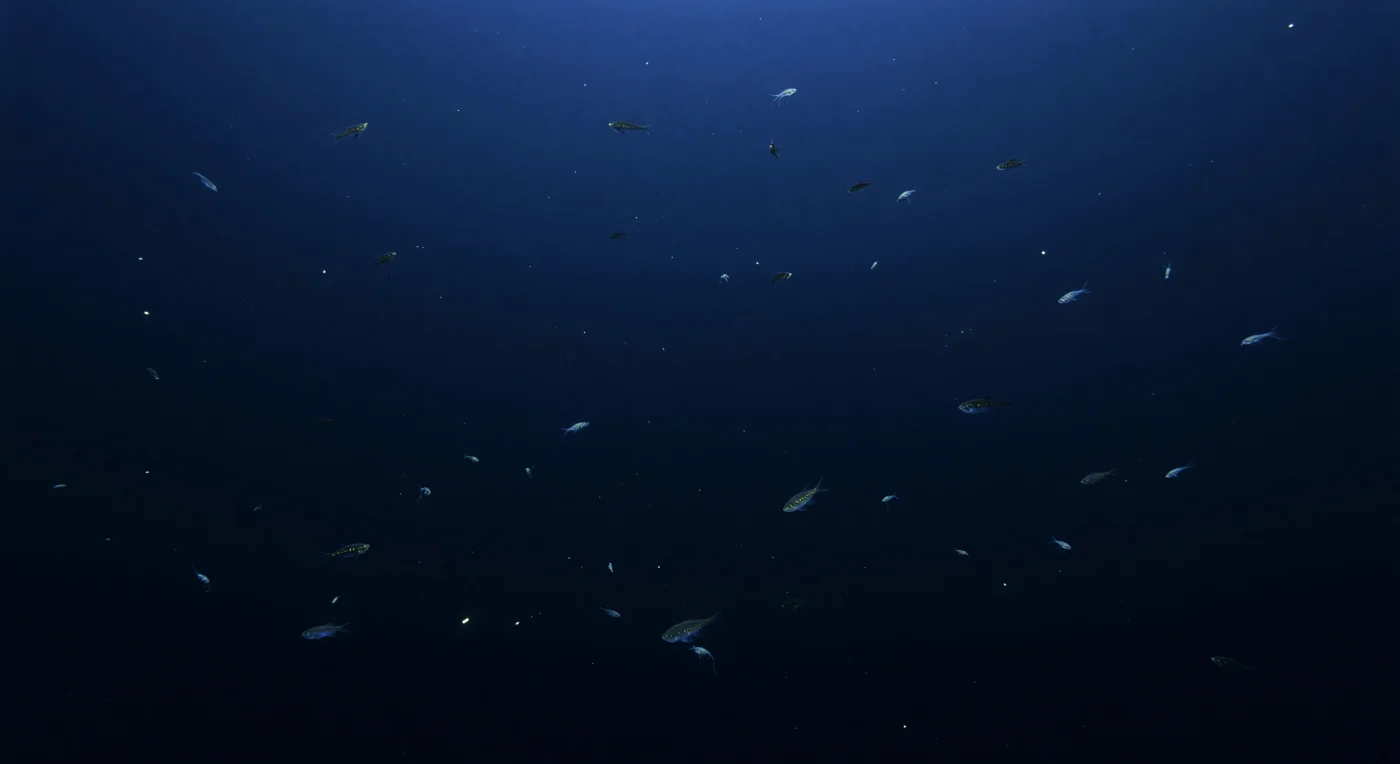
Between roughly two hundred and one thousand metres below the surface, the last residual photons of daylight compress into a cold, narrowing gradient — cobalt fading through deep indigo into a darkness so complete that pressure itself seems to acquire colour. This is the twilight zone, where ambient light fails not in an instant but across hundreds of metres of slow extinction, and where the organisms suspended within it have evolved an extraordinary counter-language of living light. Lanternfish carry orderly rows of photophores along their flanks, producing blue-green sparks that serve as counterillumination against the faint downwelling glow above, effectively erasing their silhouettes from predators hunting from below. Viperfish hang in the water column like living needles, their minute ventral lights and lure-like photophores pulsing at intervals measured in silence, while transparent crustaceans and planktonic shrimp drift through the marine snow — a slow vertical rain of organic particles descending from the productive surface far above — each particle a calorie, each calorie contested. At these depths the water column exerts pressures exceeding twenty atmospheres, cold hovers near four degrees Celsius, and no solar photon has sufficient energy to drive photosynthesis, yet the zone teems with biomass constituting what researchers estimate may be the largest daily animal migration on Earth, as countless organisms ascend each dusk and retreat each dawn through this very gradient of vanishing blue.