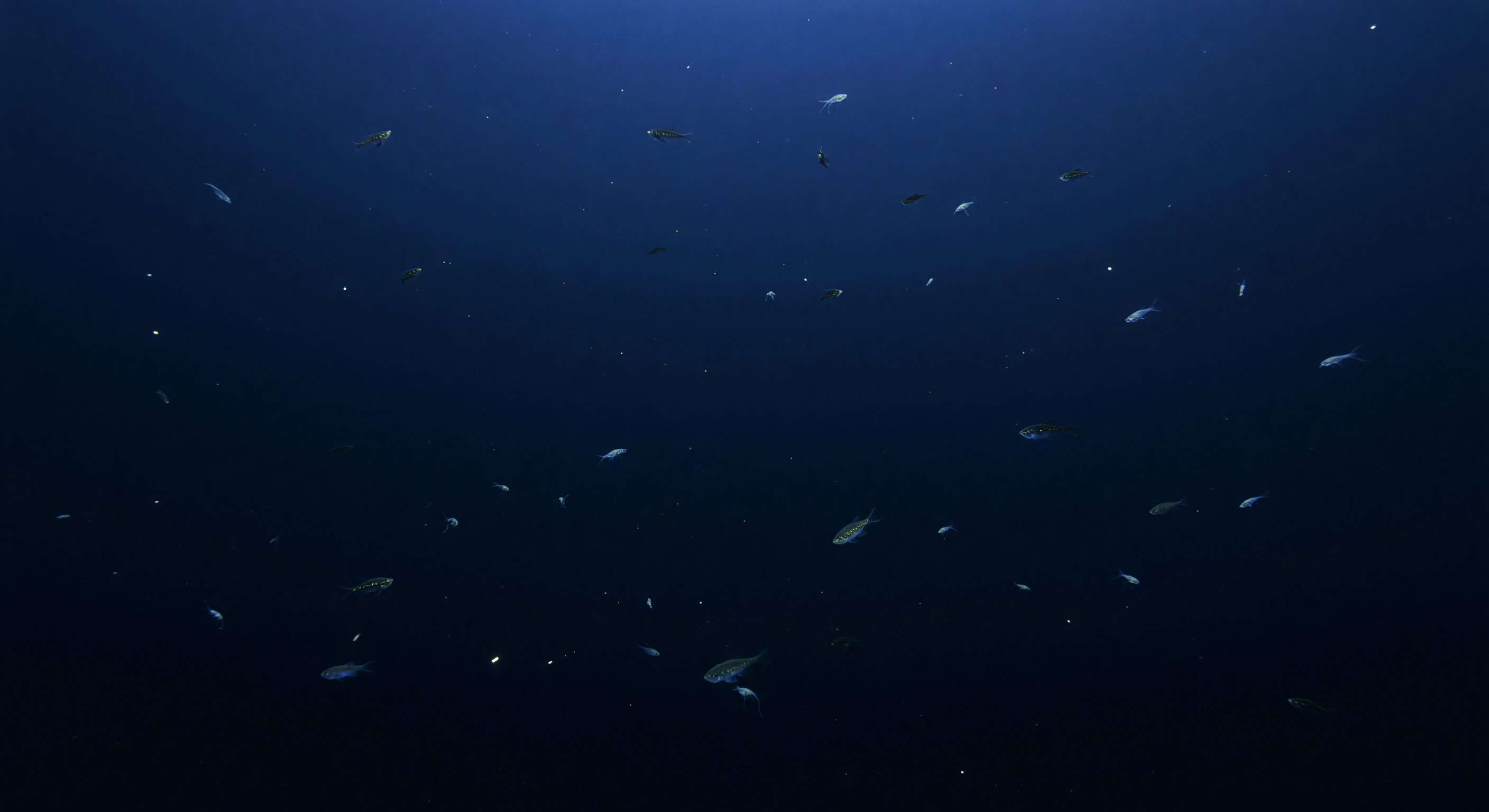
Between roughly two hundred and one thousand metres below the surface, the last residual photons of daylight compress into a cold, narrowing gradient — cobalt fading through deep indigo into a darkness so complete that pressure itself seems to acquire colour. This is the twilight zone, where ambient light fails not in an instant but across hundreds of metres of slow extinction, and where the organisms suspended within it have evolved an extraordinary counter-language of living light. Lanternfish carry orderly rows of photophores along their flanks, producing blue-green sparks that serve as counterillumination against the faint downwelling glow above, effectively erasing their silhouettes from predators hunting from below. Viperfish hang in the water column like living needles, their minute ventral lights and lure-like photophores pulsing at intervals measured in silence, while transparent crustaceans and planktonic shrimp drift through the marine snow — a slow vertical rain of organic particles descending from the productive surface far above — each particle a calorie, each calorie contested. At these depths the water column exerts pressures exceeding twenty atmospheres, cold hovers near four degrees Celsius, and no solar photon has sufficient energy to drive photosynthesis, yet the zone teems with biomass constituting what researchers estimate may be the largest daily animal migration on Earth, as countless organisms ascend each dusk and retreat each dawn through this very gradient of vanishing blue.
Mesopelagic bioluminescence