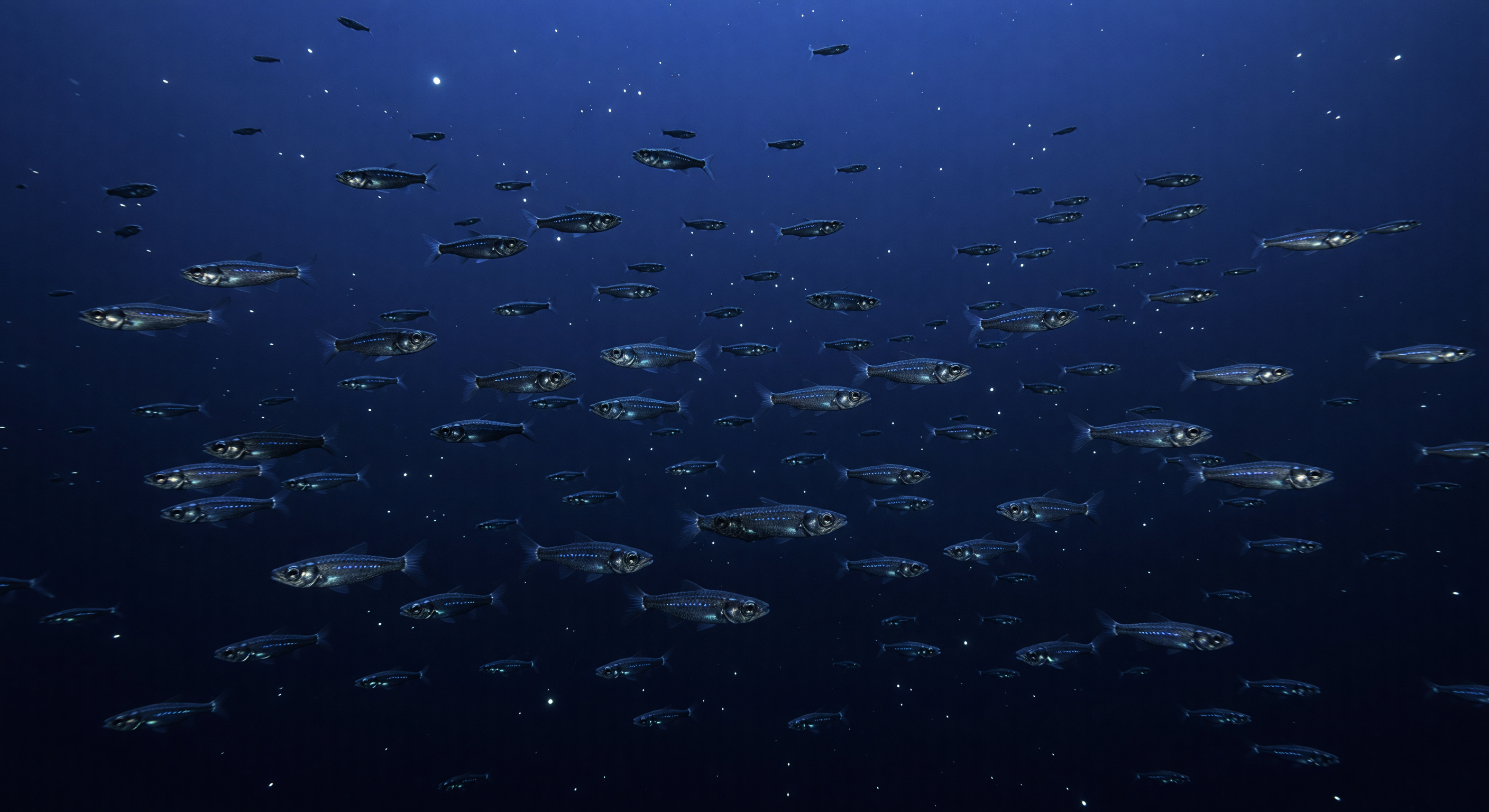
Between roughly 200 and 1,000 metres below the surface, sunlight surrenders its warmth and colour until only a last bruised cobalt persists, too faint to support photosynthesis yet just sufficient to silhouette the bodies of creatures that have learned to carry their own stars. Here, bristlemouths — genus *Cyclothone* and their kin, almost certainly the most numerically abundant vertebrates on Earth — hang suspended in midwater by the hundreds of millions, their slender silver-black bodies so slight they seem drawn in pencil against the indigo void. Along each belly runs a precise cadastral survey of photophores, organelles packed with luciferin and luciferase that fire cold blue-green light: a counter-illumination strategy that erases their own shadows when viewed from below by a predator scanning upward toward the faint remnant sky. At these pressures — twenty to one hundred atmospheres — water is not empty but structured, a medium threaded with marine snow, the slow confetti of organic detritus sinking from the sunlit world above, each particle drifting through the ambient blue as though time itself has thickened. Seen together, the dispersed school achieves an accidental astronomy, each photophore a point of slightly different brightness and spacing, composing a living constellation that tilts and recedes into darkness with no witness, no boundary, and no knowledge that it is observed.
Other languages
- Français: Champ d'étoiles bristlemouths
- Español: Campo Estelar de Bristlemouths
- Português: Campo Estelar de Bristlebocas
- Deutsch: Borstenmäuler Sternfeld
- العربية: حقل نجوم أسماك الشعيرات
- हिन्दी: ब्रिसलमाउथ तारामंडल क्षेत्र
- 日本語: ハダカイワシの星座野
- 한국어: 까칠입 별자리 들판
- Italiano: Campo Costellazione Bristlemouth
- Nederlands: Borstelbek Sterrenveld