Between roughly 200 and 1,000 metres beneath the surface, the last residual photons of sunlight fade from dim blue to near-extinction, and yet the ocean here is not dark in any simple sense. A band of mesopelagic shrimp — likely sergestids or euphausiid-relatives — arcs through the water column on an invisible current, their translucent bodies almost indistinguishable from the surrounding blue-black until, triggered by some chemical or mechanical cue, their ventral photophores and luminous secretions detonate in asynchronous bursts of cold blue-green light, stitching a trembling seam across the void. At this depth, ambient pressure exceeds twenty atmospheres, marine snow drifts perpetually downward, and bioluminescence is the dominant form of illumination — produced not by any external source but by the organisms themselves through luciferin-luciferase reactions, used variously for counterillumination camouflage, predator deterrence, and intraspecific signalling. The sparse, glinting particles suspended in the water column are testimony to the biological pump, the slow rain of organic matter that connects this twilight world to the sunlit layers far above. Here, in total solitude, the ocean generates its own constellations — brief, purposeful, and utterly indifferent to any witness.
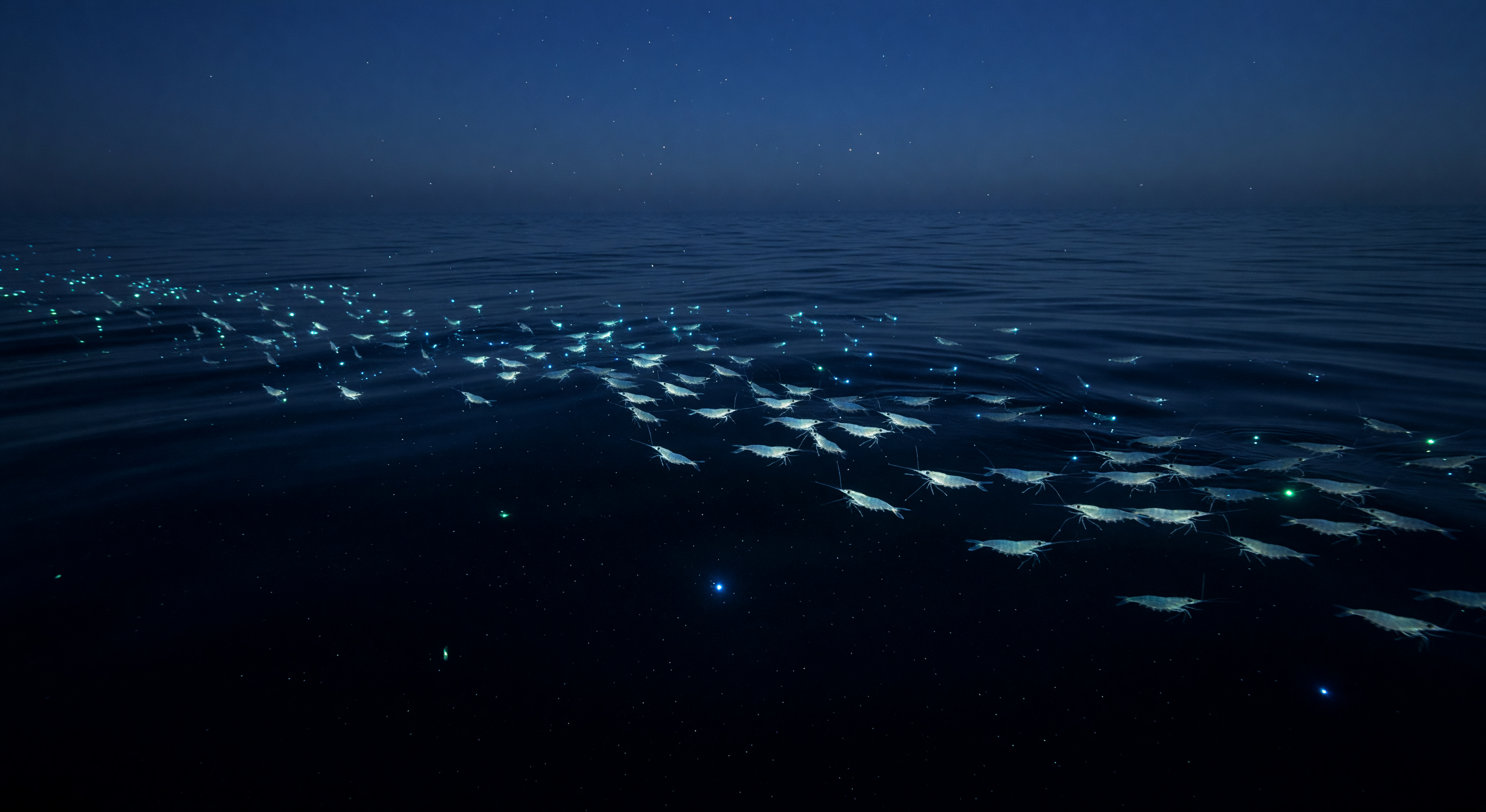
Mesopelagic bioluminescence