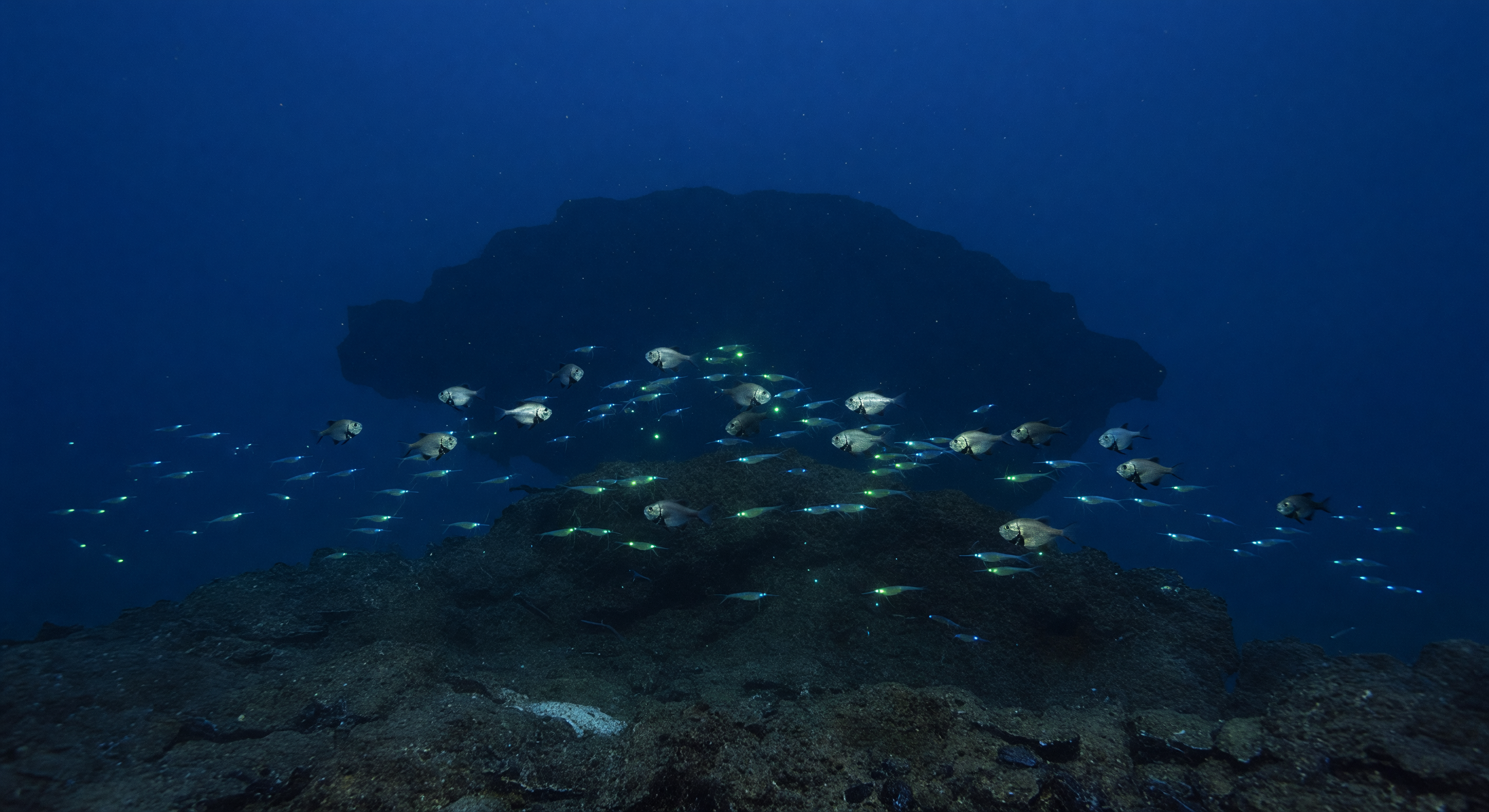
At the edge of a submerged volcanic rise somewhere between two hundred and a thousand metres down, the last vestiges of solar radiation arrive as a cold cobalt veil — attenuated, stripped of every warm wavelength, barely sufficient to trace the seamount's crest against the surrounding darkness. Here, pressure mounts steadily with depth, and the water column holds a permanent chill that borders on freezing, yet this realm pulses with its own quiet light. Lanternfish — myctophids among the most biomass-rich vertebrates on Earth — compress into a denser migratory ribbon along the topographic contour of the rise, their precisely arranged ventral photophores producing ordered constellations of blue-green sparks that collectively dissolve into a diffuse luminous haze hovering just above the rock shadow. Alongside them, nearly transparent mesopelagic shrimp drift on threadlike antennae, their bioluminescent organs flickering with cold cyan light, the entire assembly representing a nightly vertical migration of staggering ecological scale — billions of organisms ascending toward surface productivity under cover of darkness and retreating again before dawn. Marine snow drifts silently through the scene, each particle of sinking organic matter a quiet reminder of the biological pump connecting this dim, pressurized world to the sunlit ocean far above, the seamount itself an ancient volcanic formation deflecting deep currents and concentrating life along its crest as it has done, unseen, for millennia.
Other languages
- Français: Crépuscule du Mont Sous-Marin
- Español: Penumbra del Monte Submarino
- Português: Crepúsculo da Elevação Submarina
- Deutsch: Tiefseeberg Dämmerglut
- العربية: غسق حافة الجبل البحري
- हिन्दी: समुद्री शिखर संध्या
- 日本語: 海底山の薄暮光
- 한국어: 해저 산등성이 황혼
- Italiano: Crepuscolo del Monte Sommerso
- Nederlands: Zeeberg Schemertwilight