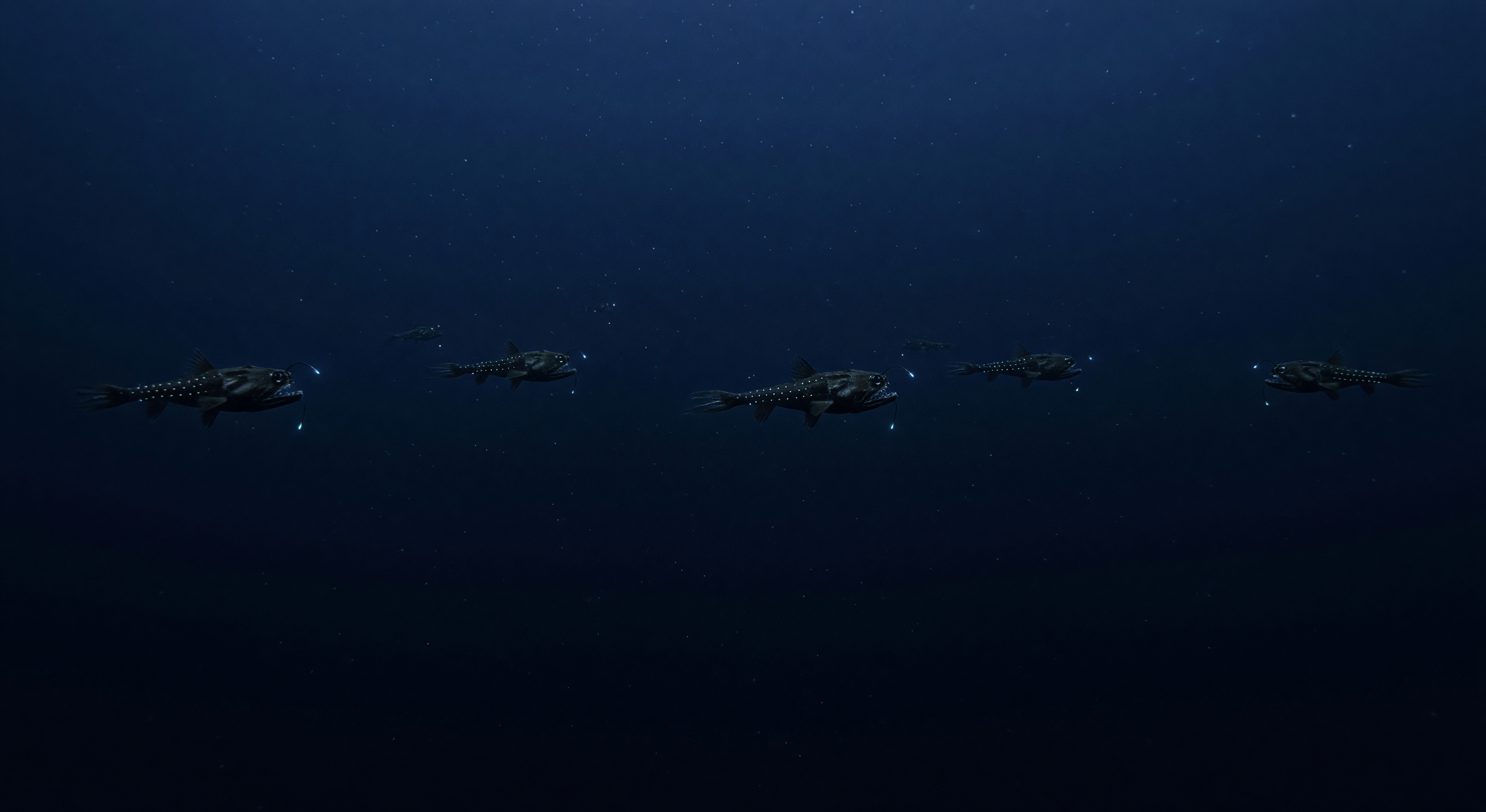
Between 500 and 700 meters, the last traces of solar energy arrive not as warmth or color but as a faint cobalt stain dissolving into absolute black, a threshold where photosynthesis is impossible and pressure already exceeds fifty atmospheres. Here, Chauliodus sloani — the viperfish — suspends itself in the water column with near-perfect stillness, its fang-lined jaws held slightly agape, waiting; the chin barbel trails below the head like a fishing line tipped with living fire, its cold blue-green photophore producing light through luciferin oxidation rather than any external source, a biochemical lantern refined across hundreds of millions of years. Along each flank, rows of ventral photophores form dim dotted constellations that break the fish's silhouette when viewed from below against whatever residual downwelling light remains — a phenomenon known as counter-illumination, a survival strategy written in light. Marine snow drifts freely through the corridor, a slow rain of organic particles descending from the productive surface far above, carrying energy downward into this sparse and pressurized world. Nothing here glows for any witness; the light exists entirely within its own logic, a language of predation and concealment spoken in the dark.
Other languages
- Français: Ligne de Lanternes Vipères
- Español: Fila de Linternas Víbora
- Português: Fila de Lanternas Víbora
- Deutsch: Schlangenfish Laternenreihe
- العربية: خط فوانيس سمك الأفعى
- हिन्दी: वाइपरफिश लालटेन पंक्ति
- 日本語: バイパーフィッシュの灯籠列
- 한국어: 바이퍼피시 등불 행렬
- Italiano: Fila di Lanterne Serpente
- Nederlands: Addervis Lantaarnlijn