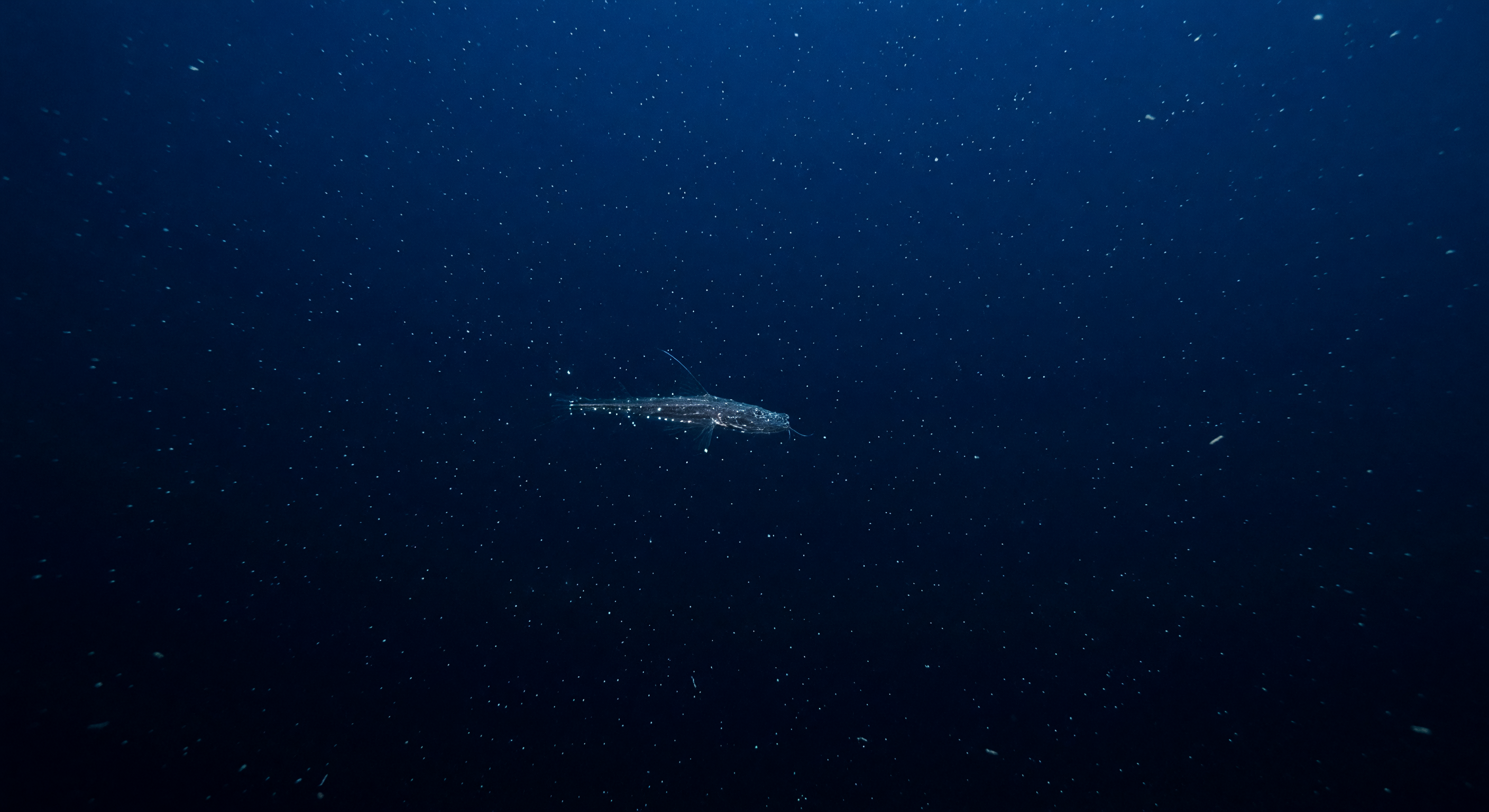
Between roughly 200 and 1,000 metres below the surface, sunlight dwindles to a last blue-grey memory, too faint to sustain photosynthesis yet still sufficient to silhouette a body against the void — a fact that has shaped the predator-prey arms race of the twilight zone for hundreds of millions of years. Here, a single stomiid dragonfish — one of the mesopelagic's most accomplished ambush hunters — hangs in near-perfect suspension, its elongated body tuned by evolution to the crushing pressure of several megapascals and the perpetual cold of water barely above 4 °C. Along its flanks and belly, rows of photophores emit steady blue-green bioluminescence produced by luciferin-luciferase reactions within specialised light organs, each point of living light serving simultaneously as counter-illumination camouflage against the residual downwelling radiance and as potential lure in a world where every photon carries biological consequence. Around it, marine snow descends in an endless slow rain — aggregates of dead cells, faecal pellets, mucus threads, and mineral particles that form the primary carbon conveyor linking the sunlit ocean above to the abyss below, their irregular surfaces catching the faintest ambient blue as they fall. This is a world of immense silence and pressure, governed entirely by biological light and the slow physics of sinking matter, persisting in complete indifference to any surface existence.
Mesopelagic bioluminescence