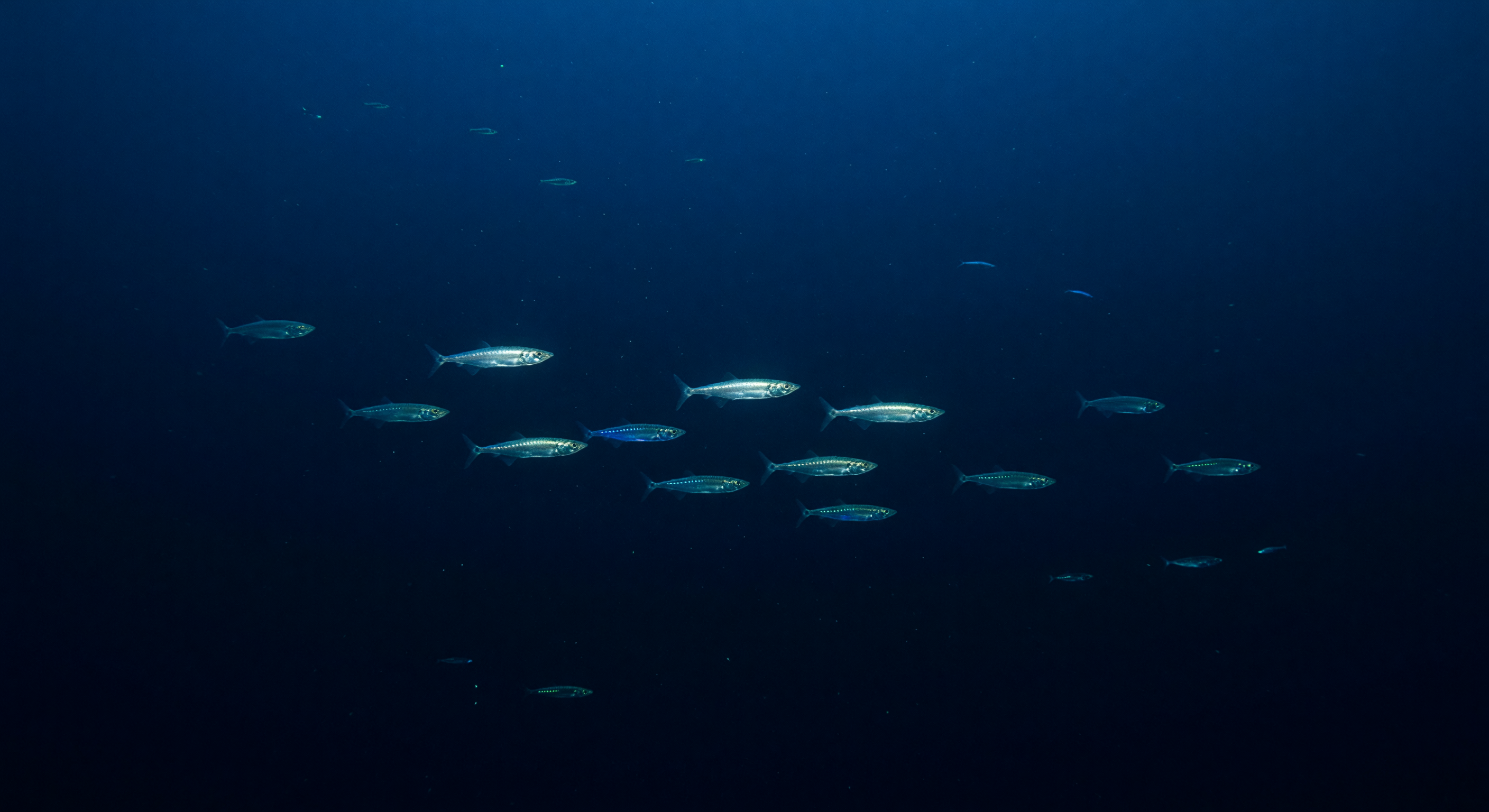
Between roughly 200 and 1,000 metres below the surface, sunlight surrenders its warmth and colour, leaving only a residual cobalt twilight that dims with every metre of descent — a gradient the eye can barely register but that governs the survival strategies of everything living here. In this vast midwater realm, pressure exceeds twenty atmospheres, temperatures hover just above freezing, and the water column stretches unbroken for hundreds of metres in every direction, populated not by seafloor or reef but by open space and its extraordinary inhabitants. Sternoptychid hatchetfish are among the most specialised products of this environment: their bodies are laterally compressed to near-transparency, their flanks silvered like polished metal to scatter and diffuse any ambient light and dissolve their silhouette against the dim ceiling above, and along their ventral edges a precise row of photophores emits soft blue-green light tuned almost exactly to the residual wavelengths still penetrating from the surface — a phenomenon called counterillumination, which erases their shadow from the perspective of predators hunting from below. Scattered through the surrounding water column, other mesopelagic organisms contribute their own cold sparks of bioluminescence, so that this zone, far from being dark and inert, pulses with a quiet, distributed living light that no surface dweller ever sees. Marine snow — the slow drift of organic particles from the productive surface layers — drifts among them, carrying carbon downward into the deep in a flux that links the sunlit ocean above to the abyssal darkness still far below.
Other languages
- Français: Dérive Miroir Hachette
- Español: Deriva Espejo Hacha
- Português: Deriva Espelho Peixe-Machado
- Deutsch: Beilbauchfisch Spiegeltreiben
- العربية: انجراف مرايا سمك الفأس
- हिन्दी: हैचेटफिश दर्पण प्रवाह
- 日本語: ハチェットフィッシュ鏡漂流
- 한국어: 도끼고기 거울 표류
- Italiano: Deriva Specchio Pesce Ascia
- Nederlands: Bijlvis Spiegel Drift