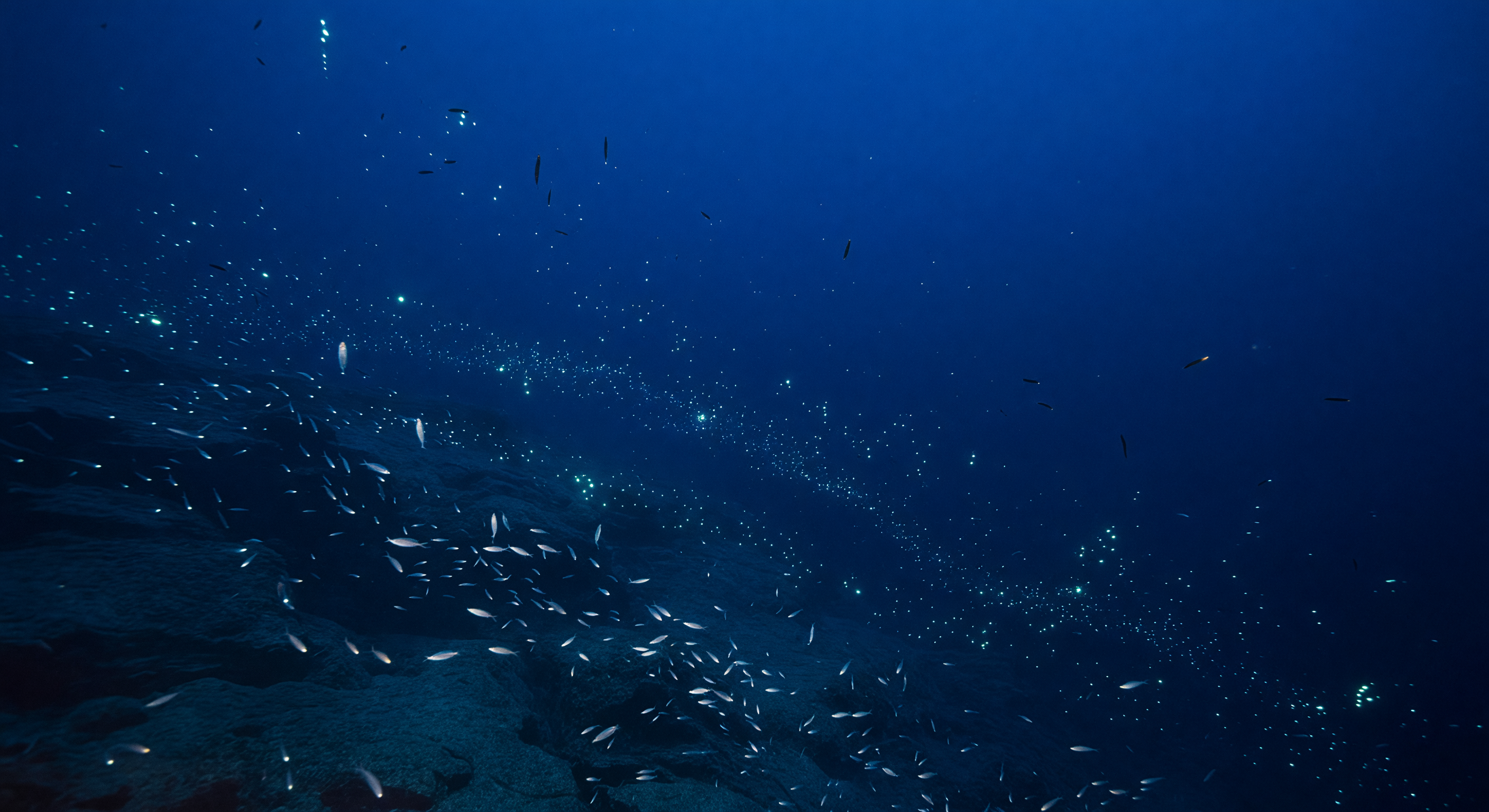
Each day, as the last traces of filtered sunlight fade to near-extinction somewhere between two hundred and one thousand metres depth, the continental slope wall rises through the darkness like a drowned escarpment, its indigo mass softened by cold water and immense pressure into something geological and ancient. Against this backdrop, the deep scattering layer performs its nightly vertical migration — a biomass event so vast it registers on ship echosounders as a false seafloor rising — as myriads of lanternfishes, bristlemouths, sergestid shrimps, and gelatinous zooplankton ascend toward the surface's faint residual cobalt glow to feed. Their bodies betray themselves only in fragments: glassy slivers of transparency, mirror-flashes from silvered swim bladders, and the precise photophore rows of viperfish stitched like cold blue-green circuitry through the dark, each bioluminescent pulse a defensive startle response or a species-recognition signal evolved across millions of years of lightless coevolution. Marine snow — the constant slow rain of organic particles from above — drifts freely through the water column, momentarily illuminated by each bioluminescent spark before dissolving back into the pressure haze, reminding us that this twilight world is not empty but profoundly alive, cycling carbon and energy through a silent biosphere that has never required a witness.
Other languages
- Français: Migration des ombres du talus
- Español: Migración de sombras del talud
- Português: Migração de sombras do talude
- Deutsch: Hangschatten Wanderung
- العربية: هجرة ظلال المنحدر
- हिन्दी: ढलान छाया प्रवास
- 日本語: 斜面影の移動
- 한국어: 경사면 그림자 이동
- Italiano: Migrazione delle ombre del pendio
- Nederlands: Hellingschaduw Migratie