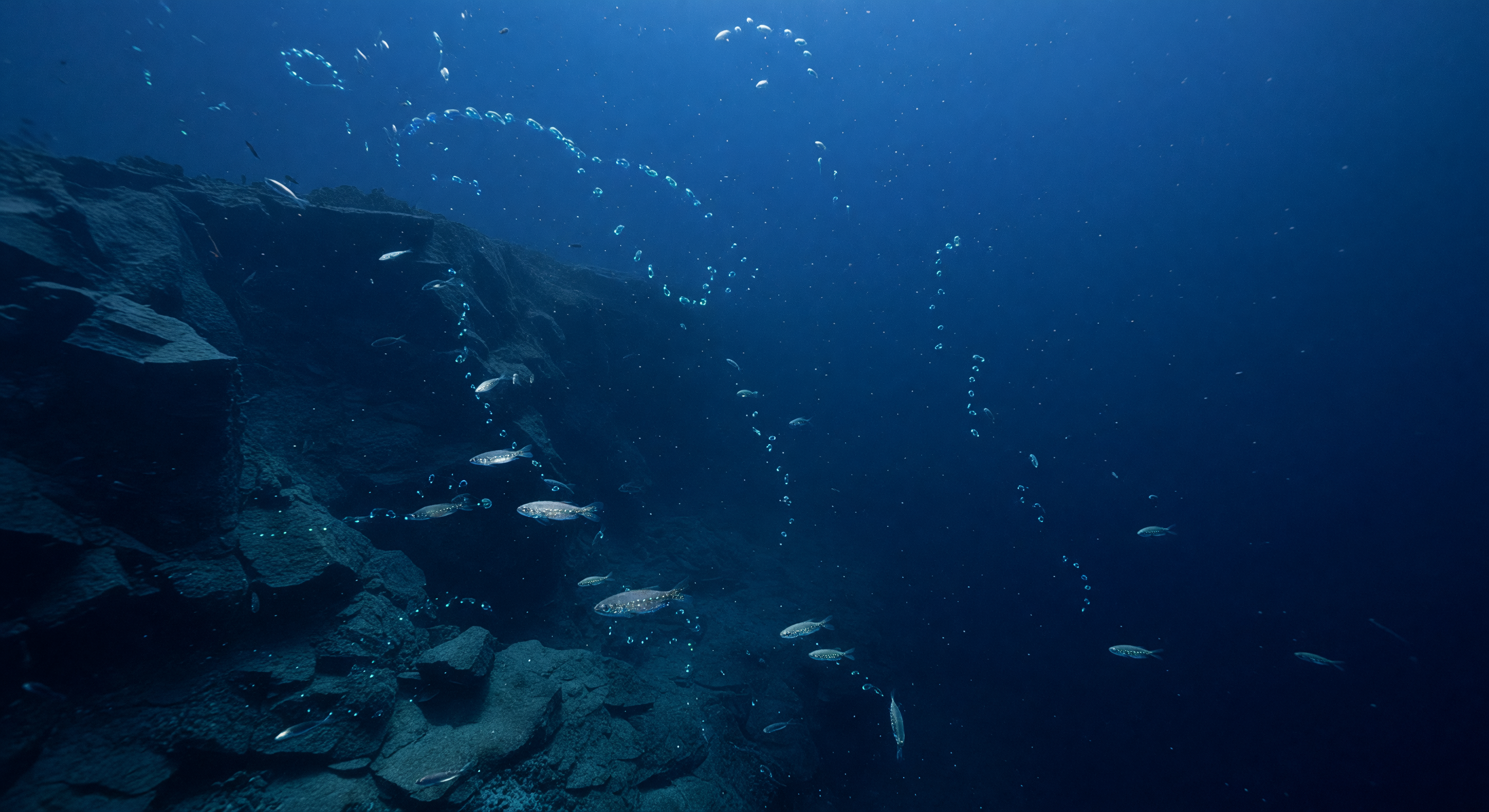
Between roughly 200 and 1,000 metres beneath the surface, sunlight becomes a memory — not yet entirely absent, but attenuated to a cold, directionless cobalt that barely distinguishes rock from water. Here, a submarine canyon wall rises as a looming darker plane, its ledges and sediment-dusted relief only fractionally separable from the surrounding sea, the geology ancient and indifferent beneath a slow rain of marine snow drifting down from the productive waters far above. Into this near-darkness, life has written its own light: siphonophores extend in loose, suspended chains across the open water column, their gelatinous bodies nearly invisible except where bioluminescent photophores punctuate the chain in repeating blue-green sparks, each colony a collaborative organism metres long, trailing through water at pressures exceeding 50 atmospheres. Lanternfish — among the most abundant vertebrates on Earth by biomass — hang as slender silvery silhouettes in the midwater, their ventral photophores arranged in precise taxonomic rows that may serve for counter-illumination, disrupting their own shadows against the faint residual downwelling light. This world turns ceaselessly without witness, its luminous signals exchanged between organisms across distances measured in the silent geometry of the deep, a biosphere operating entirely on its own terms.
Mesopelagic bioluminescence