Between roughly 200 and 1,000 metres below the surface, sunlight surrenders its last coherent wavelengths, and what remains is a fading cobalt wash that deepens, metre by metre, into pure midnight blue and then into nothing at all. Here, at this luminous threshold, the water itself becomes the medium of an ancient dialogue between residual photons from the world above and the cold chemical fire produced by the organisms that inhabit the column below — sergestid shrimp trailing ghostly blue-green sparks from rows of photophores, siphonophores barely distinguishable from the surrounding water except for the intermittent chemical flashes that pulse along their trailing filaments, and the distant silhouette of a viperfish, its ventral lanterns mimicking the dim skylight overhead in a strategy of counter-illumination refined across hundreds of millions of years. The pressure here — tens of atmospheres pressing equally from every direction — imposes a physical discipline on all life: bodies are reduced to the barest necessary architecture, transparent, compressible, and almost weightless, drifting within a slow rain of marine snow that carries the fragmented remains of the sunlit world down toward the abyss. No current announces itself, no surface intrudes; there is only the immense, pressurized silence of open water and the sparse, cold light that organisms make for themselves in the dark.
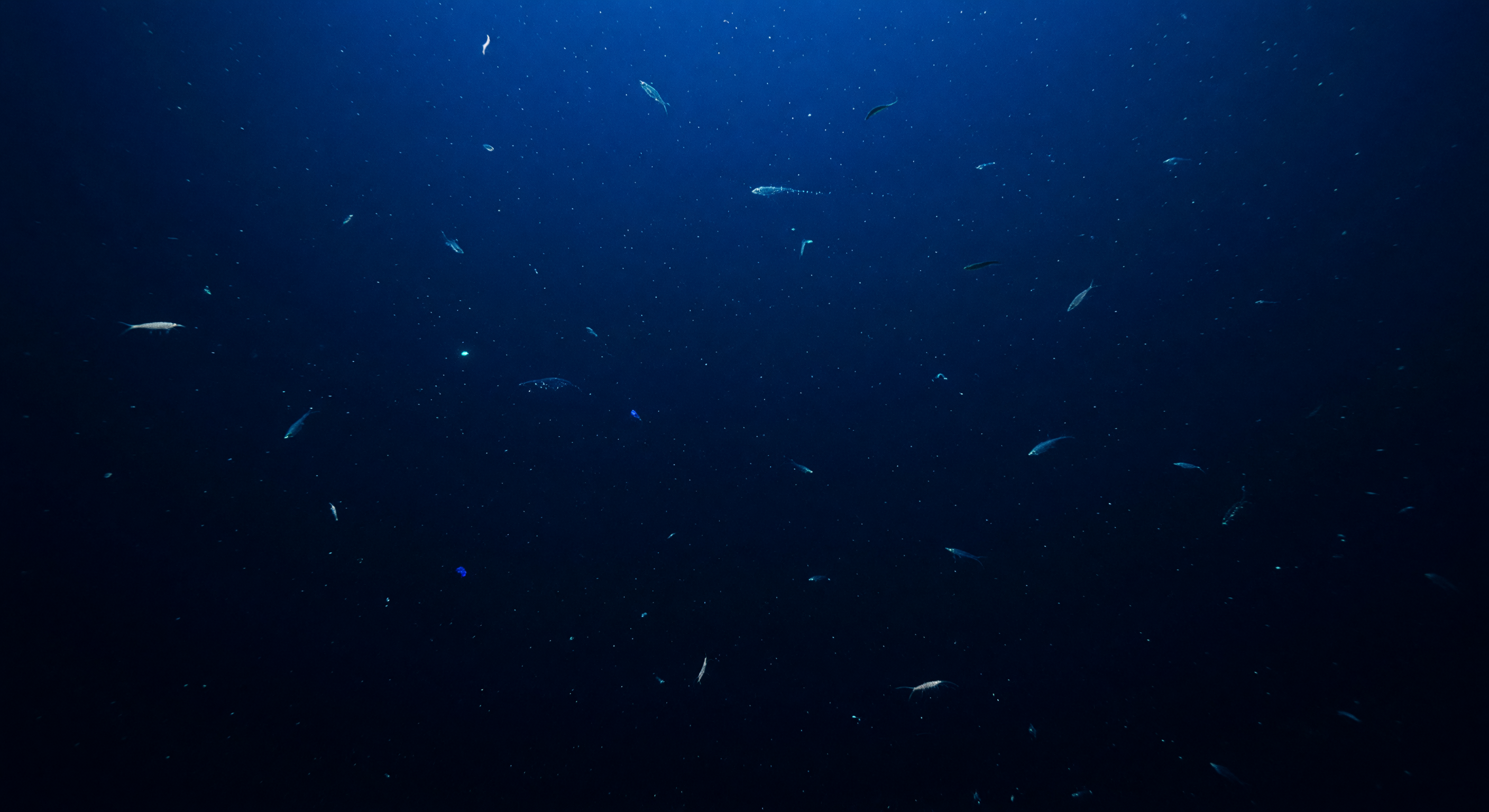
Mesopelagic bioluminescence