Scientific confidence: Very High
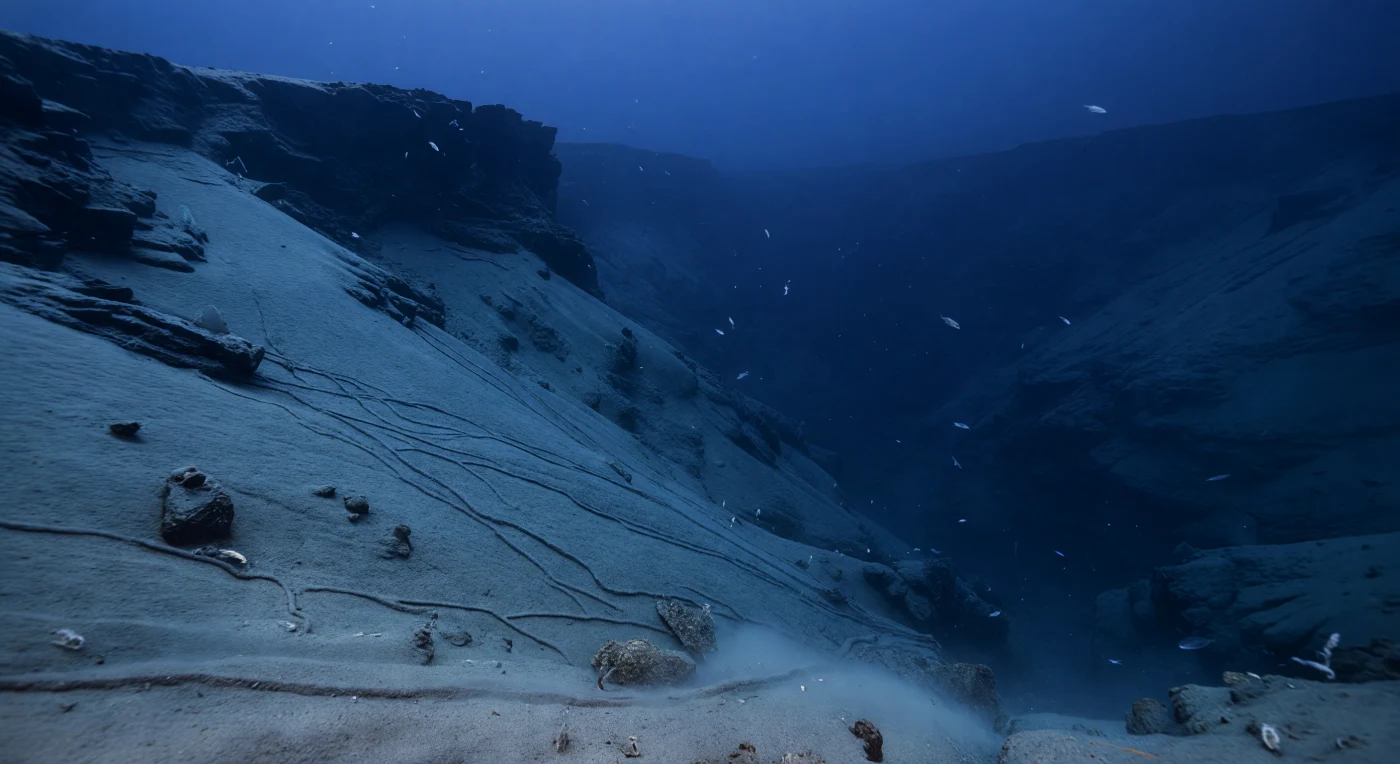
At roughly 220 metres, the continental shelf break marks one of the ocean's great topographic thresholds — the point where the gently inclined shelf abruptly surrenders to the steepening slope, and sunlight begins its final, losing struggle against depth. Here, in the upper mesopelagic, pressure already exceeds 22 atmospheres, and the residual solar radiation filtering down from the surface arrives as a dim, diffuse cobalt wash, attenuated to perhaps one percent of its surface intensity, stripping away warmer wavelengths and leaving only blue. The canyon wall descends in a steep diagonal of pale bluish-grey silt, its surface sculpted by narrow gullies, faint slump scars, and occasional dark rock outcrops — evidence of episodic gravity flows and the slow creep of sediment downslope under the influence of contour currents and the slope's own incline. A thin nepheloid layer clings close to the sediment surface, a suspension of resuspended particles stirred by near-bottom currents, while above it sparse marine snow drifts in slow, undeflected descent — the ceaseless rain of organic aggregates, fecal pellets, and diatom fragments that links the sunlit surface to the deep. Transparent medusae and small silvery mesopelagic fish hang as delicate silhouettes in the water column, adapted to this perpetual monochromatic dusk, while deeper in the canyon's shadow a handful of cold blue-white bioluminescent points pulse without witness — chemical light produced by organisms that have never needed the sun, in a world that has always existed in perfect indifference to our own.
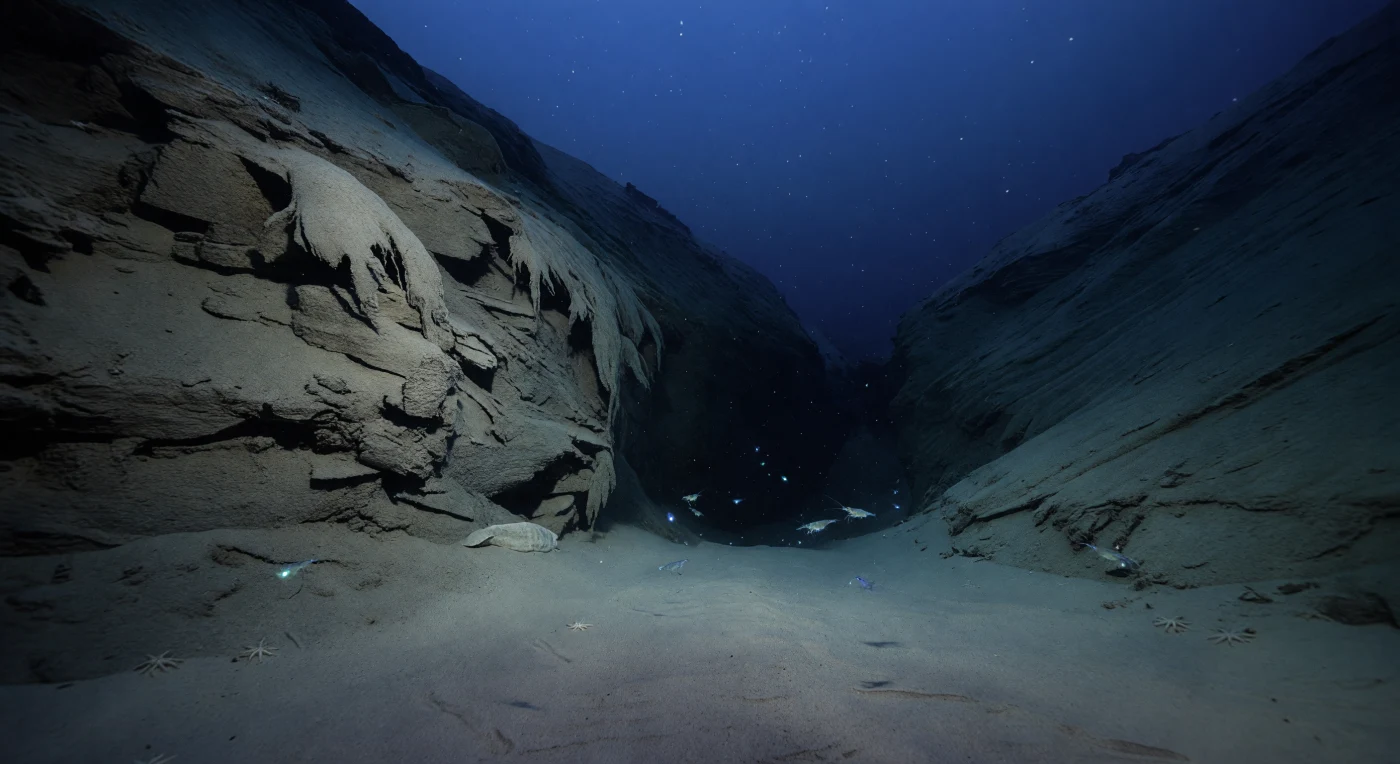
At 560 meters depth, the continental slope folds into a shadowed gully where geology tells its own violent history — a fresh slump scar exposes raw gray-beige mud in fractured plates and torn silt drapes, evidence of a recent gravitational failure along the steep margin where sediment periodically surrenders to slope and pressure. The last residual downwelling sunlight reaches this depth as little more than a dim cobalt gradient, attenuating rapidly into indigo and then absolute black within the ravine's deepest recesses, where the water column above exerts roughly 57 atmospheres of pressure against every surface. Suspended marine snow drifts in languid suspension through the cold water column, while a fragile carpet of recently displaced silt mantles the gully floor, its smooth surface still bearing the faint textural memory of its own slow movement. Against this near-darkness, transparent mesopelagic shrimp — startled into bioluminescent response — emit scattered blue-green pinpricks of light, each brief flash briefly illuminating glassy bodies, fine antennae, and silvery tapetal eyes before extinguishing back into the dark; this chemical light is not decoration but defense, a startle response evolved across millions of years in a world where the only illumination has ever been biological. Along the gully margins, brittle stars trace delicate signatures across the silt and a pale holothurian rests near the slump scar, these benthic organisms part of a transition fauna that shifts markedly with depth along the slope, living entirely within a silence and pressure that has never required our witnessing.
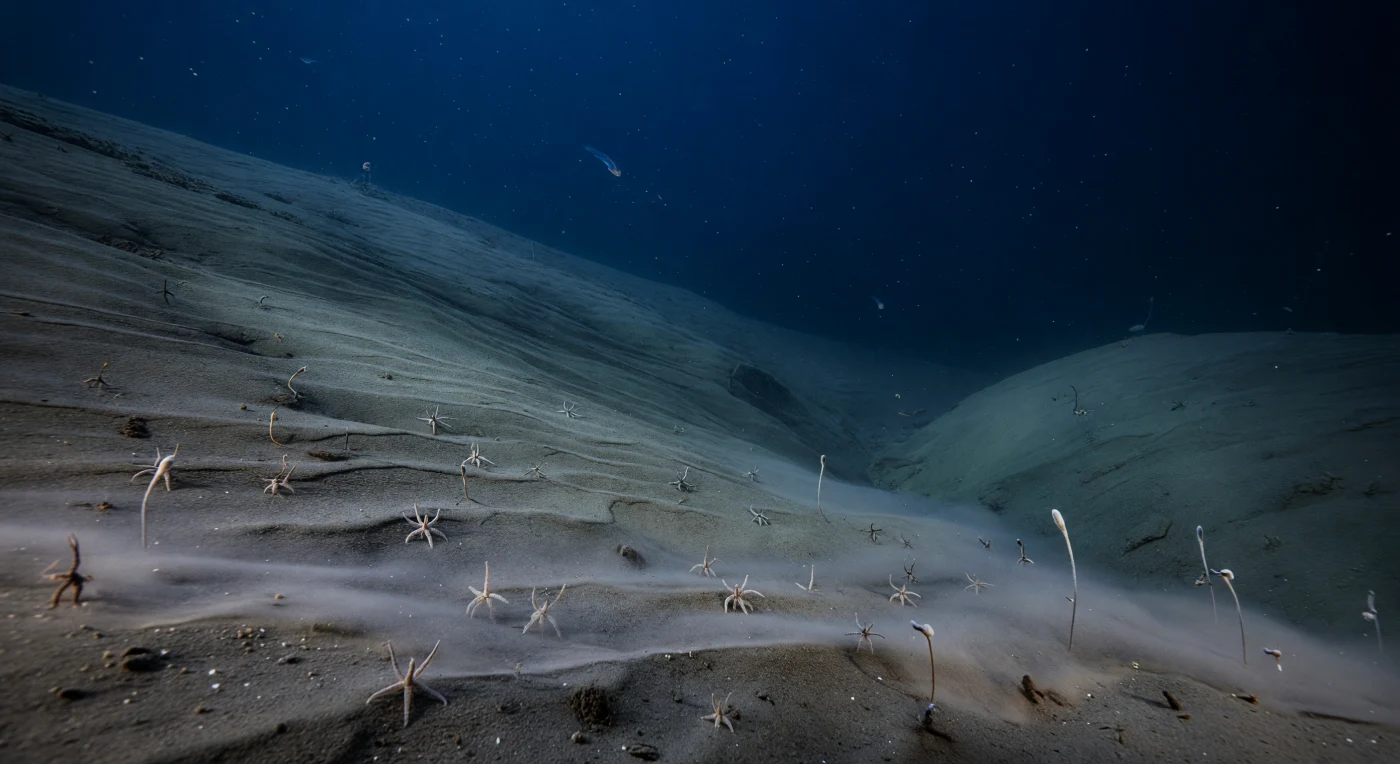
At 690 meters along the continental slope, the world narrows to cold mud and slow-moving water pressed beneath roughly 70 atmospheres of pressure. A nepheloid layer — that perpetual near-bottom suspension of resuspended silt and organic particles carried by contour currents and downslope gravity seeps — streams as a pale veil across rippled hemipelagic sediment, its boundary a soft frontier between settled seafloor and water column still carrying the memory of turbulence. Brittle stars have positioned their sinuous arms upward into the gentle current, filter-feeding on the particle rain that drifts densely within this boundary layer, while sea pens stand half-swallowed by mud, their colonial polyps bowed slightly by the same flow that redistributes fine shell grit and flocculent organic aggregates across the seabed. The last residual indigo light from the surface world above has traveled 690 meters to reach this slope, so attenuated it registers more as an absence of absolute darkness than as illumination, occasionally punctuated by cold bioluminescent sparks from drifting mesopelagic plankton suspended in the water column. Tiny burrow openings and scattered fecal casts betray the presence of infaunal communities invisible beneath the sediment surface, processing organic matter in the silence of a margin that has known no witness, only pressure, current, and time.
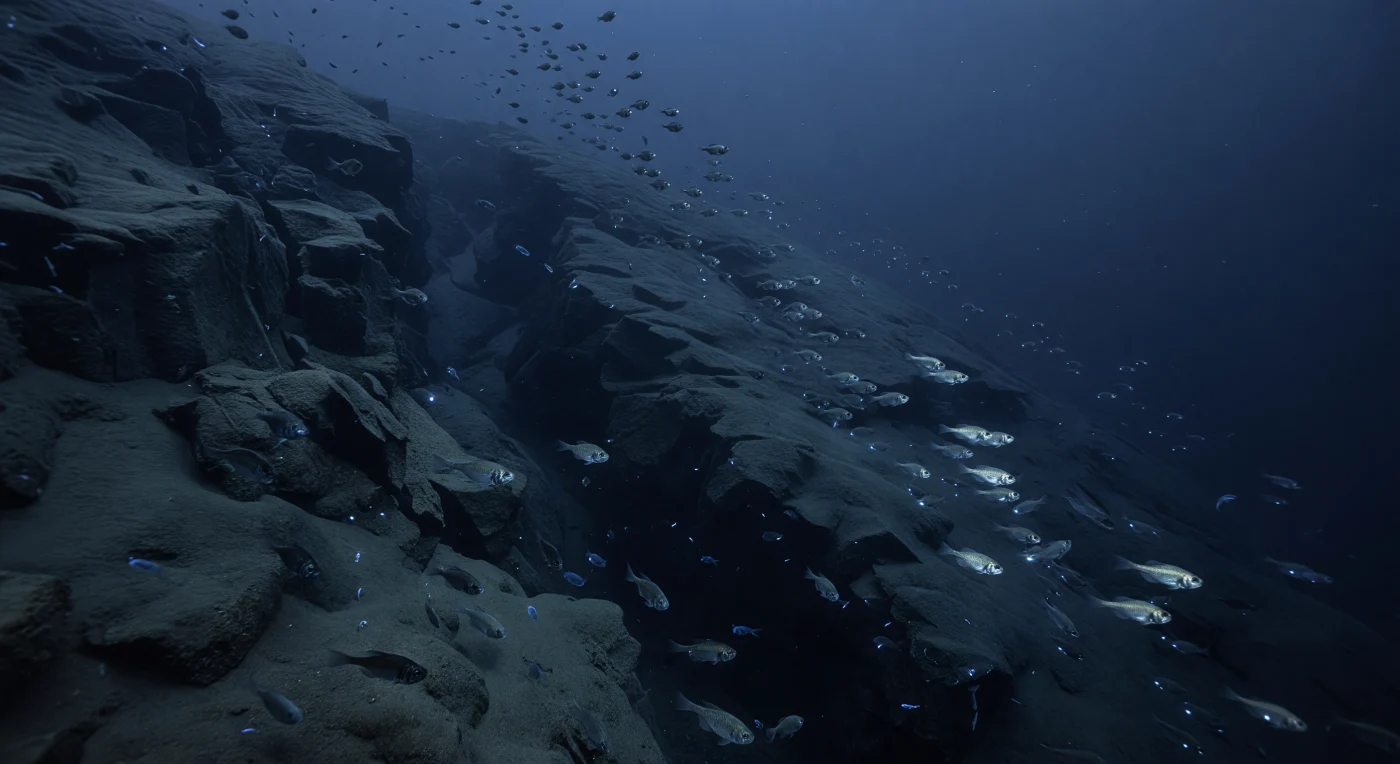
Along the continental slope at 430 meters, a loose procession of myctophids — lanternfish of the family Myctophidae — threads upward along the contour, their slender silver bodies suspended in water where downwelling daylight has diminished to a faint cobalt residue, insufficient to cast shadows yet just sufficient to strike mirror flanks as brief, cold blue-gray flickers. At this depth, pressure exceeds 43 atmospheres, temperatures hover between 6 and 10 degrees Celsius depending on the intermediate water mass pressing against the slope, and the mesopelagic twilight zone is defined precisely by this threshold where photosynthetically active radiation collapses but biological light begins to take its place — the ventral photophores of each fish igniting as tiny cyan-white points that serve for counter-illumination, concealing their silhouettes from predators looking upward against the last remnant of sky. The slope wall itself is fractured and sedimented, carved by contour currents and episodic gravity flows into gullies and narrow ravines draped with fine hemipelagic silt, a tectonically shaped substrate hosting the transition between shelf benthos and true deep-sea communities — sparse encrusting forms barely distinguishable against the cold blue-gray rock. This population of myctophids is almost certainly engaged in diel vertical migration, ascending each dusk toward productive surface waters and retreating each dawn into the oxygen-minimum-zone margins, a behavioral cycle that makes lanternfish among the most important vectors of biological carbon export on Earth, their collective metabolism linking the sunlit ocean to the abyss below. Marine snow drifts freely through the water column between them — microscopic fecal pellets, mucus aggregates, and the transparent bodies of gelatinous zooplankton — each particle part of the slow gravitational rain that feeds the slope community beneath, in a world that has operated this way, without witness, for millions of years.
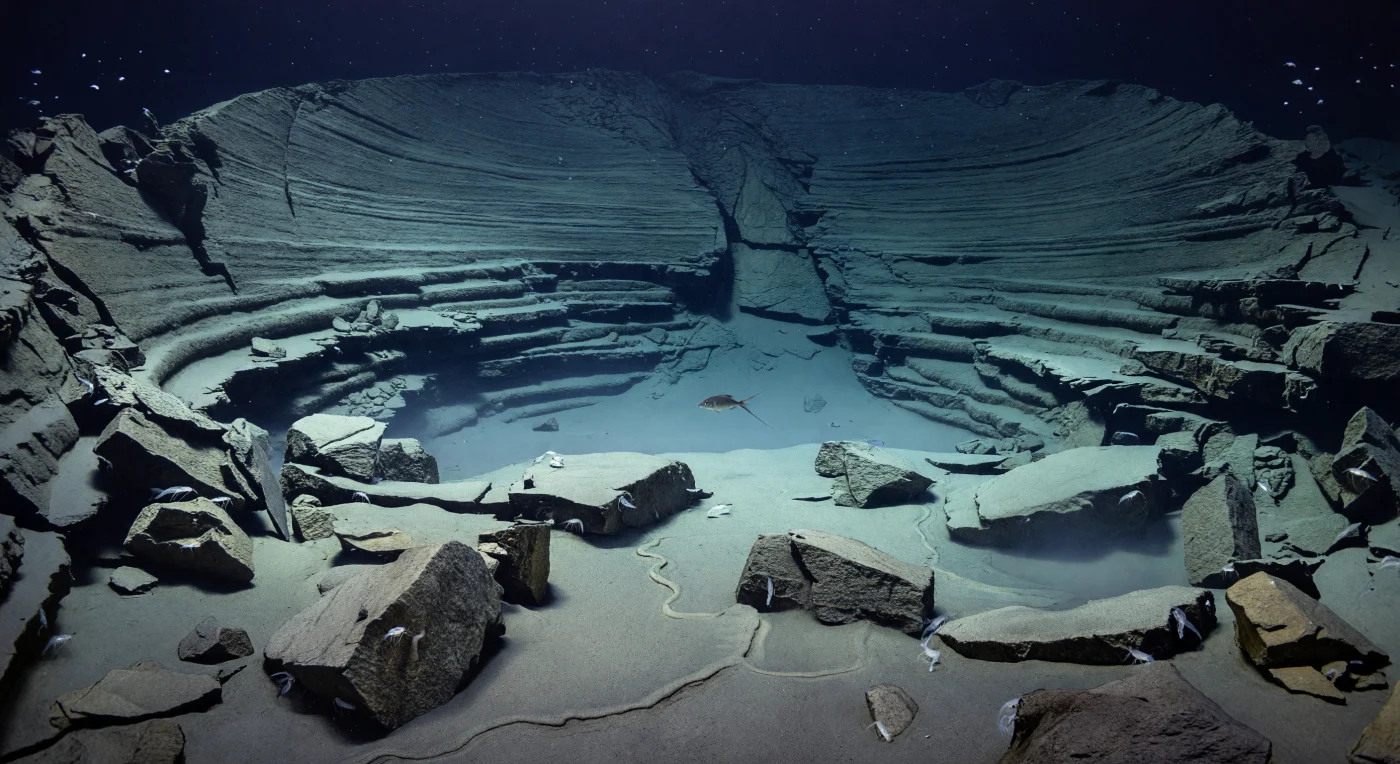
At 620 metres depth on the continental slope, the seafloor bears the exposed anatomy of a past catastrophic failure: a crescent headwall of pale compacted sediment and fractured mudstone rises in clean arcuate bands above a basin strewn with angular toppled blocks, all draped in thin silts and flanked by narrow ravines that record the geometry of ancient downslope collapse. Pressure here exceeds 60 atmospheres, the water hovers just above 4°C, and the only illumination is the last attenuated remnant of sunlight — a monochromatic deep blue that dissolves into indigo within the recesses of the amphitheater, naturally tracing every scarp and ledge without a single artificial source. A lone grenadier, Coryphaenoides or a close relative, hangs motionless over the sedimented basin floor, its long tapering tail and silvery-charcoal body characteristic of the rattail family that dominates benthic fish communities across the world's slopes at this depth; sparse transparent shrimps and small invertebrates occupy crevices in the rock edges, part of the mesopelagic–benthic transition fauna adapted to near-zero light and crushing pressure. Marine snow descends steadily through the water column, each particle a fragment of biological production from far above, while a thin nepheloid layer hazes the sediment surface and occasional pinpoints of bioluminescence flicker at the darker margins — the cold, silent, self-sufficient metabolism of a world that has never required a witness.
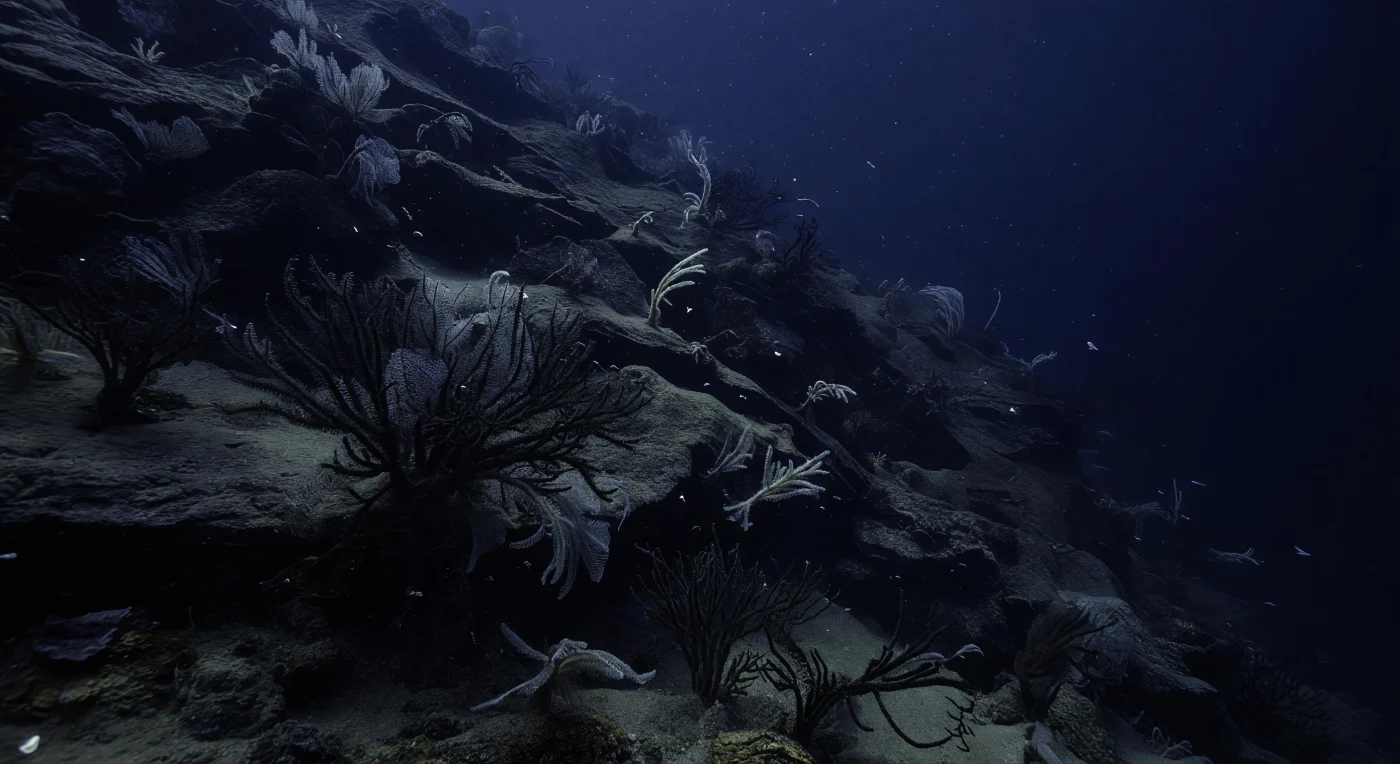
At 780 metres on the continental slope, where the shelf break is long past and the seafloor tilts steeply toward the abyss, a fractured rock escarpment rises through water pressing down at roughly 78 atmospheres — cold, near 4–6 °C, and carrying only the most attenuated ghost of sunlight that has filtered through nearly a kilometre of ocean above. That residual indigo twilight, too faint to be called illumination in any terrestrial sense, is just sufficient to render antipatharian black corals as intricate dark silhouettes against the cobalt water column; their polyp-covered branches have grown outward over decades or centuries into the sluggish along-slope current, filtering a rain of particulate organic matter drifting down from productive surface waters far above. Glassy hexactinellid sponges cling to the ledges and gullies of the escarpment, their siliceous frameworks faintly translucent where the ambient light catches them, while the spread arms of crinoids — stalked or free-living feather stars — intercept the same slow flow, their ambulacral grooves directing captured particles toward central disc mouths. Sediment drapes pocket the rock shelves, reworked by contour currents and episodic gravity flows channelled down from shallower canyon heads, and a thin nepheloid layer of resuspended fine particles drifts freely across the scene. Scattered blue-green bioluminescent pinpoints from dinoflagellates, copepods, and small crustaceans punctuate the midwater beside the wall — light produced entirely from within living tissue, chemistry answering chemistry in a place where the sun has never directly reached — while below the escarpment's base the slope simply vanishes into blue-black void, continuing its descent toward depths that exist in absolute and permanent darkness.
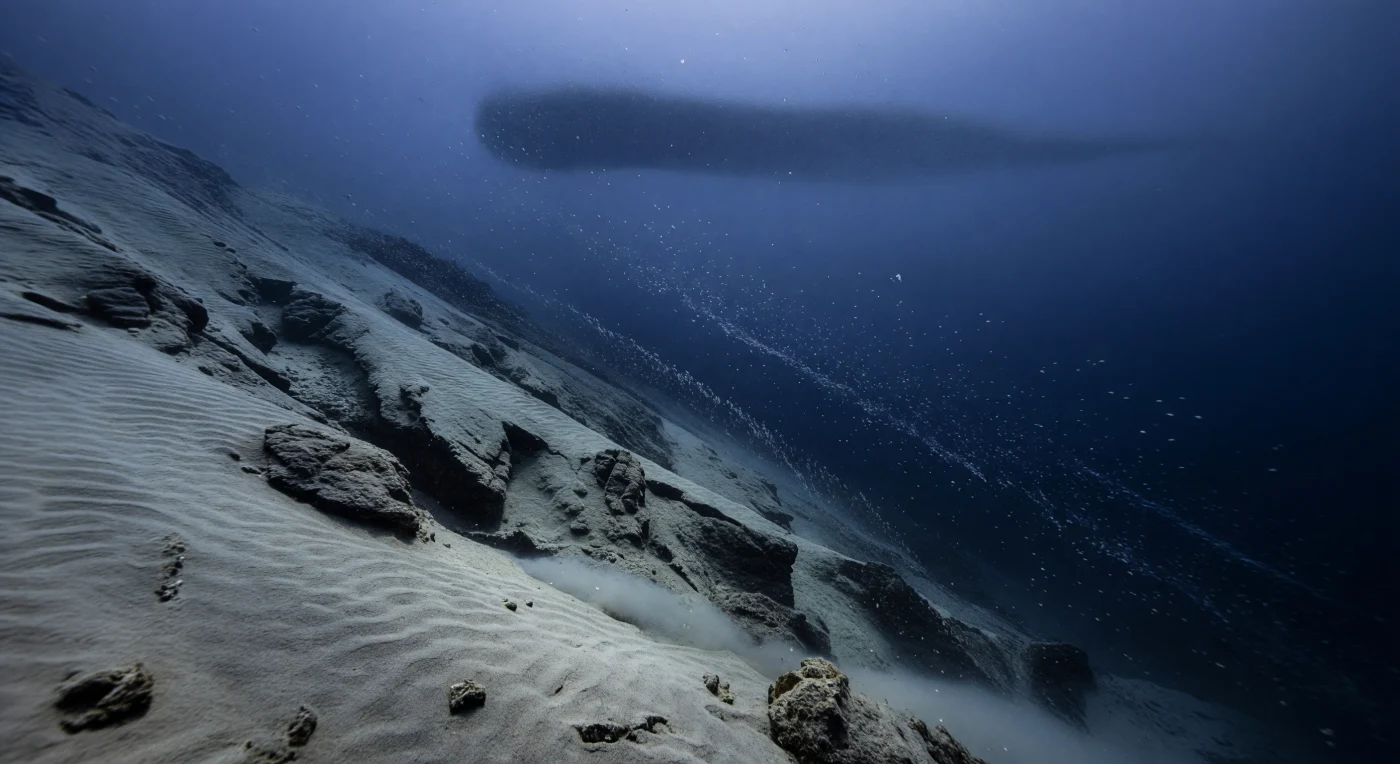
At 300 metres down the continental slope, sunlight has been stripped of every warm wavelength by the weight of water above, arriving here only as a cold, attenuating blue that bleaches to indigo against the gullied sediment face and surrenders entirely in the deeper ravines below. Pressure at this depth exceeds 30 atmospheres, and the water column is anything but empty: an internal tidal pulse — the slow, rhythmic heaving of density interfaces set in motion by the interaction of barotropic tides with the slope itself — organises marine snow and transparent copepods into diagonal streaming lanes, a quiet blizzard of organic detritus, faecal pellets, shed exoskeletons, and collapsed mucous feeding webs drifting steadily downslope to feed the benthos below. Near the sediment face, a faint nepheloid layer hovers, a whisper of resuspended silt kept aloft by bottom shear, while deep in the darker recesses of the gully walls, isolated bioluminescent pinpricks flash without witness — chemical light produced by organisms that have never known sunlight and require none. Far overhead, the deep scattering layer resolves as a broad, diffuse dark band suspended across the fading blue ceiling, a living acoustic mirror composed of myctophid fish, siphonophores, euphausiids, and gelatinous zooplankton that migrate vertically each day across hundreds of metres, coupling the sunlit surface with this cold, pressured twilight through the simple act of breathing and eating.
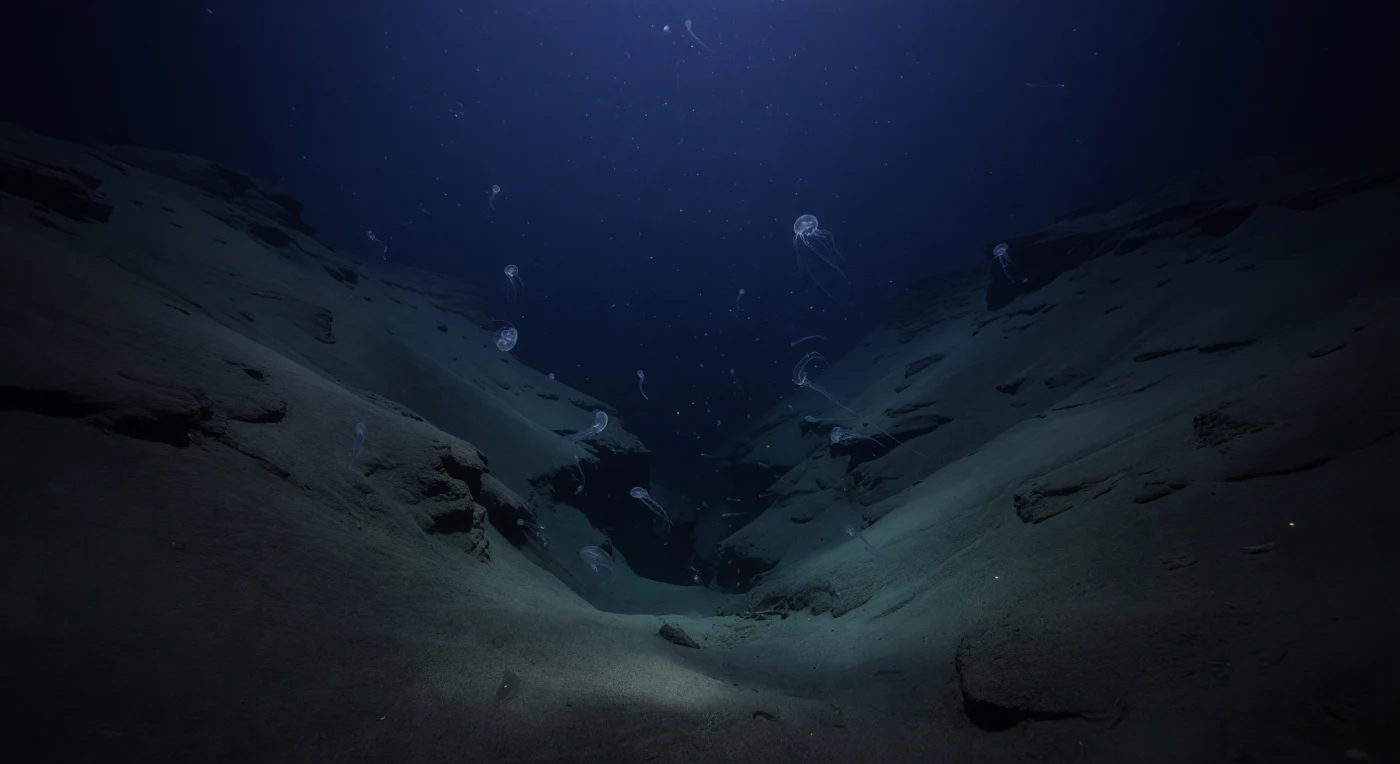
Along the canyon's steeply descending axis, the last residual photons of surface daylight filter down as a cold cobalt veil, dissolving into near-black long before they reach the sedimented floor some four hundred meters below the sunlit world. At this depth, pressure bears down at roughly forty atmospheres, cold enough to slow nearly every chemical process, yet the canyon corridor is quietly alive: ctenophores hang suspended in the open water like slivers of living glass, their refractive edges catching the faint ambient blue and throwing back pale, linear glints, while short siphonophore chains trail their specialized zooids in loose formation, each colony a superorganism whose division of labor — feeding, reproduction, defense — rivals any more familiar animal body plan. Fine marine snow, the constant rain of organic particles from the productive surface far above, drifts freely through the water column, accumulating into a subtle nepheloid layer close to the sediment-draped walls, its slow drift tracing the canyon's persistent downslope currents and the advection of distinct intermediate water masses along the continental margin. The canyon walls themselves record an older violence: slump scars, small ravines, and occasional exposed rock ledges speak to episodic gravity flows that have carved and recarved this passage over geological time, shaping a corridor through which organic matter, sediment, and pelagic life all move together into the deeper ocean. Here, in the permanent twilight between geology and open water, a world of extraordinary biological sophistication unfolds in total, undisturbed silence.
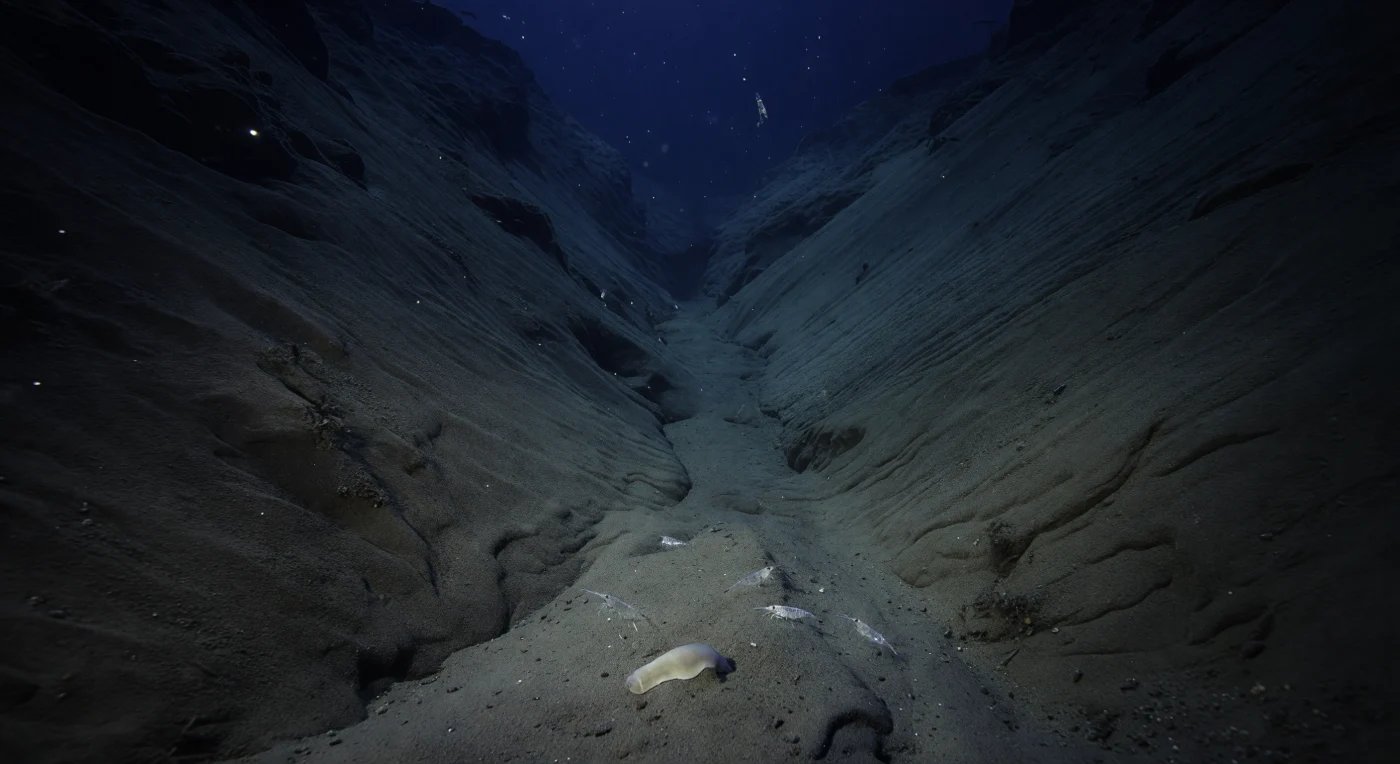
At 910 meters on the continental slope, where pressure exceeds 91 atmospheres and temperatures hover near 4–6°C, a steep sediment chute descends like a narrow geological wound cut into the soft muds of the upper-to-middle slope. This dynamic corridor channels downslope gravity flows and turbidity currents that periodically flush the system, leaving behind fresh slump textures, delicate erosion rills, and a nepheloid layer of resuspended particles drifting in a gentle cross-current just above the seafloor. A small holothurian — a sea cucumber adapted to life at extreme pressure — rests motionlessly on the gray-brown sediment, its soft, translucent body processing the organic detritus that continuously rains down from the sunlit surface far above as marine snow, the principal energy currency of this lightless world. Benthopelagic shrimp, their bodies near-transparent and reflective as glass, hover just above the sediment boundary, occupying the transitional niche between the water column and the benthos that characterizes this mesopelagic-to-bathyal transition zone. The last traces of downwelling blue light from the surface dissolve somewhere far above, leaving only the cold pinpoint bioluminescence of drifting plankton to punctuate the darkness — a world of immense silence, relentless pressure, and continuous slow motion that has persisted entirely without witness.
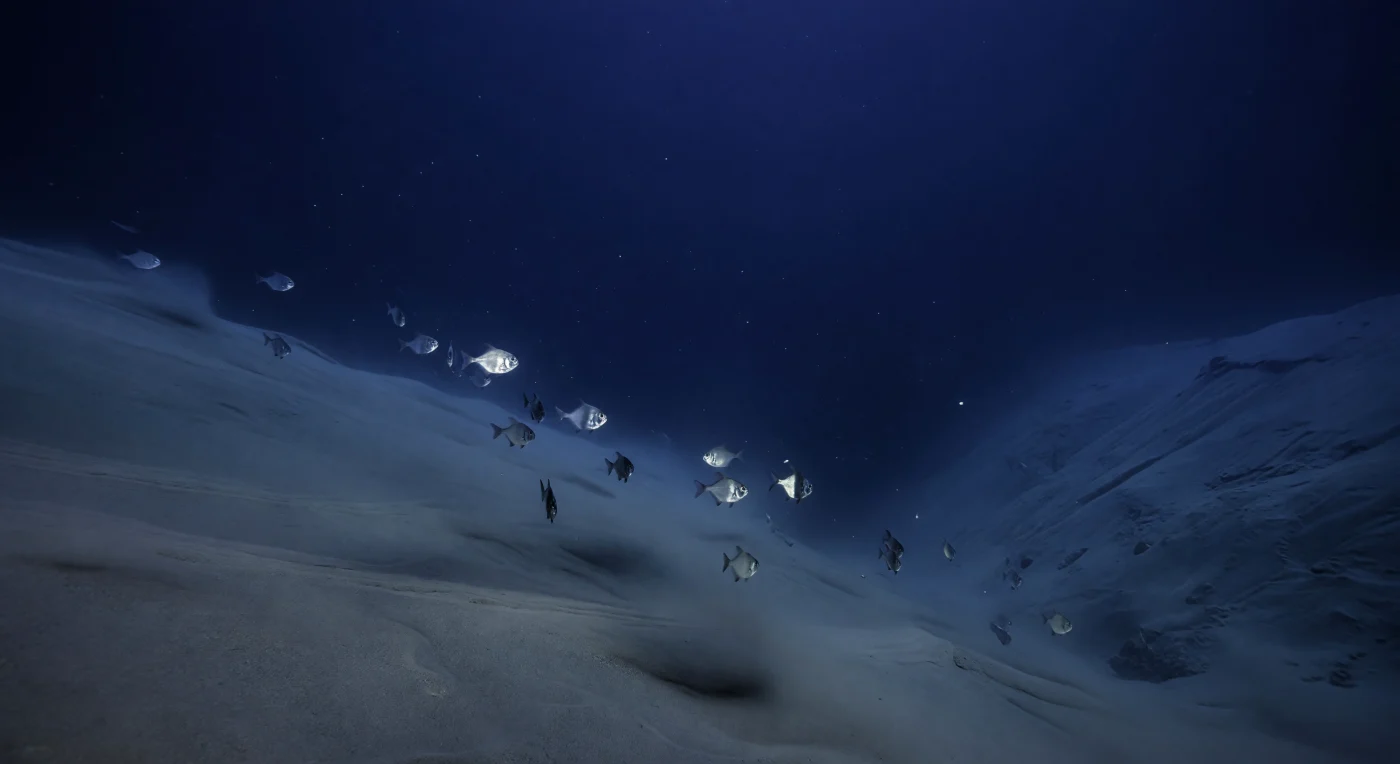
Along this open continental slope at 260 meters, the last viable wavelengths of sunlight — compressed into a cold, monochromatic indigo — penetrate just enough to cast soft gradients across a pale sediment drape that has settled silently over the incline over millennia, its surface faintly scoured by contour currents that move parallel to the slope in persistent, invisible rivers of denser water. At this depth, pressure exceeds 26 atmospheres, and the water temperature has fallen through the thermocline into the mid-single digits, creating conditions that demand extraordinary physiological adaptation from every organism present. Sternoptyx and related hatchetfish hover in the midwater flow, their ultra-thin, laterally compressed bodies and mirror-finish flanks — composed of stacked guanine crystal platelets — functioning as near-perfect camouflage in this dim column, reflecting ambient blue light so precisely that they become indistinguishable from the water itself when viewed edge-on by predators below. Alongside them, juvenile bristlemouths of the genus Cyclothone, among the most numerically abundant vertebrates on the planet, drift in the same cross-current, their translucent tissues and bioluminescent photophores calibrated for this exact niche of attenuating twilight. Further into the cobalt haze, where the ravine wall dissolves into depth, faint pinpricks of biological light pulse autonomously — a grammar of bioluminescence written entirely for an audience of other creatures, in an ecosystem that has been complete and coherent long before any surface-dwelling mind conceived of its existence.
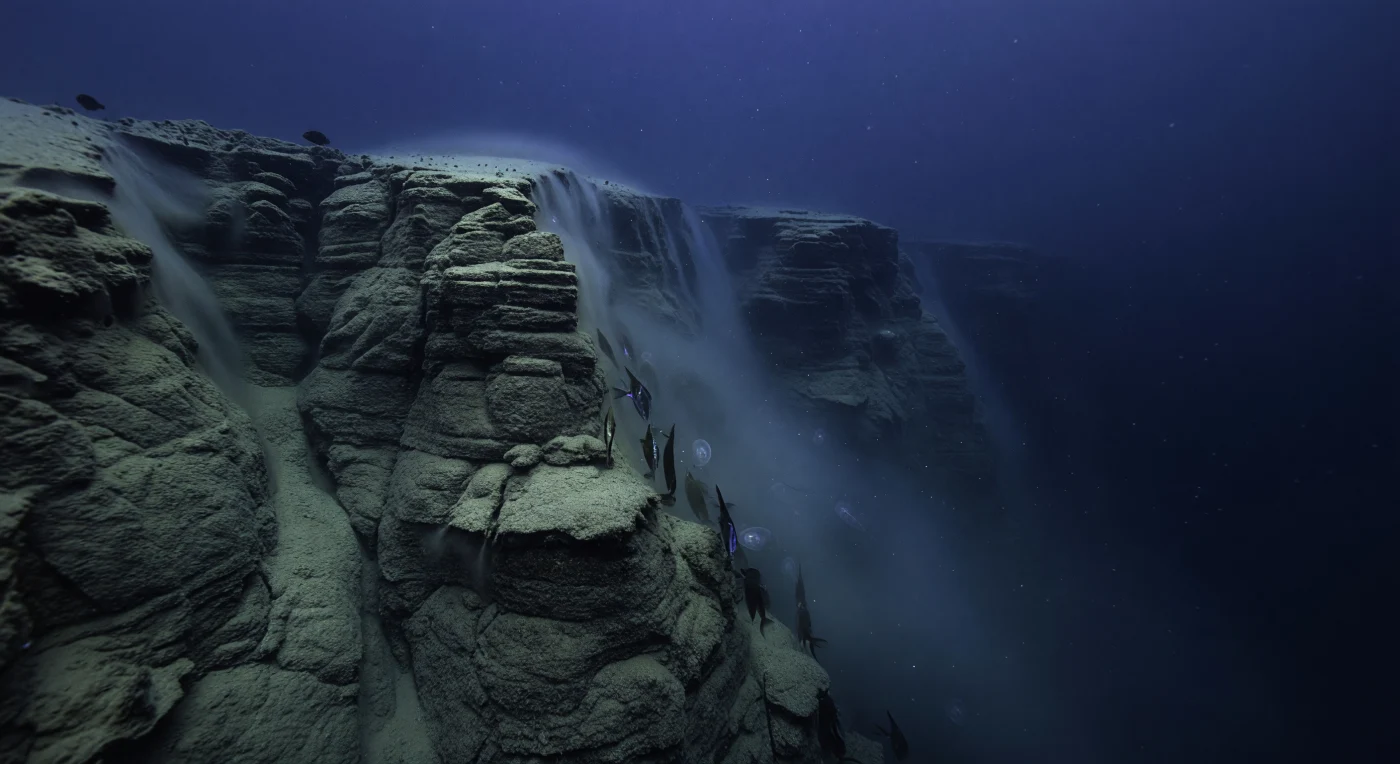
At around 500 metres depth along the continental slope, the water enters a realm where dissolved oxygen plummets to near-lethal minima, creating an oxygen minimum zone that acts as an invisible biological filter — a curtain of physiological pressure that compresses life into narrow, specialized bands along canyon walls and rocky ledges. The last traces of sunlight penetrate here only as a cold, monochromatic blue suffusion, attenuated to perhaps one ten-thousandth of surface irradiance, just barely enough to cast the faintest silhouette of a hatchetfish's laterally flattened, mirror-scaled body as it hovers at the boundary layer, its ventral photophores providing counter-illumination against the residual downwelling light in a predator-evasion strategy refined across tens of millions of years. The submarine canyon wall beside them bears the layered geological record of the continental margin itself — sedimentary sequences slumped and re-draped, narrow ravines carved by turbidity currents, ledges mantled in fine hemipelagic sediment carried grain by grain through the water column as marine snow, which now drifts visibly through the frame as pale motes suspended in a nepheloid haze pressed close to the rock face. Ctenophores — gelatinous, nearly optically transparent, their eight comb rows of fused cilia occasionally catching ambient blue light in a fleeting iridescent shimmer — drift without muscular effort through water pressing down at roughly 51 atmospheres, their bodies so nearly equivalent in density to seawater that pressure itself is barely a constraint. This is a world of chemical boundaries and geological architecture, existing in cold silence utterly independent of any observer, shaped entirely by physics, chemistry, and the slow negotiation of life with scarcity.
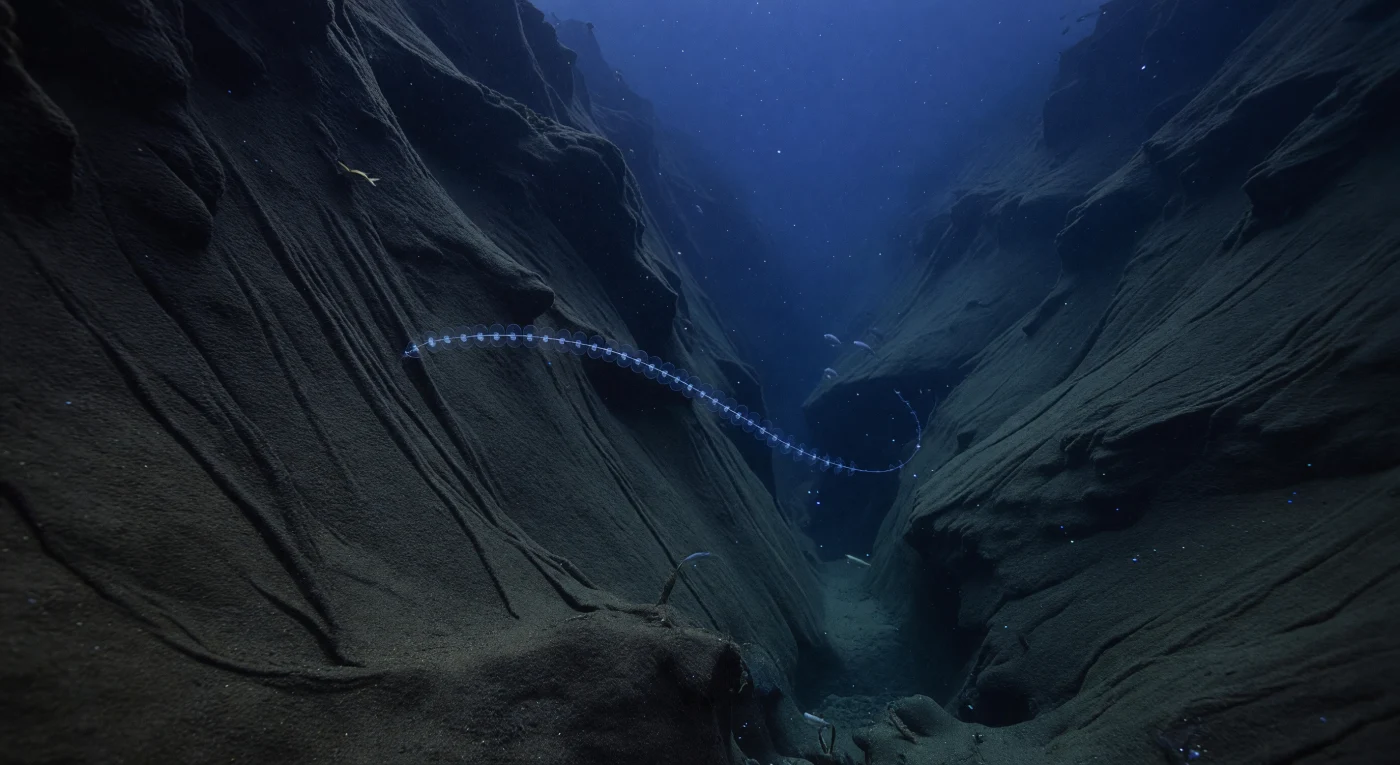
At roughly 340 meters depth, the continental slope fractures into a narrow ravine where dark mud rills streak down the near wall like arrested rivers of fine sediment, and ledges draped in pale silt overhang small slump scars — the quiet evidence of gravity's patient work on an unstable margin. Residual downwelling light, filtered to a cold monochromatic blue by hundreds of meters of water above, barely reaches this confined gash in the slope, fading to near-black against the opposite wall where the ravine swallows all illumination. Here, at roughly 35 atmospheres of pressure, the water is not empty but animated by a slow drift of marine snow — organic particles, diatom fragments, fecal pellets — descending through a column that supports an entire community of organisms evolved for perpetual twilight. Suspended in the middle distance, a meter-long siphonophore hangs almost imperceptible against the sedimented wall, its colonial body a chain of specialized zooids — nectophores, dactylozooids, gonozooids — each transparent enough that the ravine shows through it, betrayed only by faint refractive edges where gelatinous tissue bends the ambient blue. These colonial cnidarians drift as passive hunters through the mesopelagic, trailing tentacles across cubic meters of water in a silence that has never needed a witness.