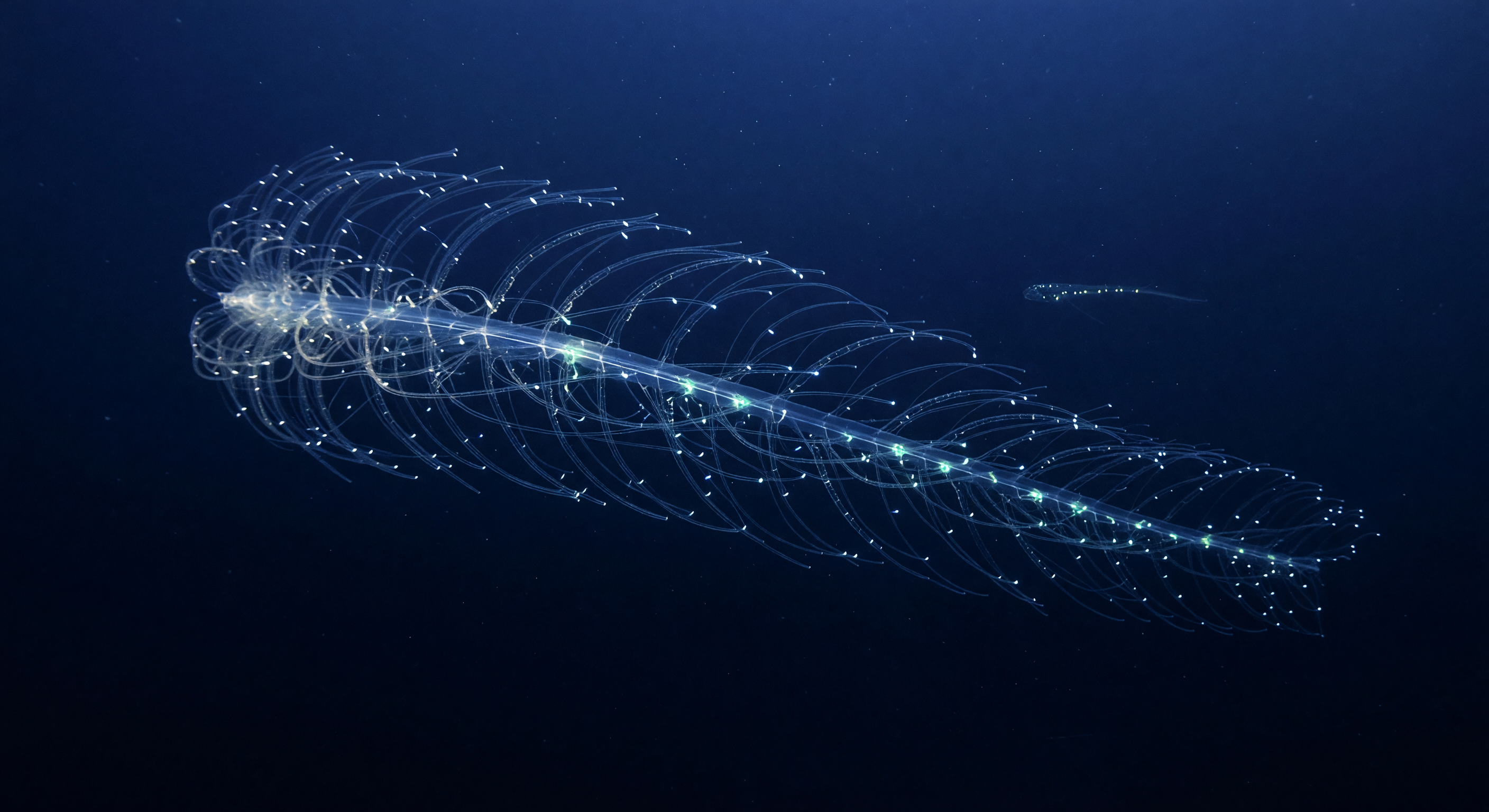
At five hundred to seven hundred meters beneath the surface, the last geometry of sunlight dissolves into a featureless cobalt gradient — not darkness exactly, but a slow erasure of wavelength, pressure mounting to sixty or seventy atmospheres against every transparent body suspended in the column. Here, a giant siphonophore — perhaps forty meters in total extent, one of the longest organisms on Earth — has deployed its feeding curtain across the open water, a colonial superorganism whose individual zooids are so optically clear that the entire structure exists as negative space until bioluminescence betrays it: turquoise pulses travel along the pneumatophore stem and thread outward through a vast lattice of hair-fine tentilla, each pulse a coordinated electrochemical signal propagating through shared tissue, briefly illuminating nodes and gelatinous nectophores like cold fire moving through glass. Where microscopic copepods and larval fish brush the nearly invisible tentilla, the contact triggers tiny blue-green sparks — defensive and predatory photochemistry firing simultaneously, luciferin oxidizing in milliseconds, the prey's own disturbance becoming the mechanism of its capture. Marine snow drifts slowly downward through the scene, particles of aggregated organic matter descending at centimeters per minute, and somewhere in the middle distance a viperfish traces its own quiet arc, its ventral photophores forming a dim constellation that mimics the downwelling light, a counter-illumination strategy perfected across millions of years in a world that has always been exactly this dark, this pressured, and this entirely its own.
Other languages
- Français: Rideau Chasseur Siphonophore
- Español: Cortina Cazadora Sifonóforo
- Português: Cortina Predatória Sifonóforo
- Deutsch: Siphonophoren Fanggardine
- العربية: ستارة صيد السيفونوفور
- हिन्दी: साइफोनोफोर शिकार पर्दा
- 日本語: クダクラゲの捕食カーテン
- 한국어: 관해파리 포식 커튼
- Italiano: Tenda Predatrice Sifonoforo
- Nederlands: Sifonofoor Vangstgordijn