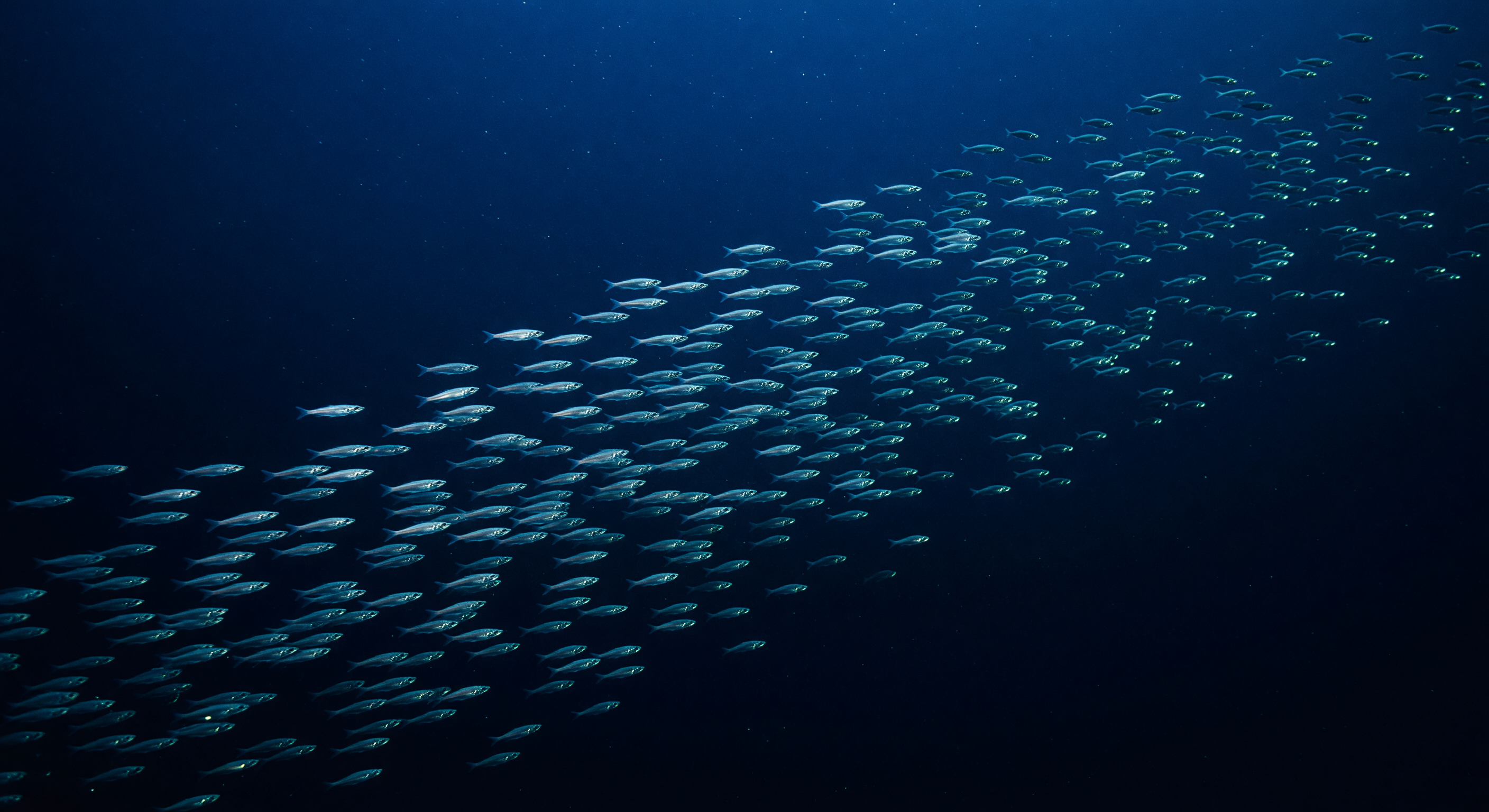
Between roughly 200 and 1,000 metres below the surface, sunlight surrenders its full spectrum to the sea, leaving only a residual cobalt frequency that grows fainter with every metre of descent — a monochromatic twilight that the mesopelagic zone wears like a permanent dusk. Through this attenuated glow, a vast ascending sheet of myctophid lanternfish — among the most numerically abundant vertebrates on Earth — rises through the open water column in a broad, layered migration, each small silvery body no longer than a finger yet carrying along its flanks and belly a precise arrangement of photophores that fire blue-green light in species-specific geometric patterns. At this depth, atmospheric pressure has been multiplied dozens of times over, the cold intensifies, and the faint marine snow of organic particles drifts in every direction through water that is neither dark nor lit but suspended in an intermediate state the ocean sustains without interruption. The collective bioluminescence of the school transforms the surrounding volume into a trembling lattice of living points, individual glows close enough to faintly illuminate neighbouring scales, translucent fins, and dark glassy eyes, the photophores functioning simultaneously as camouflage against the residual downwelling light and as recognition signals within the school. This world of orchestrated light and silent vertical motion has persisted across geological time, entirely indifferent to observation, a breathing architecture of biology and physics that the ocean enacts each day and night on its own terms.
Other languages
- Français: Voile de Poissons Lanternes
- Español: Velo de Peces Linterna
- Português: Véu de Peixes Lanterna
- Deutsch: Aufsteigender Laternenfisch Schleier
- العربية: حجاب سمك الفانوس
- हिन्दी: उठता लालटेन मछली आवरण
- 日本語: 昇るハダカイワシの帳
- 한국어: 떠오르는 등불고기 장막
- Italiano: Velo di Pesci Lanterna
- Nederlands: Rijzend Lantaarnvis Sluier