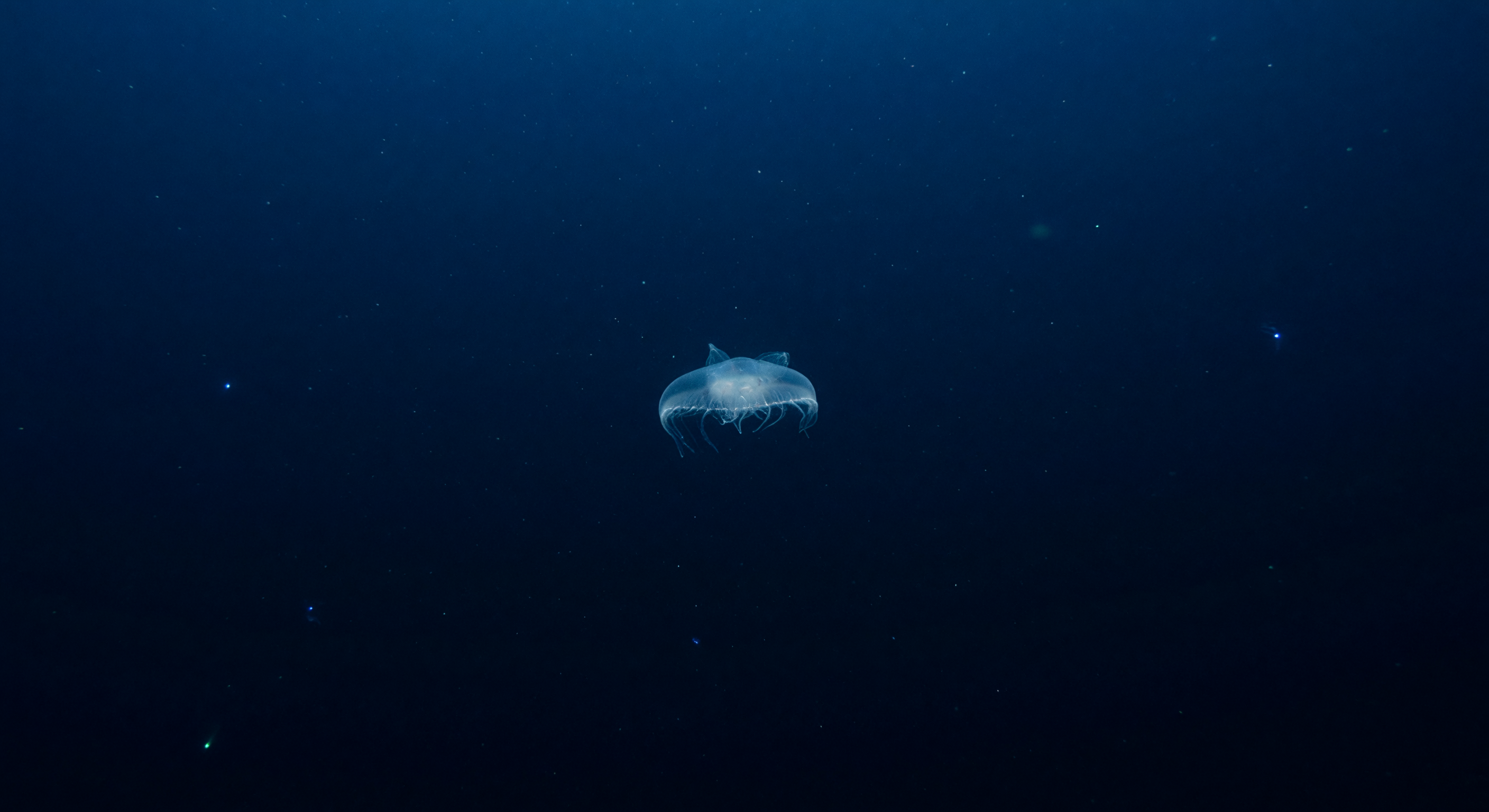
At roughly 400 to 600 metres below the surface, the last traces of sunlight arrive as a cold, attenuated cobalt wash — monochromatic, dimensionless, and so faint that it barely defines the water itself. Within this twilight column, a lobate ctenophore drifts in perfect suspension, its body a near-invisible architecture of gelatinous tissue: broad oral lobes unfurled like soft petals, fine auricles trailing behind, and eight comb rows arrayed along its flanks as delicate pearly ribs that catch the residual downwelling blue with the quietest possible luminosity, not glowing so much as simply being revealed. At these depths, pressure exceeds 50 atmospheres and temperatures drop toward 4 or 5 degrees Celsius, yet the mesopelagic zone teems with life adapted to this permanent dusk — ctenophores, copepods, lanternfish, siphonophores, and countless organisms capable of producing their own cold light through luciferin-luciferase chemistry. Farther back in the water column, isolated bioluminescent bursts from planktonic organisms punctuate the fading blue-black like brief cold sparks scattered at different depths, each one a flash of chemical light that may serve as a lure, a warning, or a startle defence in a world where visibility itself is a scarce and dangerous resource. Fine marine snow — the slow rain of organic particles descending from the sunlit surface — drifts freely through the scene, and the ctenophore moves among it all without sound, without urgency, in a silence so complete and a darkness so nearly total that this entire living world might as well exist on another planet.
Other languages
- Français: Rangées et Éclairs Brillants
- Español: Filas y Destellos Brillantes
- Português: Fileiras e Flashes Bioluminescentes
- Deutsch: Kammreihen und Lichtblitze
- العربية: صفوف مشطية وومضات
- हिन्दी: कंघी पंक्तियाँ और चमकें
- 日本語: 櫛の列と閃光
- 한국어: 빗살 줄기와 섬광
- Italiano: File di Pettine e Bagliori
- Nederlands: Kamrijen en Lichtflitsen