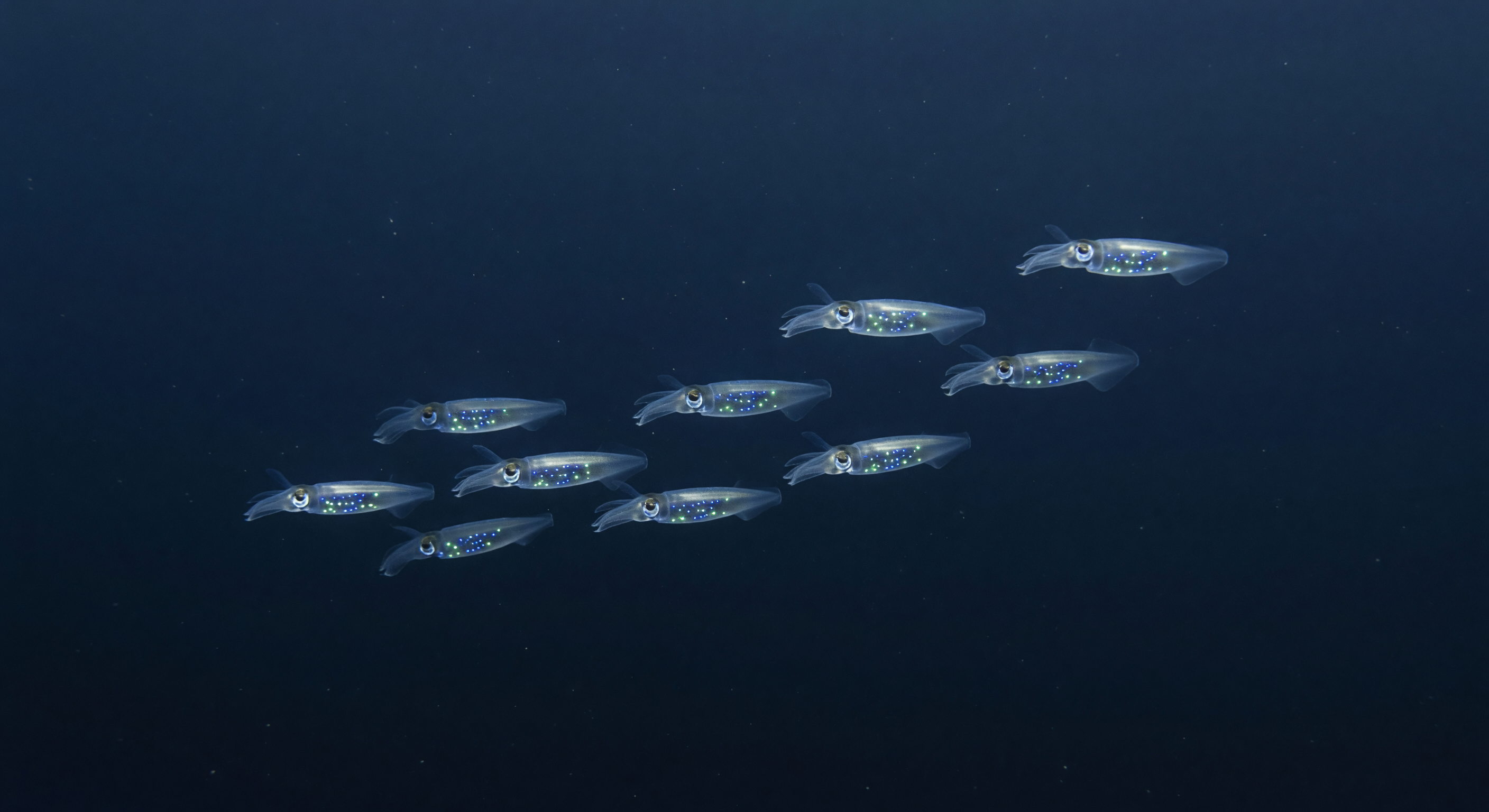
At depths where sunlight dissolves into a dim, diffuse blue and pressure climbs to tens of atmospheres, a small procession of jewel squid — likely *Histioteuthis* or a closely related enoploteuthid — crosses open midwater on a diagonal path through the pelagic void. Each compact animal, no longer than a human hand, carries rows of photophores along its ventral mantle and arm crowns that pulse in crisp blue-green points, some firing in synchrony, others offset in a scattered, asynchronous constellation of living light — a display thought to function in counterillumination, breaking up the squid's silhouette against the faint residual downwelling that still penetrates from far above. That residual light, attenuated to a near-monochromatic twilight blue and carrying only a fraction of a percent of surface intensity, renders the animals as faint glassy silhouettes, their transparent tissues and large dark eyes betraying the visual arms race that has shaped midwater fauna across hundreds of millions of years. Sparse marine snow — disaggregated organic matter sinking from the productive surface — drifts freely between the squid, each particle a reminder that this column of cold, oxygen-minimum water is neither empty nor inert but a living highway of vertical migration and chemical flux. Here, in the absolute silence of the open ocean's interior, bioluminescence is not spectacle but ecology — the primary currency of visibility, predation, and concealment in a world that has never required the sun.
Mesopelagic bioluminescence