Scientific confidence: High
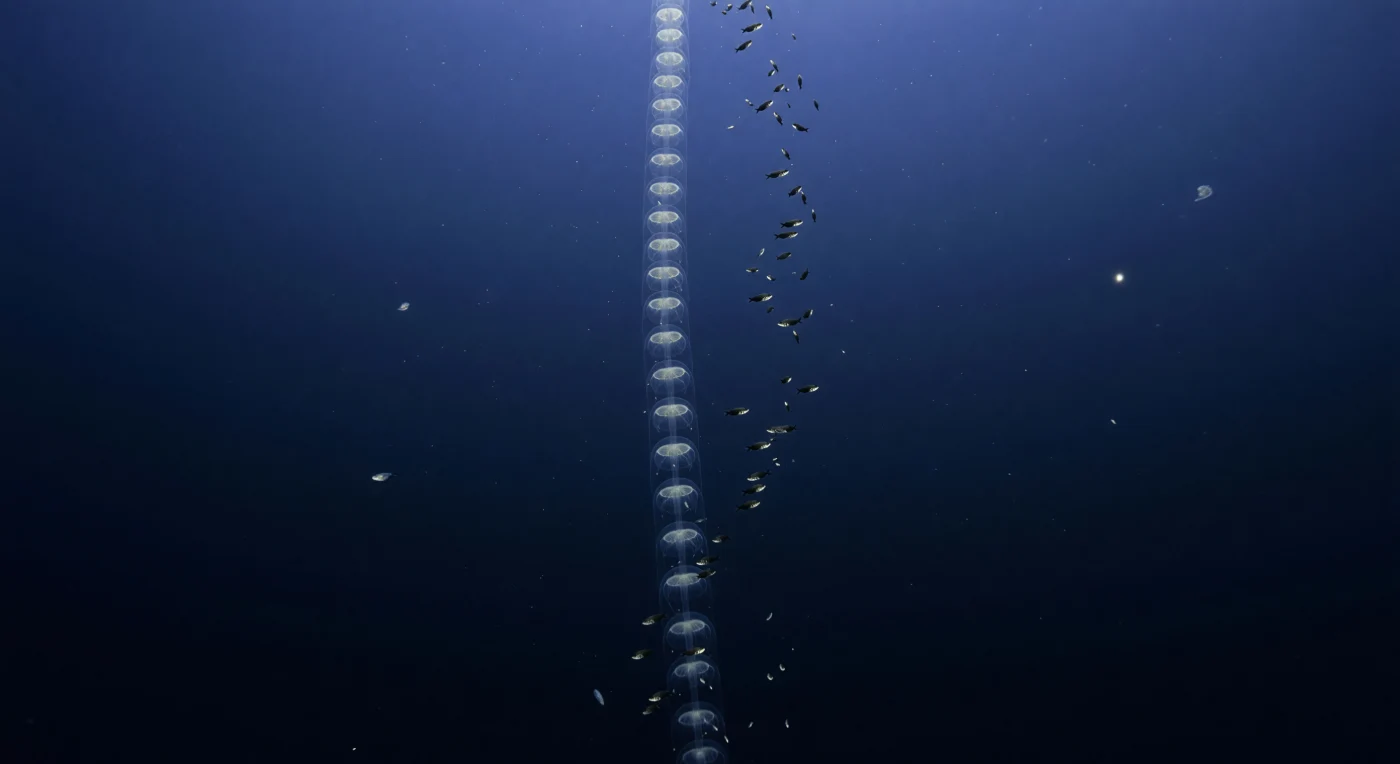
At around 400 to 600 metres depth over a continental slope, where the last faint traces of solar blue still descend from far above before surrendering entirely to blackness, a *Praya dubia* colony hangs almost perfectly vertical through the water column — one of the longest animals on Earth, its transparent nectophores arranged like hollow bells of near-invisible glass, each unit catching the weak ambient light only as a faint opaline rim before dissolving back into indigo. Pressures here exceed fifty atmospheres, and the cold — close to six or seven degrees Celsius — slows the world to a patient stillness, favouring exactly this kind of low-metabolism, near-massless body plan, built mostly of mesoglea and seawater, requiring almost no energy to maintain neutral buoyancy across hundreds of metres of open pelagic space. Beside the colony, a loose aggregation of lanternfish — likely *Myctophum* or *Diaphus* species undertaking their diel vertical migration toward the surface — ascends through the water column, their ventral photophores arranged in species-specific patterns that function as counter-illumination against the residual downwelling glow, their small silvery-black forms reading as clean silhouettes against a ceiling of dying light. In the far background, scattered bioluminescent pinpoints mark the presence of other gelatinous life — ctenophores, copepods, fragmentary colonial organisms — while fine marine snow, the slow rain of organic particles from the productive waters above, drifts freely through a space that is immense, pressurized, and entirely indifferent to any witness.
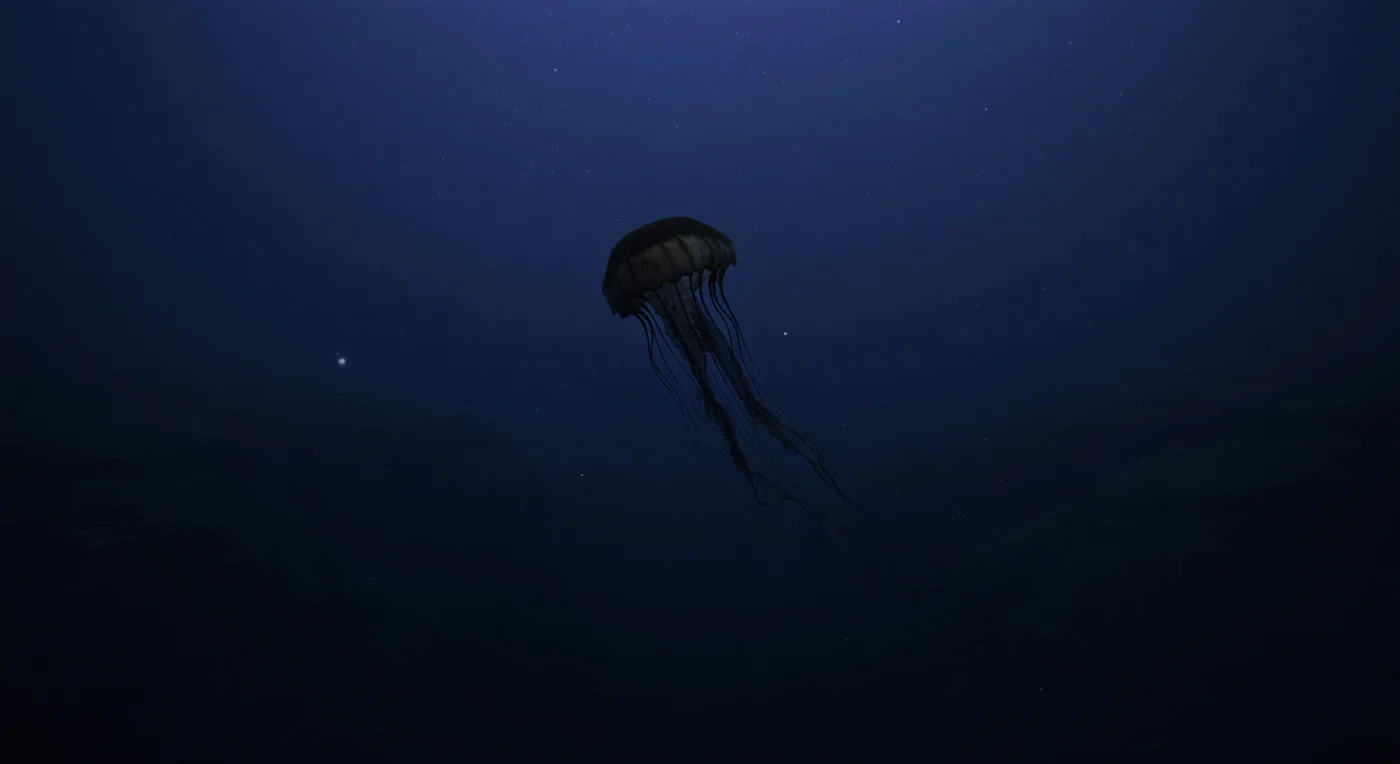
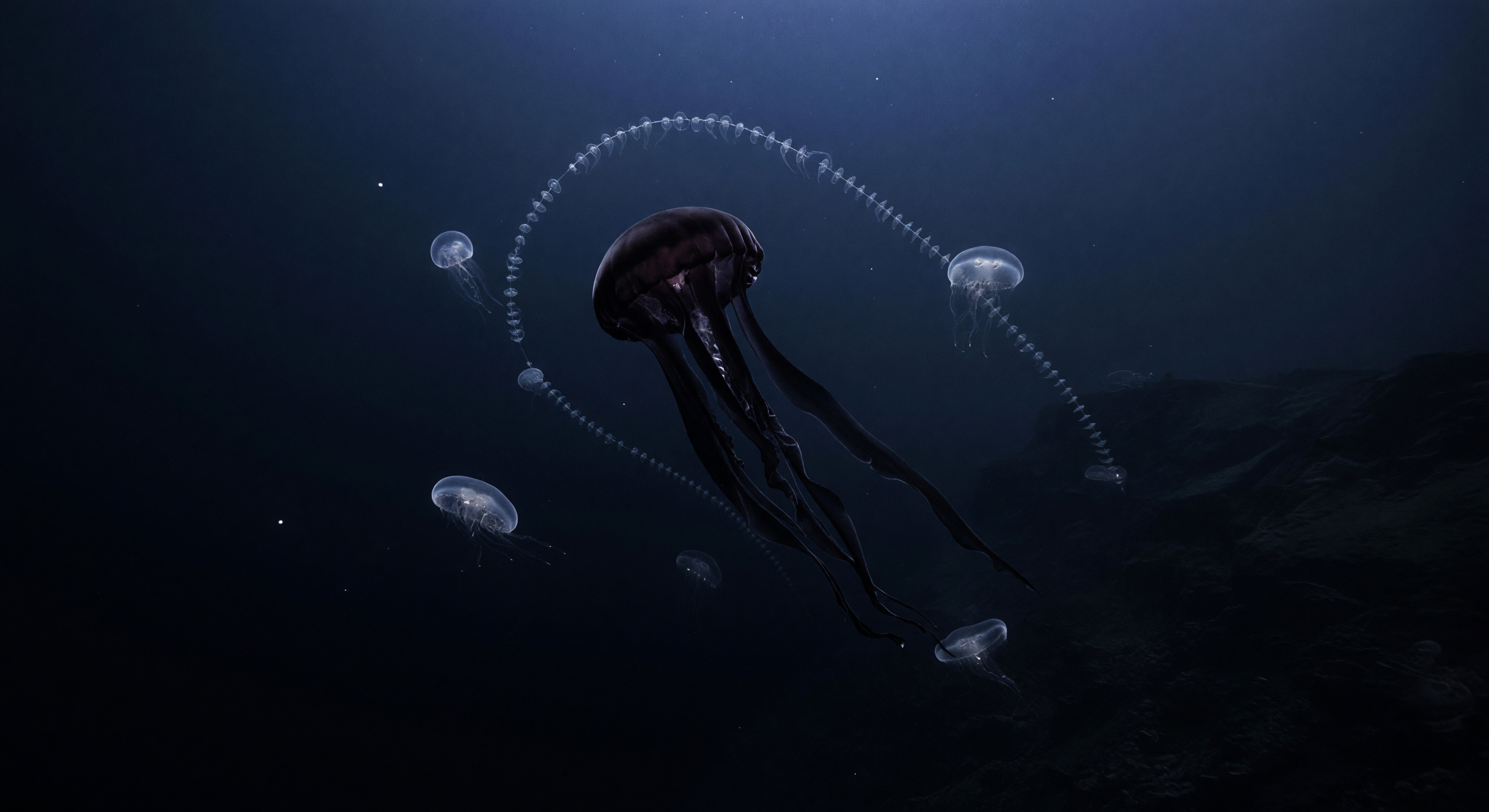
At somewhere between two hundred and six hundred metres below the surface, where the last residual sunlight has been stripped of every wavelength except a fading cobalt gradient, *Stygiomedusa gigantea* drifts in near-total silence above the softened flank of a continental-slope canyon. Its bell can exceed one metre across, yet the animal is almost entirely water, its dark wine-toned tissues hovering at near-neutral buoyancy without any rigid structure, the four enormously elongated oral arms descending several metres below it through the marine snow — a continuous, slow precipitation of organic detritus that carries fixed carbon from the sunlit surface into the deep. At these pressures, exceeding fifty atmospheres, the water column is cold, typically five to nine degrees Celsius, stratified into distinct density layers that concentrate micronektonic prey and create invisible architecture through which *Stygiomedusa* moves by gentle pulsation, sweeping small crustaceans and fish larvae passively against its ribbon-like arms. The canyon wall behind it recedes into blue-black indistinction, its geology — slumped sediment, exposed carbonate, the geological memory of a continental margin — barely legible against the depth gradient. Scattered across the far darkness, a few cold bioluminescent sparks mark the presence of other organisms advertising nothing to us, communicating only among themselves in a world that has proceeded, unchanged, without witness.
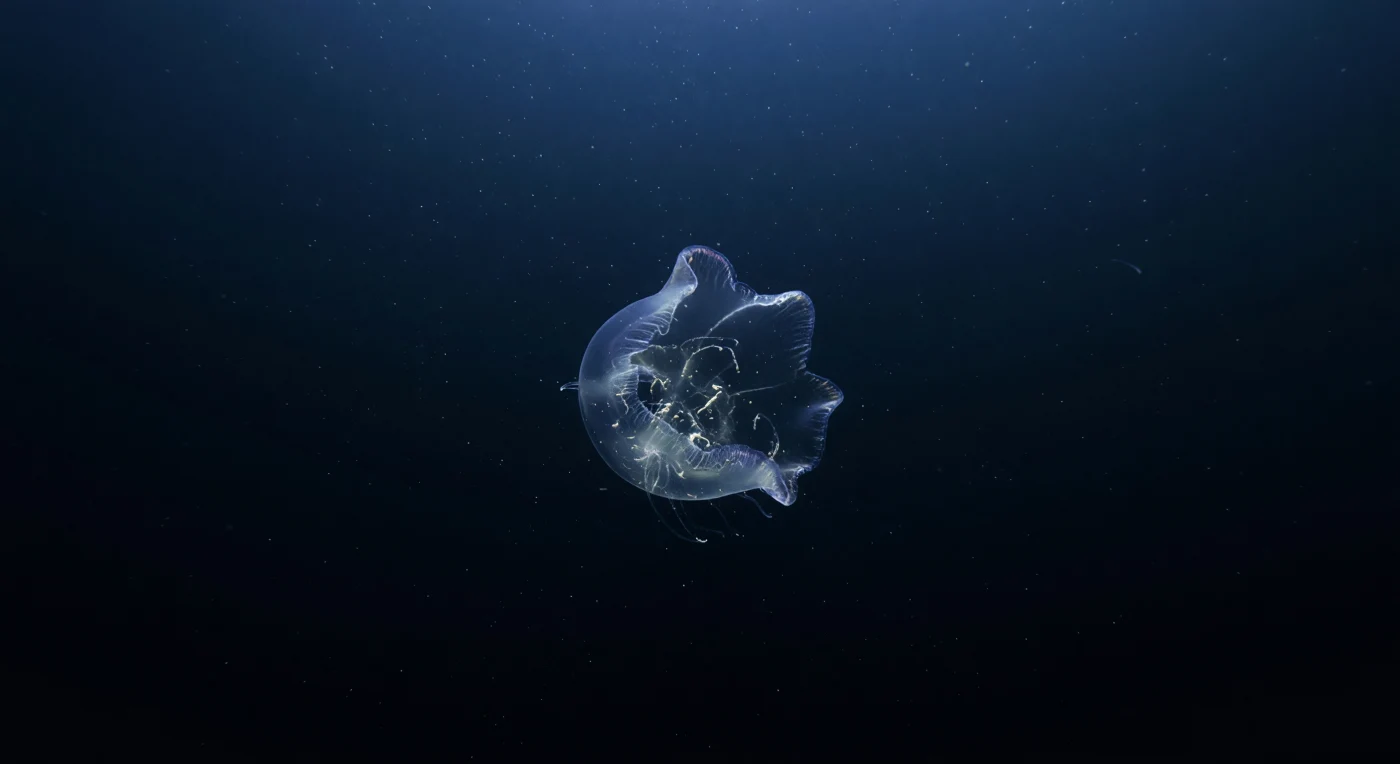
At around 400 metres depth over a continental slope, where the last whisper of sunlight filters down as a barely perceptible cobalt gradient fading into absolute darkness below, a large *Thalassocalyce* ctenophore hangs motionless in the pressurized midwater column — roughly 41 atmospheres bearing silently on its almost entirely aqueous body. Its paired oral lobes have spread wide into the characteristic feeding-cup posture, forming a translucent dome of nearly invisible tissue around a small concentration of planktonic prey, tiny crustaceans suspended inside the gelatinous cavity as though caught in glass. Where the faint residual downwelling light grazes the ruffled membrane edges, violet-blue interference colours ripple in restrained iridescence along the comb rows — not bioluminescence, but the structural optics of extraordinarily thin tissue refracting what little ambient photons still exist at this depth. Around it, the mesopelagic water column stretches away in every direction as a dim, particle-dusted silence, interrupted only by the occasional cold pinpoint of bioluminescent light from organisms deeper in the darkness, where sunlight no longer reaches at all. This is a world of near-perfect stillness, where gelatinous animals have found enormous evolutionary success precisely because their fluid bodies cost almost nothing to maintain, their transparency renders them effectively invisible, and the layered density structure of the water column concentrates the prey that sustains them.
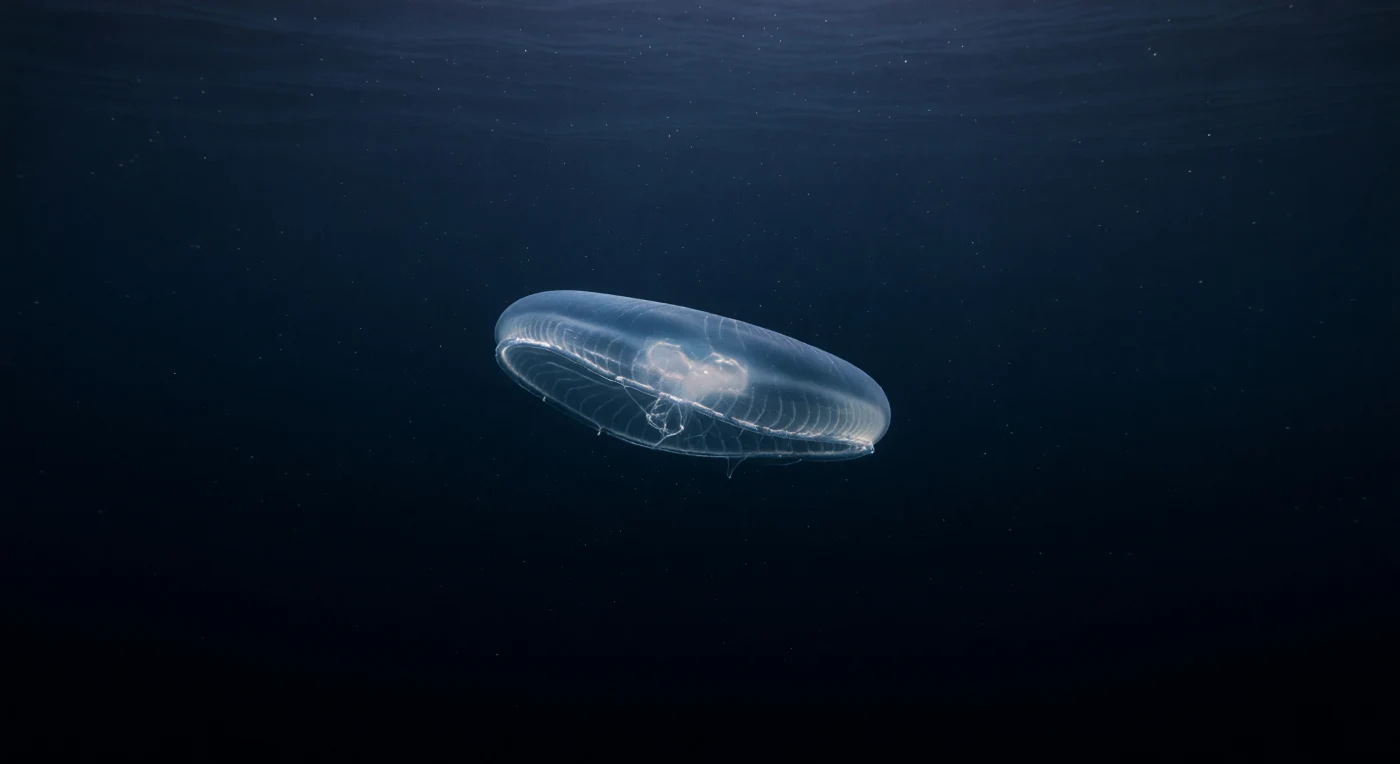
At roughly 400–500 meters beneath the surface, where hydrostatic pressure exceeds 50 atmospheres and the last attenuated photons of sunlight arrive as little more than a cold cobalt memory overhead, a *Bathocyroe* ctenophore drifts bowl-upward through open midwater, its hemisphere of living tissue so nearly water that it vanishes entirely into the surrounding sea except where its comb rows catch that faint overhead gradient and scatter it into ghost-thin bands of iridescent cyan and violet. Ctenophores of this genus are among the most mechanically fragile macroanimals in the ocean — bodies composed almost entirely of mesoglea, the gelatinous matrix that makes them near-neutrally buoyant and immune to the crushing pressures that would destroy gas-filled tissues — and they hunt by holding their translucent bowl open to intercept copepods and other small crustaceans drifting on the same stratified layers. Around it, marine snow descends in slow suspension through thermally stratified water, tracing the invisible density boundaries of an intermediate water mass flowing along the continental slope far below, while scattered bioluminescent pinpricks flicker at distance in the blackness — the chemical light of other organisms, the only illumination that truly belongs to this depth. This is the permanent condition of the mesopelagic twilight world: a vast, pressured, nearly lightless pelagic volume where gelatinous life thrives in silence precisely because no hard structure, no large gas space, and no high metabolic demand is required — only water shaped into life, suspended between a dying blue ceiling and the absolute dark below.
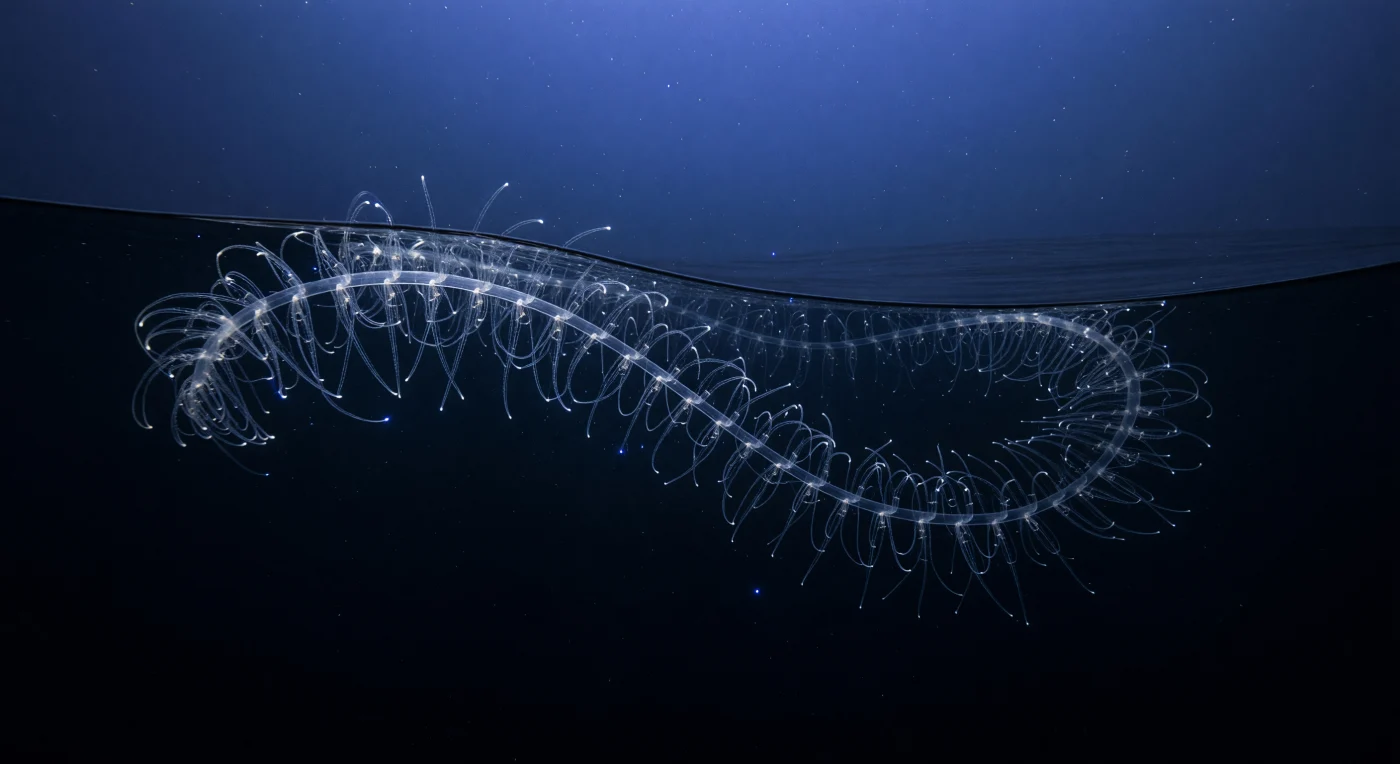
At around 450 to 600 metres over a continental slope, where pressure reaches roughly 50 atmospheres and the last faint traces of surface blue dissolve into surrounding blackness, an *Apolemia* siphonophore colony of extraordinary length curves through a sharp pycnocline in a slow, gravitational S — its transparent stem and thousands of specialised zooids, nectophores, dactylozooids, and trailing tentilla forming a suspended lattice of near-invisible tissue, refracting the dim overhead cobalt into silvery filaments and cold iridescent glints. A physonect siphonophore is not a single organism but an integrated supercolony of genetically identical yet functionally differentiated individuals, each polyp performing a specific task — propulsion, feeding, reproduction, defence — so that the whole structure operates as a coherent predatory entity capable of spanning tens of metres through open water. The pycnocline itself is rendered faintly visible as an optical interface, a stratified boundary where water masses of slightly different density and particle load meet, warping the background in subtle waves and concentrating marine snow into a thin suspended layer that drifts without any external force through the cold, still column. Sparse blue bioluminescent pinpricks punctuate the surrounding water and catch among the colony's branches like scattered stars, produced by the incidental flashes of copepods, dinoflagellates, and small gelatinous neighbours, each a brief chemical signal in an otherwise lightless realm. This is a world of near-perfect silence and immense hydrostatic weight, where a creature made almost entirely of seawater hangs suspended in seawater, filtering the dark for prey, entirely indifferent to any witness.
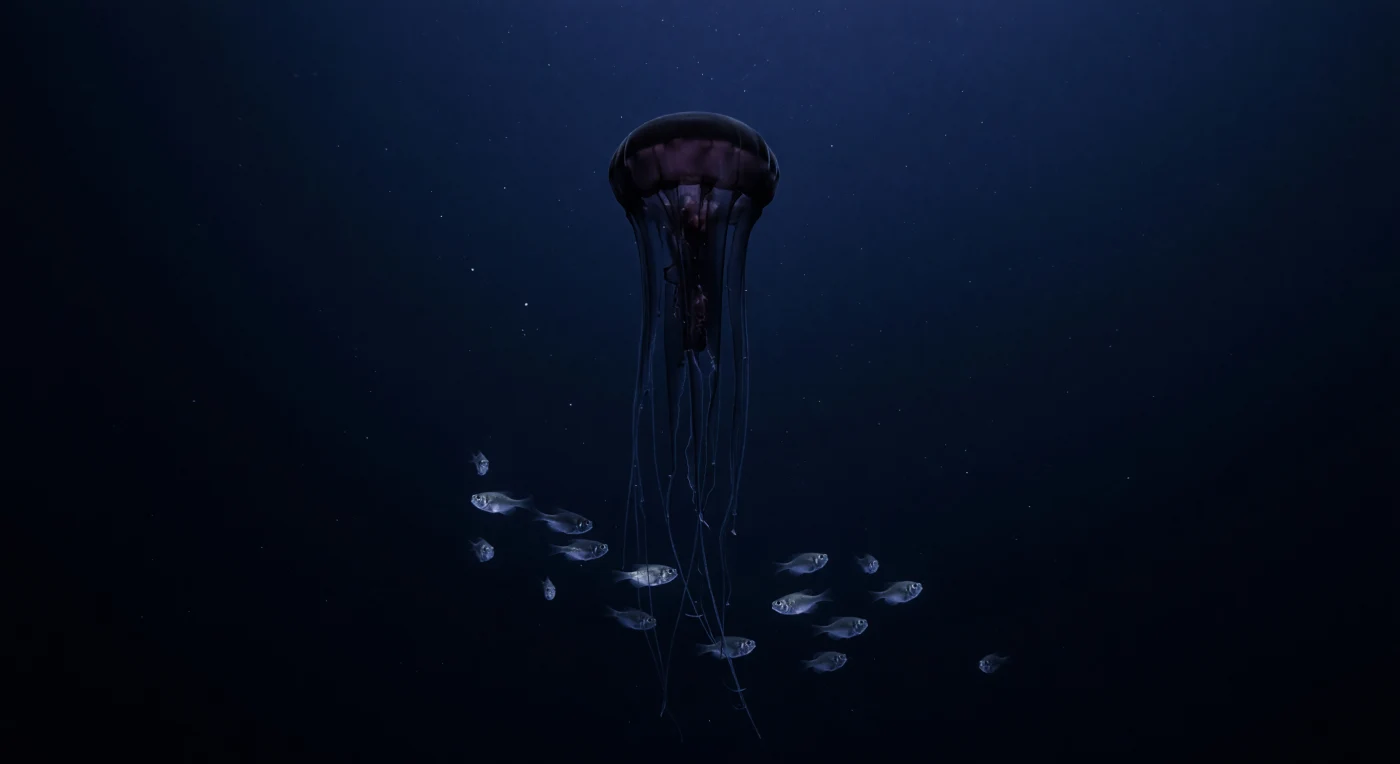
At roughly 400 to 600 metres depth over a continental slope, where residual sunlight has narrowed to a faint cobalt gradient barely distinguishable from the surrounding darkness, *Stygiomedusa gigantea* drifts in near-neutral buoyancy, its broad, softly domed bell — dark burgundy where internal structure absorbs the last trace of downwelling blue — trailing four immense oral arms that fall in loose, asymmetric curtains through cold, stratified water near 7°C and at pressures exceeding 50 atmospheres. Beneath those ribbons, a compact school of lanternfish (*Myctophidae*) cuts laterally through the water column, their laterally compressed silver flanks and enlarged dark-adapted eyes catching the ambient blue for a fraction of a second before the fish dissolve back into the monochromatic field; their presence here is part of a daily vertical migration cycle that connects sunlit surface productivity to the deep midwater through the bodies of countless small, lipid-rich fish. Fine marine snow — disaggregating fecal pellets, mucus threads, and cellular debris — drifts unimpeded through the scene, tracing the slow, continuous rain of organic matter that sustains this community in permanent near-darkness. The jelly itself is almost entirely water, its mesoglea offering no compressible gas spaces to resist the pressure, an evolutionary solution so efficient it has persisted essentially unchanged across geological time. The whole encounter is silent, self-contained, and utterly indifferent to any outside witness.
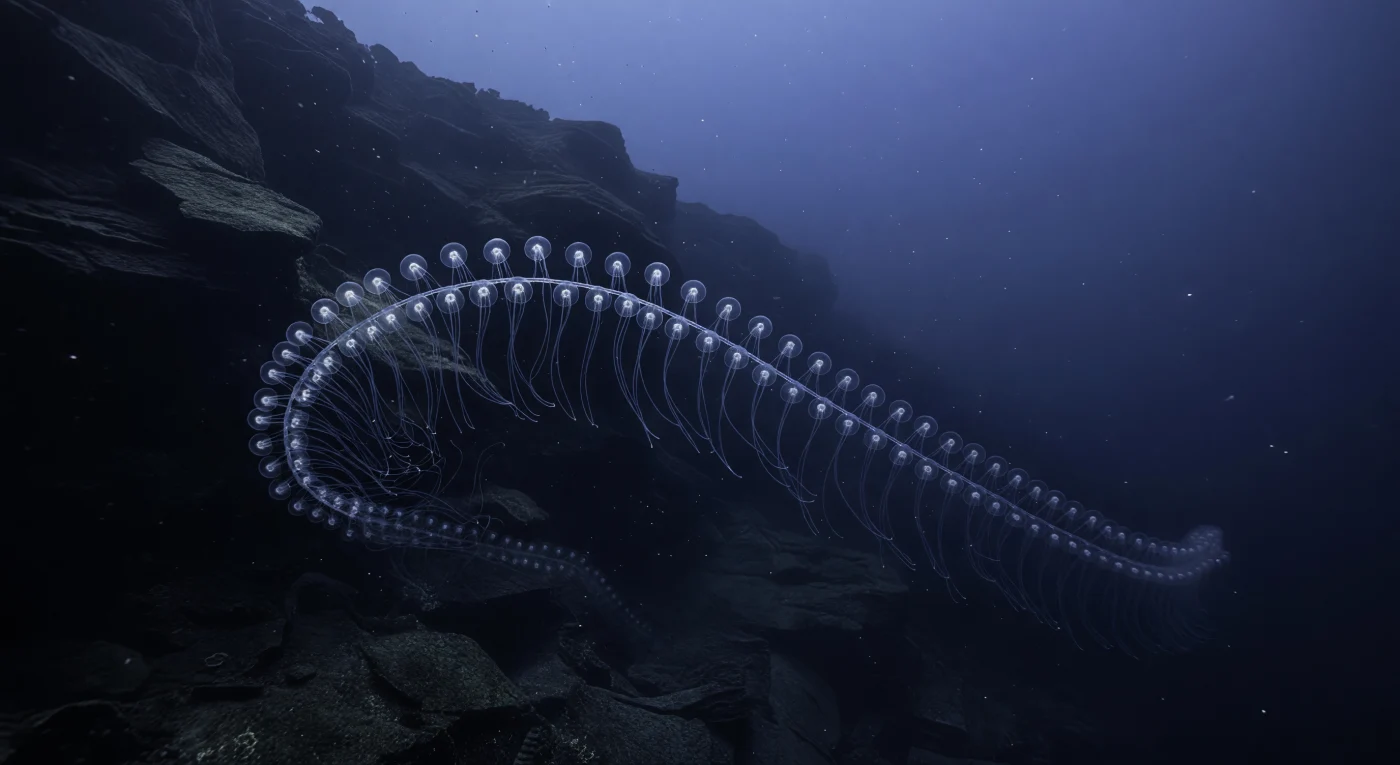
Along the gradual incline of a continental slope, a physonect siphonophore — likely *Praya dubia* or a close relative — extends its colonial body in a long, arcing chain through water that has not seen useful sunlight in hundreds of meters. Each nectophore bell is a lens of near-perfect transparency, catching only the faintest residual blue from far above, where daylight still exists as a concept rather than a reality; at these depths, pressure has climbed to fifty atmospheres or more, cold enough and heavy enough that only animals built almost entirely of water can afford to exist here at all. The siphonophore is not a single organism in any familiar sense but a superorganism — a chain of genetically identical zooids each specializing in propulsion, feeding, or reproduction — and its trailing tentilla fan in fine, silent veils against the distant rock wall of the slope, a dark geometry of ledges and faulted planes that descends without apparent end into blue-black depth. Around it, marine snow drifts in all directions at once, the slow rain of organic particles from the productive world far above, which sustains much of the mesopelagic food web in the near-absence of photosynthesis. Scattered cold pinpricks of bioluminescence mark other unseen bodies in the surrounding water, the only light this world generates for itself — quiet, chemical, and entirely its own.
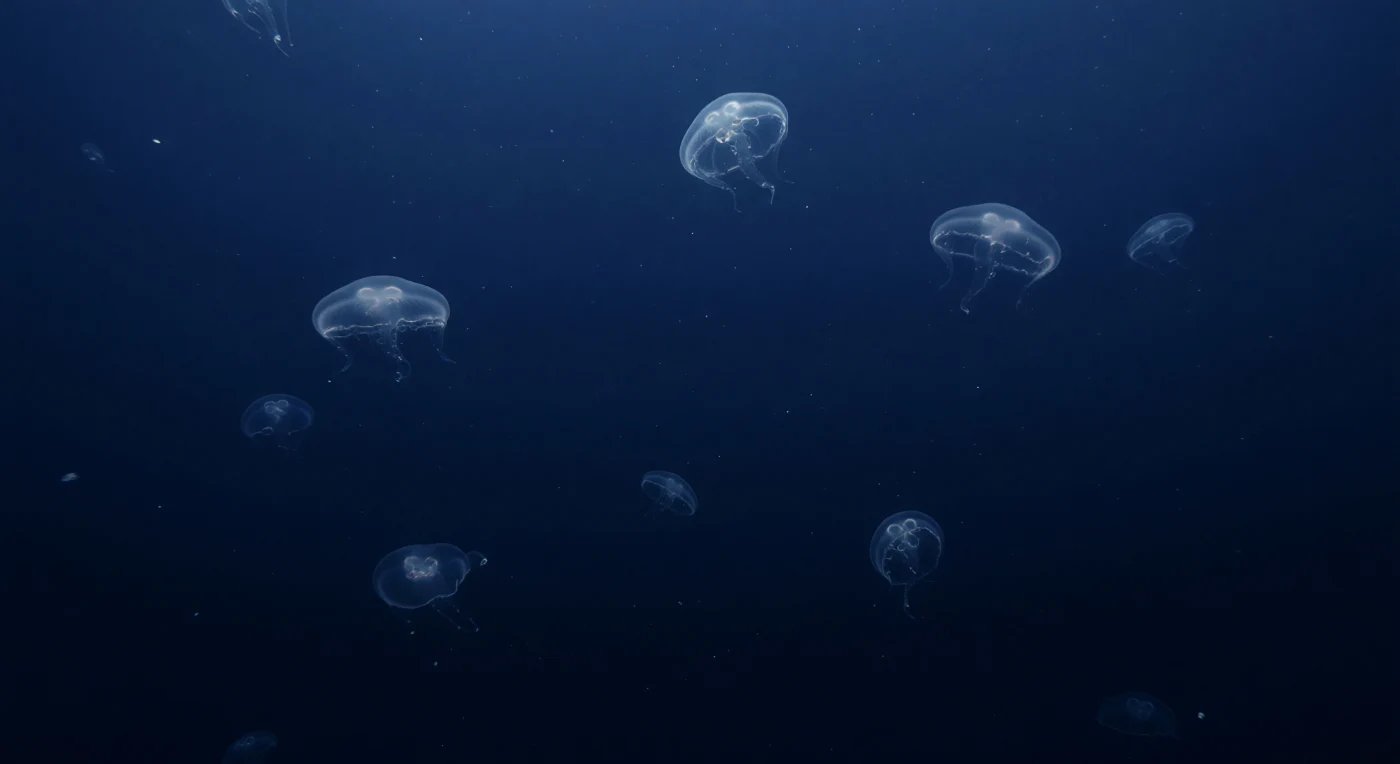
Between roughly four hundred and seven hundred meters below the ocean surface, where the last traces of sunlight have been stretched and filtered into a cold, almost colorless indigo, ctenophores drift in open water like a scattered constellation freed from any fixed plane. Species such as *Bathocyroe fosteri* and the veil-like *Thalassocalyce inconstans* are largely composed of seawater itself — gelatinous bodies with almost no solid tissue — which allows them to hover neutrally buoyant at pressures exceeding fifty atmospheres without expending appreciable energy, their entire architecture an elegant solution to a world defined by cold, stratification, and scarcity. The comb rows, each a precise rank of fused cilia called ctenes, beat in coordinated metachronal waves and scatter the faint residual downwelling light into brief prismatic threads, appearing and vanishing against the monochrome blue field like spectral notation written and erased in the same breath. Around them, marine snow — the slow, continuous fall of organic particles from the sunlit world far above — drifts through stratified water masses where pycnoclines trap prey and concentrate the thin layers on which mesopelagic food webs depend. Here, in a darkness that is neither total nor illuminated but something precisely between, these translucent giants pulse and dissolve and pulse again, tending their ancient biological business in a volume of ocean that has never required a witness.
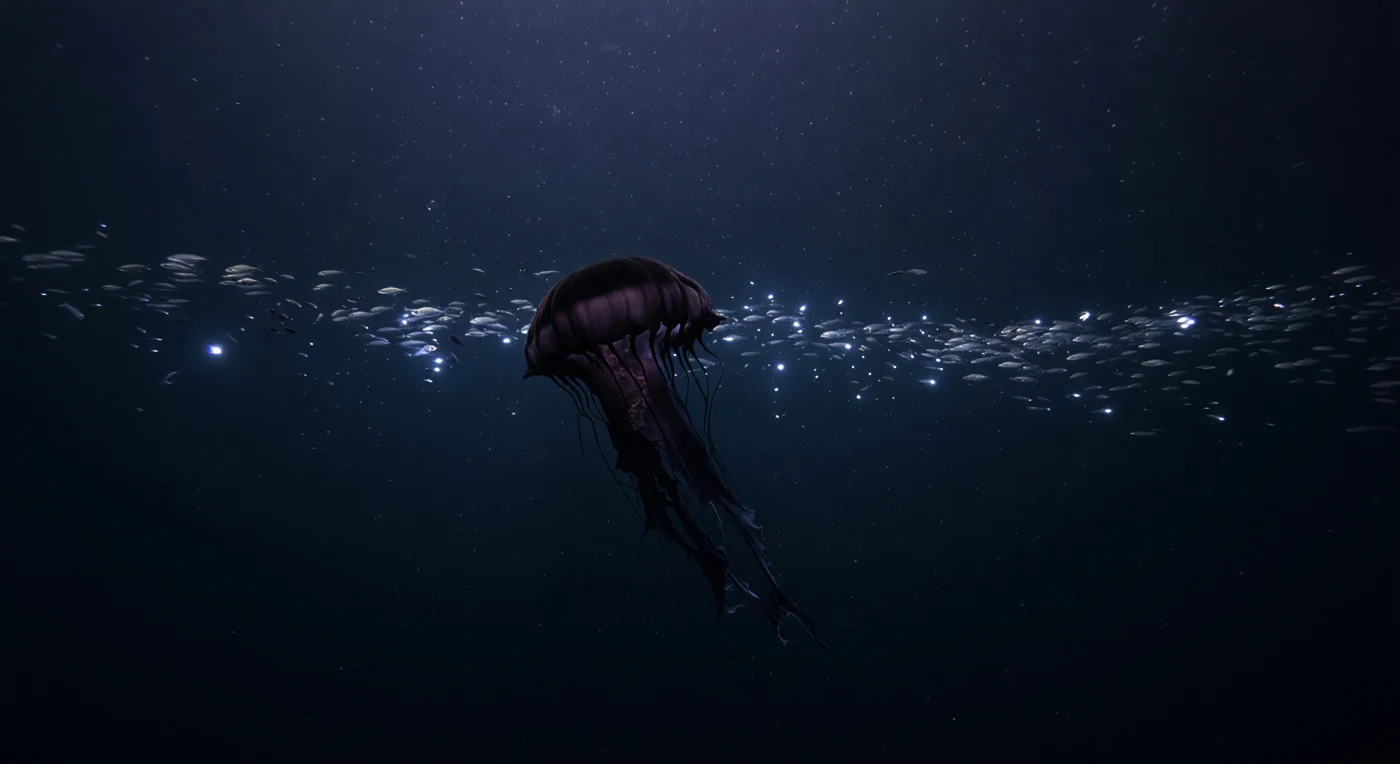
At the margin of an oxygen minimum zone over a continental slope, *Stygiomedusa gigantea* drifts through water pressing down at roughly fifty atmospheres, its broad umbrella—deep maroon fading to near-black under a light spectrum stripped of everything but the faintest residual blue—spanning more than a meter across, while immense ribbon-like oral arms trail beneath it in slow, weightless folds that require no musculature to sustain, only the patient architecture of a body that is mostly seawater. The oxygen minimum layer acts here as an ecological boundary, compressing zooplankton, larval fishes, and fragile gelatinous drifters into a thin living horizon along the density interface where conditions briefly become tolerable, a concentrated prey band that the phantom jelly navigates without active pursuit, its arms sweeping passively through the aggregation. Around this prey layer, the darkness is interrupted by sudden blue-white bioluminescent escape flashes—tiny crustaceans firing photophores or releasing luminescent clouds as a last defense, brief sparks that illuminate nothing but themselves before the blackness closes again. Marine snow drifts freely through the water column in all directions, fine particulate organic matter descending from the productive surface far overhead, each flake part of the ocean's slow biological pump transferring carbon downward into the interior. This is a world that has operated on these terms across geological timescales, cold, pressured, and fundamentally indifferent to observation, shaped entirely by chemistry, physics, and the evolutionary logic of surviving on very little light and very little oxygen.
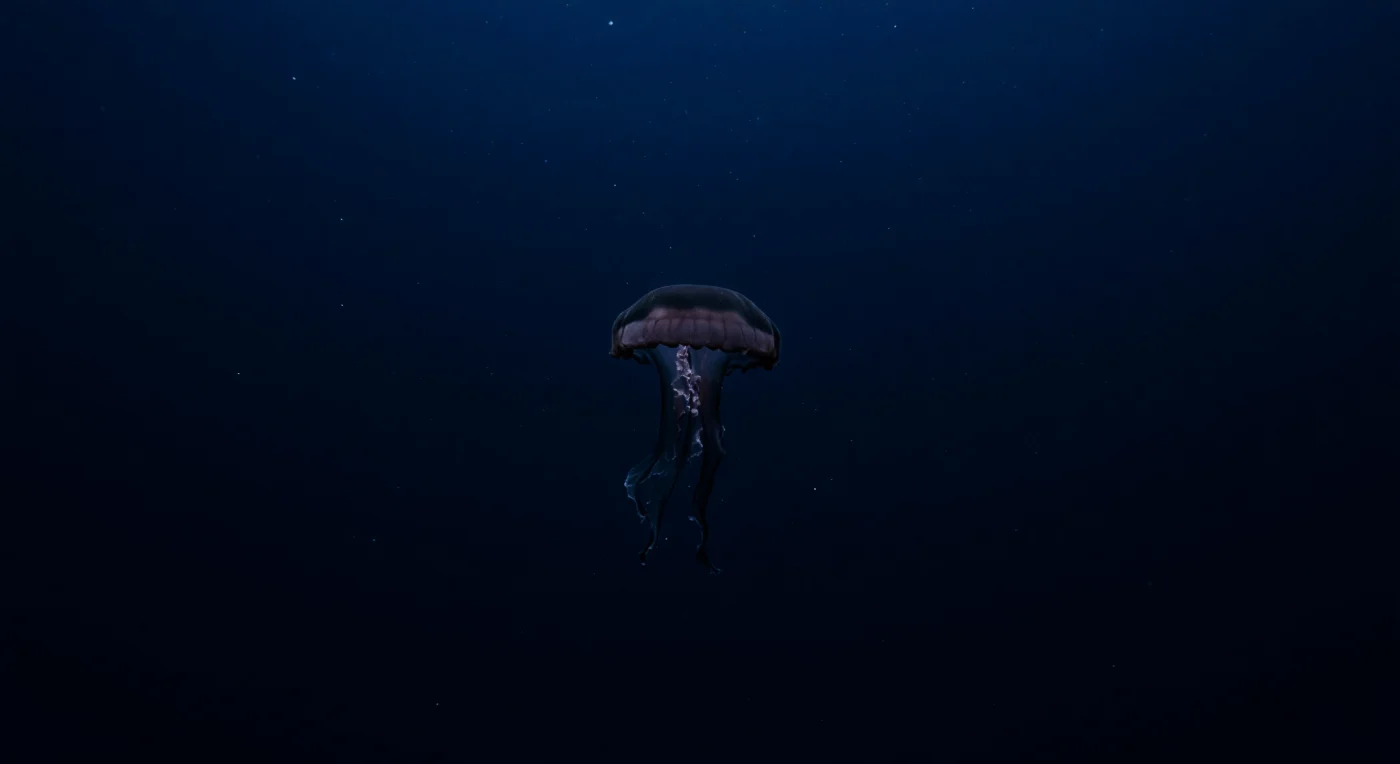
At roughly 500 to 700 meters beneath the surface, where pressure exceeds fifty atmospheres and the last measurable trace of solar energy survives only as a faint cobalt gradient dissolving overhead into absolute black below, a single *Stygiomedusa gigantea* occupies the open midwater column above an unseen continental slope — one of the largest medusae on Earth, yet belonging entirely to this void as if the ocean had willed it into being. Its broad bell, dark wine-maroon and semi-translucent, intercepts the residual downwelling blue just enough to reveal delicate internal membranes and a softly luminous rim where attenuated photons pass through gelatinous tissue only micrometers thick, while the four immense ribbon-like oral arms — which may extend several meters — curl downward and fade, unresisted, into midnight. At these depths, red wavelengths have long since been absorbed by the water column, stripping all warm color from the world and leaving *Stygiomedusa* in near-black maroon shadow, its true pigmentation irrelevant in a realm where the light that reaches it has been filtered through hundreds of meters of seawater and carries almost no energy. Sparse marine snow drifts across the frame, visible only where particles cross the thin ambient field overhead, while isolated cold bioluminescent pinpricks flicker at enormous distances in the surrounding void — other organisms, unnamed and distant — affirming that this water, cold, stratified, and largely empty, is nonetheless alive in the dark way that the mesopelagic has always been alive, long before anything evolved to witness it.
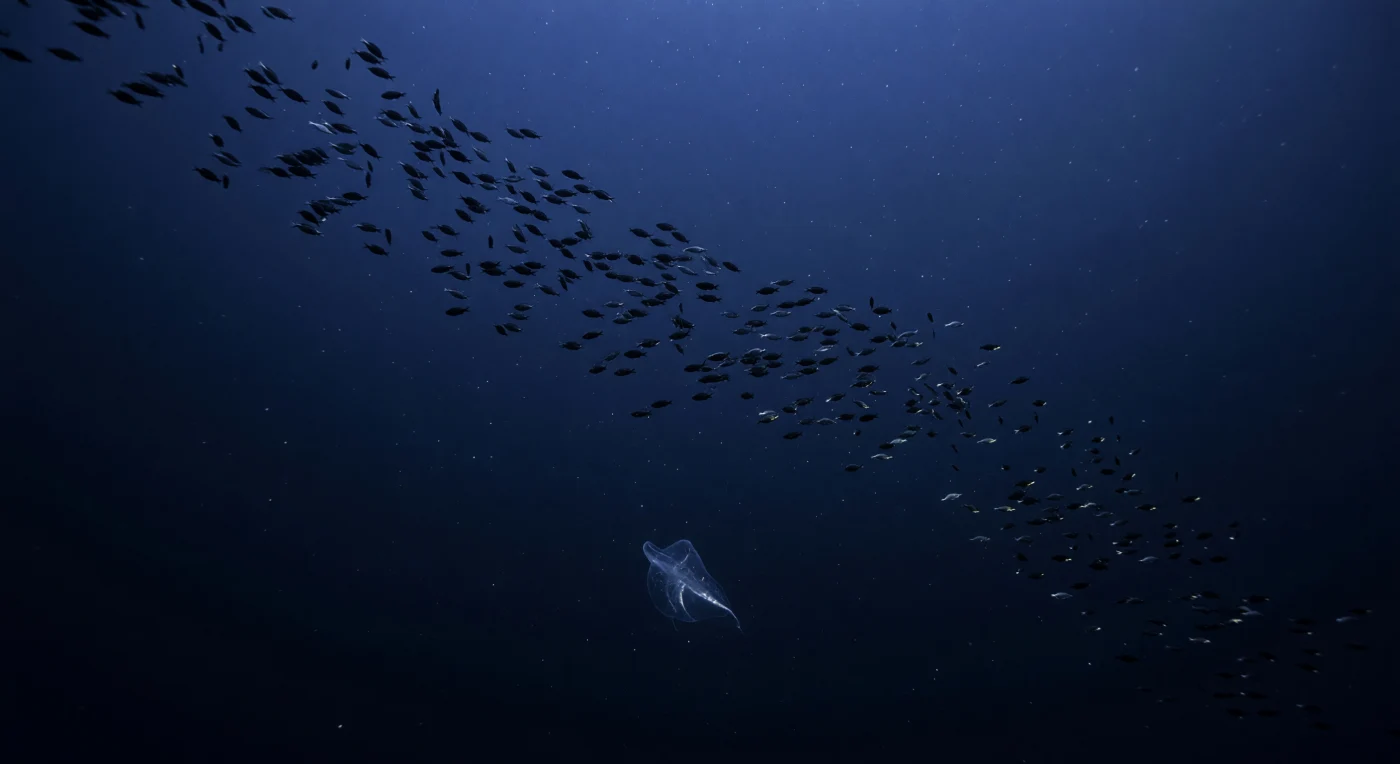
At roughly 450 to 600 metres over the continental slope, where the last ghost of surface daylight survives only as a dim cobalt gradient dissolving into black, a vast oblique curtain of lanternfish — myctophids performing their nightly vertical migration — hangs across the water column like a living veil of blue-black dust, its ribbons and loose constellations shaped by internal-wave shear, each individual fish a small dark silhouette carrying the faintest ventral photophores evolved precisely to counterilluminate against that residual downwelling blue. At this depth, pressure exceeds fifty atmospheres and temperature hovers near seven or eight degrees Celsius; the water is exceptionally clear, carrying only fine marine snow drifting in slow suspension, and the sheer three-dimensional space between organisms makes the scale of the scattering layer — a phenomenon measurable by echosounder across entire ocean basins — all the more astonishing when resolved into its constituent bodies. Below the curtain, nearly invisible until the dim overhead gradient traces its transparent lobes, a single Bathocyroe ctenophore drifts in gravitational suspension, its gelatinous body almost pure seawater by composition, and along its comb rows the mechanical beating of ctene plates splits residual light into the briefest iridescent threads — spectral needles, not bioluminescence, but structural color — that flicker and vanish. Nothing here requires a witness; this geometry of migrating fish and drifting jelly assembles and dissolves in cold silence every day and night of every year, wholly indifferent to the darkness that surrounds it.
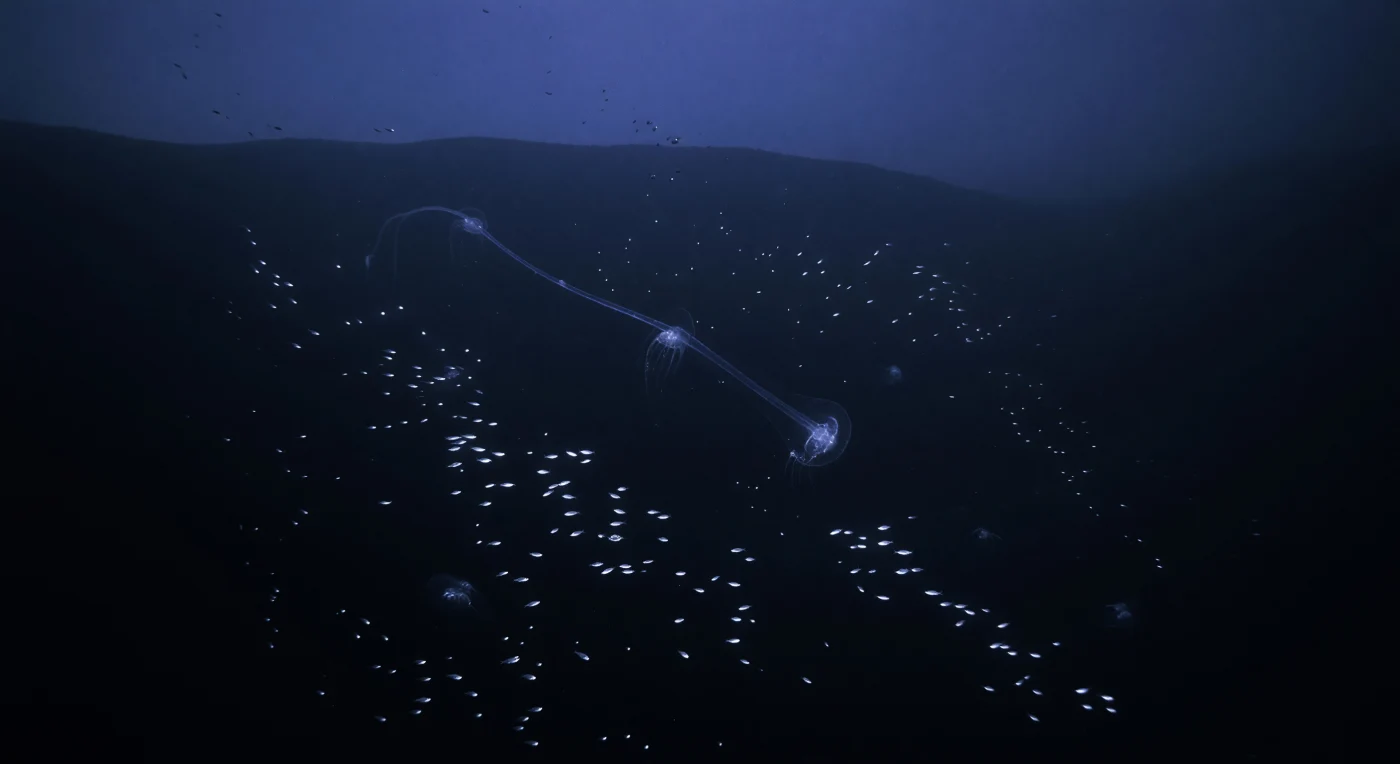
At roughly 350 to 500 metres below the surface, where the last residual blue of sunlight dissolves into a gradient indistinguishable from night, pressures exceeding 40 atmospheres press in from all sides against a world of near-weightless architecture. Here, above the shadowed crest of a continental slope, a physonect siphonophore — likely *Praya* or *Apolemia* — extends tens of metres through the water column, its gelatinous stem and trailing zooids so transparent that only the faintest scattering of dim downwelling blue reveals their presence before the colony fades entirely into the darkness below. This depth marks the upper boundary of the deep scattering layer, a living stratum of lanternfish, myctophids, and mesopelagic crustaceans that ascends nightly toward the surface in one of the ocean's largest daily migrations, their silvery flanks and photophores flickering in cold blue-white bioluminescent sparks that propagate through the rising haze like a slow, scattered electrical storm. Nearby, ctenophores drift as near-invisible bells, their comb rows catching ambient photons in brief spectral sheens, while marine snow — the slow vertical rain of organic particles from productive waters far above — drifts through the frame, each fleck a mote of chemistry descending toward the seafloor. This is an ocean that exists in total indifference to witness, governed entirely by pressure, darkness, and the ancient metabolic logic of creatures built from water itself.