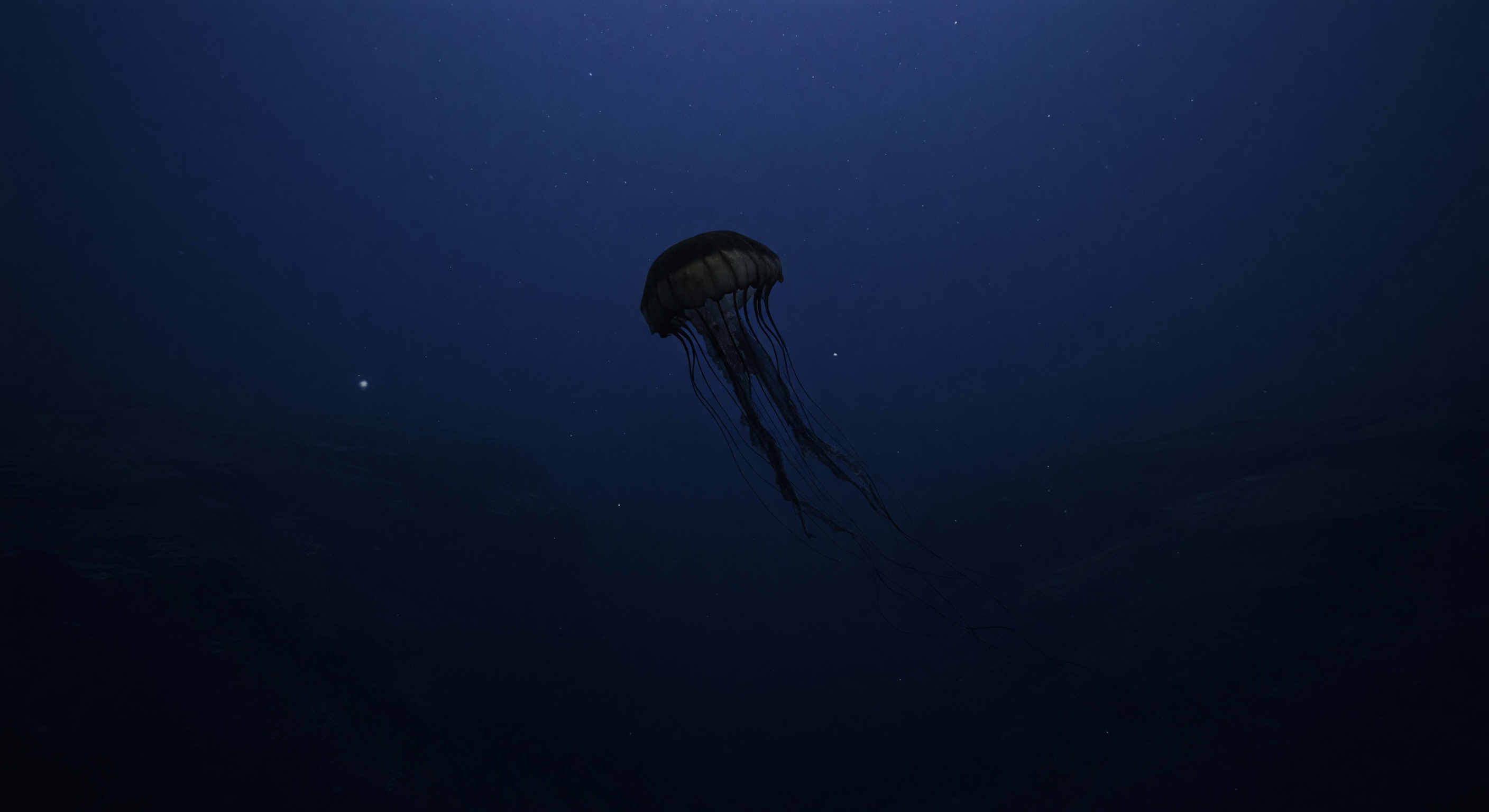
At somewhere between two hundred and six hundred metres below the surface, where the last residual sunlight has been stripped of every wavelength except a fading cobalt gradient, *Stygiomedusa gigantea* drifts in near-total silence above the softened flank of a continental-slope canyon. Its bell can exceed one metre across, yet the animal is almost entirely water, its dark wine-toned tissues hovering at near-neutral buoyancy without any rigid structure, the four enormously elongated oral arms descending several metres below it through the marine snow — a continuous, slow precipitation of organic detritus that carries fixed carbon from the sunlit surface into the deep. At these pressures, exceeding fifty atmospheres, the water column is cold, typically five to nine degrees Celsius, stratified into distinct density layers that concentrate micronektonic prey and create invisible architecture through which *Stygiomedusa* moves by gentle pulsation, sweeping small crustaceans and fish larvae passively against its ribbon-like arms. The canyon wall behind it recedes into blue-black indistinction, its geology — slumped sediment, exposed carbonate, the geological memory of a continental margin — barely legible against the depth gradient. Scattered across the far darkness, a few cold bioluminescent sparks mark the presence of other organisms advertising nothing to us, communicating only among themselves in a world that has proceeded, unchanged, without witness.
Other languages
- Français: Cloche Fantôme Sur Canyon
- Español: Campana Fantasma Sobre Cañón
- Português: Sino Fantasma Sobre Canyon
- Deutsch: Geisterglocke Über Schlucht
- العربية: جرس الشبح فوق الوادي
- हिन्दी: घाटी के ऊपर भूत घंटी
- 日本語: 峡谷に漂う幻の鐘
- 한국어: 협곡 위 유령 종
- Italiano: Campana Fantasma Sul Canyon
- Nederlands: Spookklok Boven Canyon