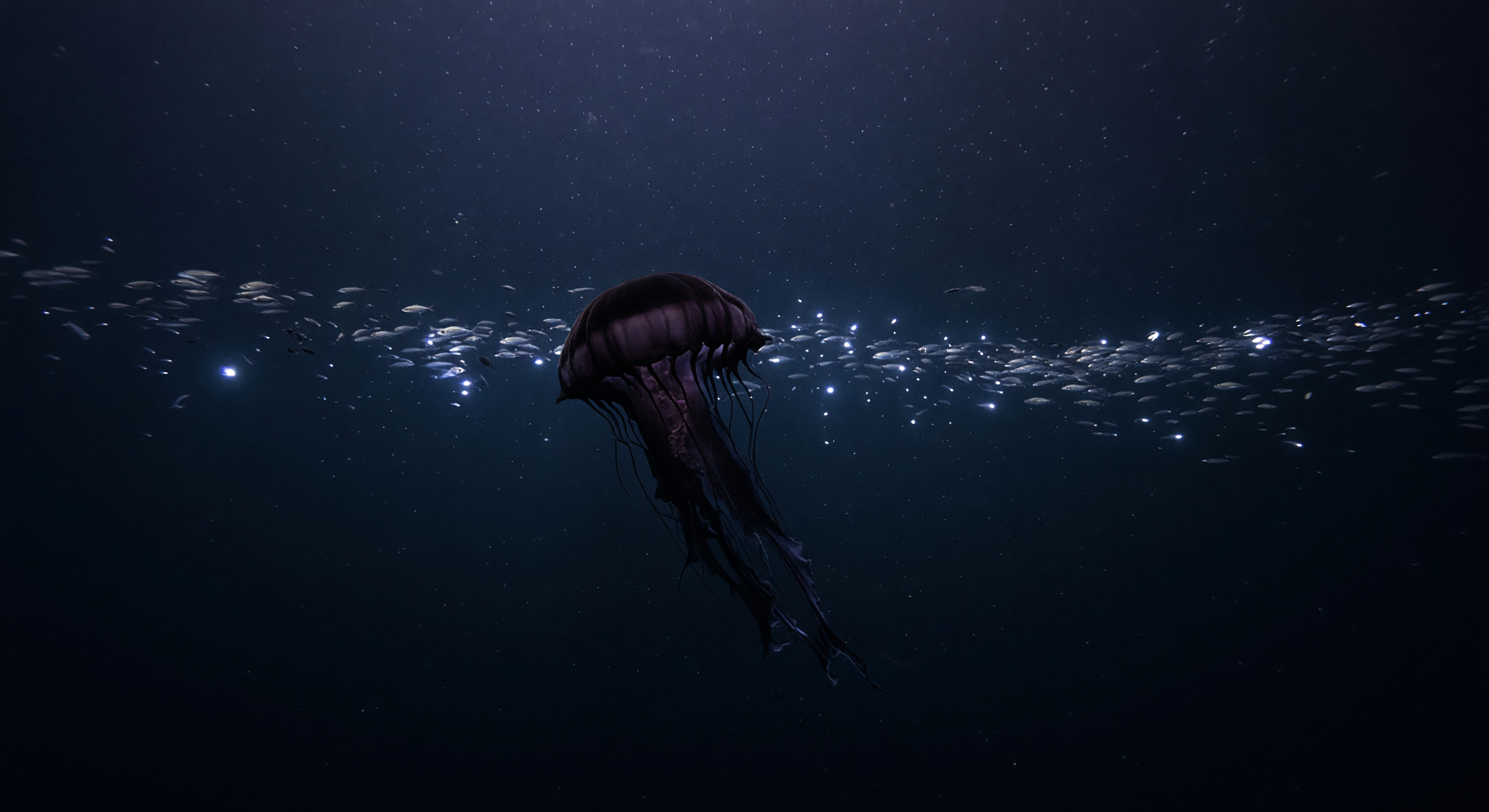
At the margin of an oxygen minimum zone over a continental slope, *Stygiomedusa gigantea* drifts through water pressing down at roughly fifty atmospheres, its broad umbrella—deep maroon fading to near-black under a light spectrum stripped of everything but the faintest residual blue—spanning more than a meter across, while immense ribbon-like oral arms trail beneath it in slow, weightless folds that require no musculature to sustain, only the patient architecture of a body that is mostly seawater. The oxygen minimum layer acts here as an ecological boundary, compressing zooplankton, larval fishes, and fragile gelatinous drifters into a thin living horizon along the density interface where conditions briefly become tolerable, a concentrated prey band that the phantom jelly navigates without active pursuit, its arms sweeping passively through the aggregation. Around this prey layer, the darkness is interrupted by sudden blue-white bioluminescent escape flashes—tiny crustaceans firing photophores or releasing luminescent clouds as a last defense, brief sparks that illuminate nothing but themselves before the blackness closes again. Marine snow drifts freely through the water column in all directions, fine particulate organic matter descending from the productive surface far overhead, each flake part of the ocean's slow biological pump transferring carbon downward into the interior. This is a world that has operated on these terms across geological timescales, cold, pressured, and fundamentally indifferent to observation, shaped entirely by chemistry, physics, and the evolutionary logic of surviving on very little light and very little oxygen.
Gelatinous giants