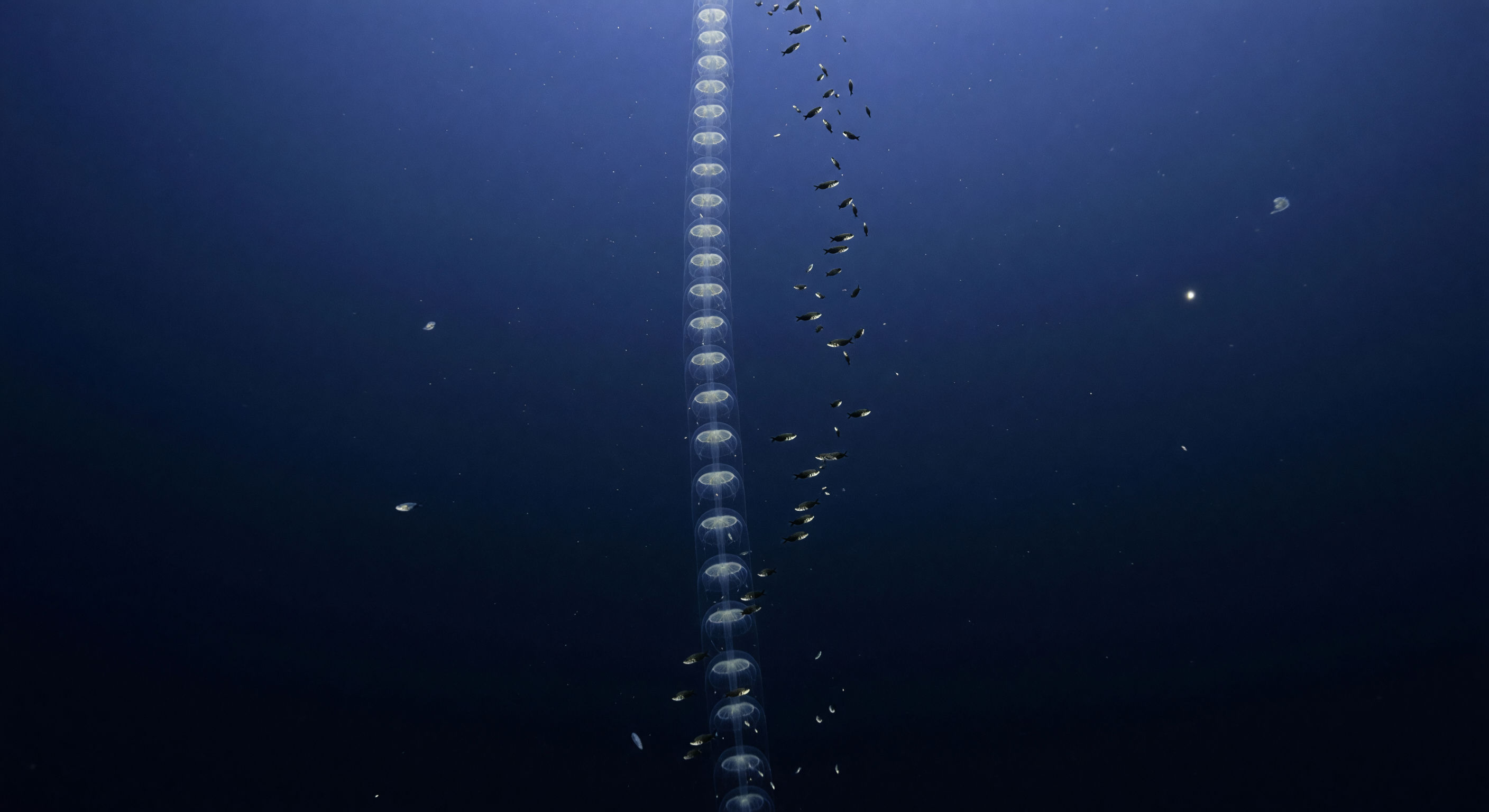
At around 400 to 600 metres depth over a continental slope, where the last faint traces of solar blue still descend from far above before surrendering entirely to blackness, a *Praya dubia* colony hangs almost perfectly vertical through the water column — one of the longest animals on Earth, its transparent nectophores arranged like hollow bells of near-invisible glass, each unit catching the weak ambient light only as a faint opaline rim before dissolving back into indigo. Pressures here exceed fifty atmospheres, and the cold — close to six or seven degrees Celsius — slows the world to a patient stillness, favouring exactly this kind of low-metabolism, near-massless body plan, built mostly of mesoglea and seawater, requiring almost no energy to maintain neutral buoyancy across hundreds of metres of open pelagic space. Beside the colony, a loose aggregation of lanternfish — likely *Myctophum* or *Diaphus* species undertaking their diel vertical migration toward the surface — ascends through the water column, their ventral photophores arranged in species-specific patterns that function as counter-illumination against the residual downwelling glow, their small silvery-black forms reading as clean silhouettes against a ceiling of dying light. In the far background, scattered bioluminescent pinpoints mark the presence of other gelatinous life — ctenophores, copepods, fragmentary colonial organisms — while fine marine snow, the slow rain of organic particles from the productive waters above, drifts freely through a space that is immense, pressurized, and entirely indifferent to any witness.
Gelatinous giants