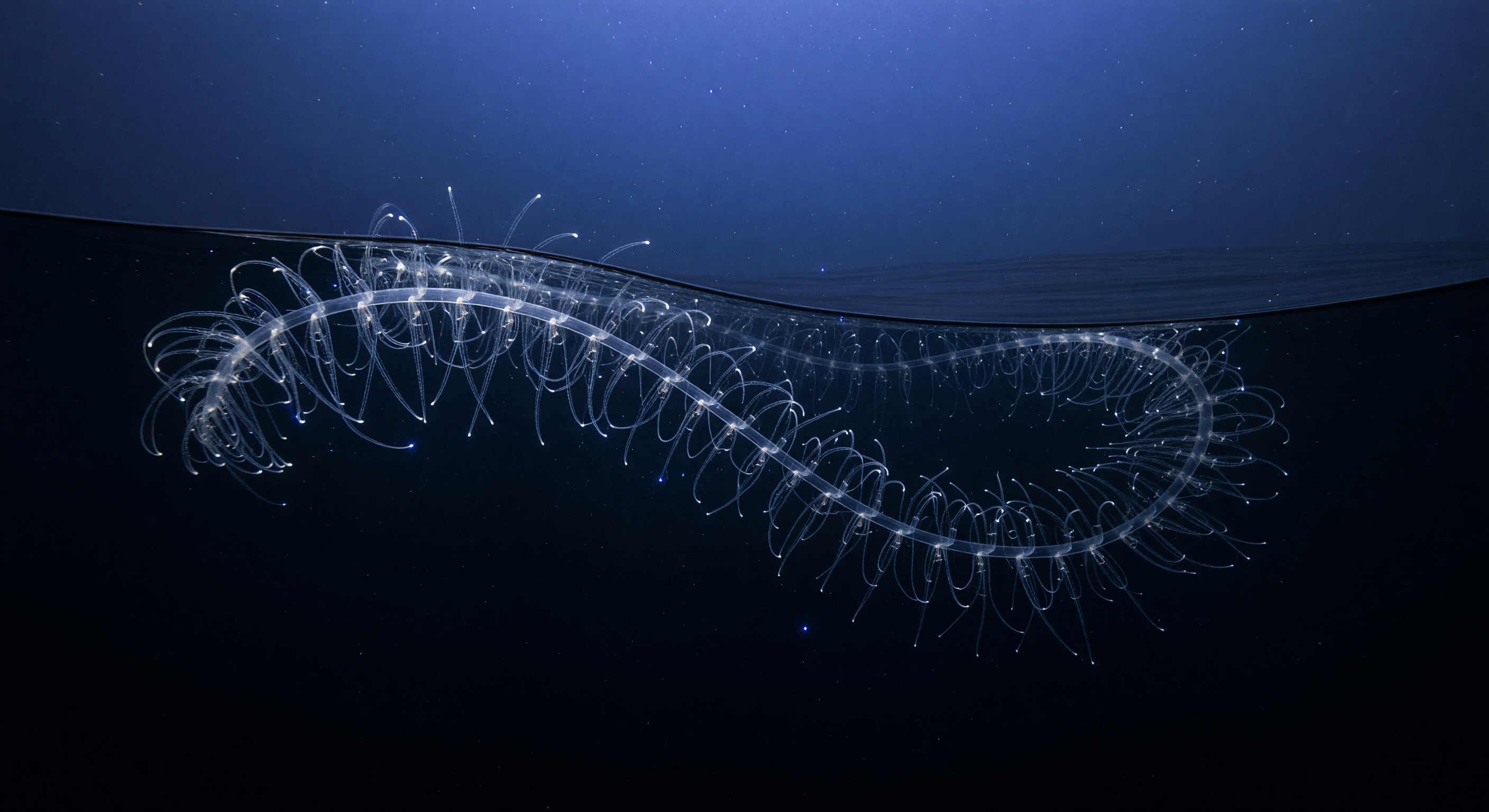
At around 450 to 600 metres over a continental slope, where pressure reaches roughly 50 atmospheres and the last faint traces of surface blue dissolve into surrounding blackness, an *Apolemia* siphonophore colony of extraordinary length curves through a sharp pycnocline in a slow, gravitational S — its transparent stem and thousands of specialised zooids, nectophores, dactylozooids, and trailing tentilla forming a suspended lattice of near-invisible tissue, refracting the dim overhead cobalt into silvery filaments and cold iridescent glints. A physonect siphonophore is not a single organism but an integrated supercolony of genetically identical yet functionally differentiated individuals, each polyp performing a specific task — propulsion, feeding, reproduction, defence — so that the whole structure operates as a coherent predatory entity capable of spanning tens of metres through open water. The pycnocline itself is rendered faintly visible as an optical interface, a stratified boundary where water masses of slightly different density and particle load meet, warping the background in subtle waves and concentrating marine snow into a thin suspended layer that drifts without any external force through the cold, still column. Sparse blue bioluminescent pinpricks punctuate the surrounding water and catch among the colony's branches like scattered stars, produced by the incidental flashes of copepods, dinoflagellates, and small gelatinous neighbours, each a brief chemical signal in an otherwise lightless realm. This is a world of near-perfect silence and immense hydrostatic weight, where a creature made almost entirely of seawater hangs suspended in seawater, filtering the dark for prey, entirely indifferent to any witness.
Other languages
- Français: Apolemia dans la densité
- Español: Apolemia en capa densa
- Português: Apolemia na camada densa
- Deutsch: Apolemia im Dichtesprung
- العربية: أبوليميا في طبقة الكثافة
- हिन्दी: घनत्व परत में अपोलेमिया
- 日本語: 密度躍層のアポレミア
- 한국어: 밀도 경계의 아폴레미아
- Italiano: Apolemia nella densità
- Nederlands: Apolemia in dichtheidslaag