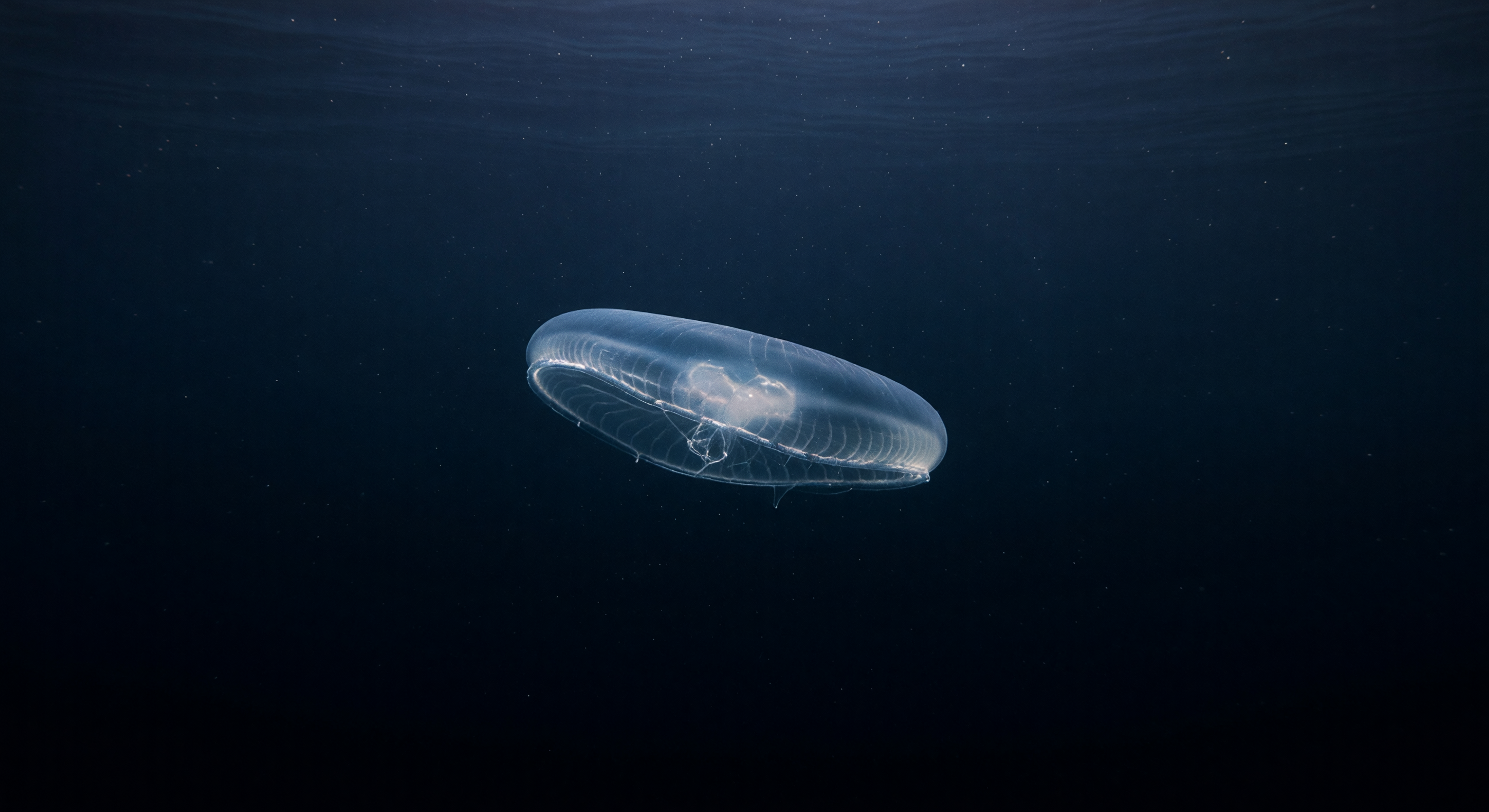
At roughly 400–500 meters beneath the surface, where hydrostatic pressure exceeds 50 atmospheres and the last attenuated photons of sunlight arrive as little more than a cold cobalt memory overhead, a *Bathocyroe* ctenophore drifts bowl-upward through open midwater, its hemisphere of living tissue so nearly water that it vanishes entirely into the surrounding sea except where its comb rows catch that faint overhead gradient and scatter it into ghost-thin bands of iridescent cyan and violet. Ctenophores of this genus are among the most mechanically fragile macroanimals in the ocean — bodies composed almost entirely of mesoglea, the gelatinous matrix that makes them near-neutrally buoyant and immune to the crushing pressures that would destroy gas-filled tissues — and they hunt by holding their translucent bowl open to intercept copepods and other small crustaceans drifting on the same stratified layers. Around it, marine snow descends in slow suspension through thermally stratified water, tracing the invisible density boundaries of an intermediate water mass flowing along the continental slope far below, while scattered bioluminescent pinpricks flicker at distance in the blackness — the chemical light of other organisms, the only illumination that truly belongs to this depth. This is the permanent condition of the mesopelagic twilight world: a vast, pressured, nearly lightless pelagic volume where gelatinous life thrives in silence precisely because no hard structure, no large gas space, and no high metabolic demand is required — only water shaped into life, suspended between a dying blue ceiling and the absolute dark below.
Other languages
- Français: Bathocyroe sous voûte bleue
- Español: Bathocyroe bajo cielo azul
- Português: Bathocyroe sob teto azul
- Deutsch: Bathocyroe unter blauem Dach
- العربية: باثوسيرو تحت سقف أزرق
- हिन्दी: नीली छत के नीचे बाथोसाइरो
- 日本語: 青い天蓋の下のバソシロー
- 한국어: 푸른 천장 아래 바소시로
- Italiano: Bathocyroe sotto volta blu
- Nederlands: Bathocyroe onder blauw plafond