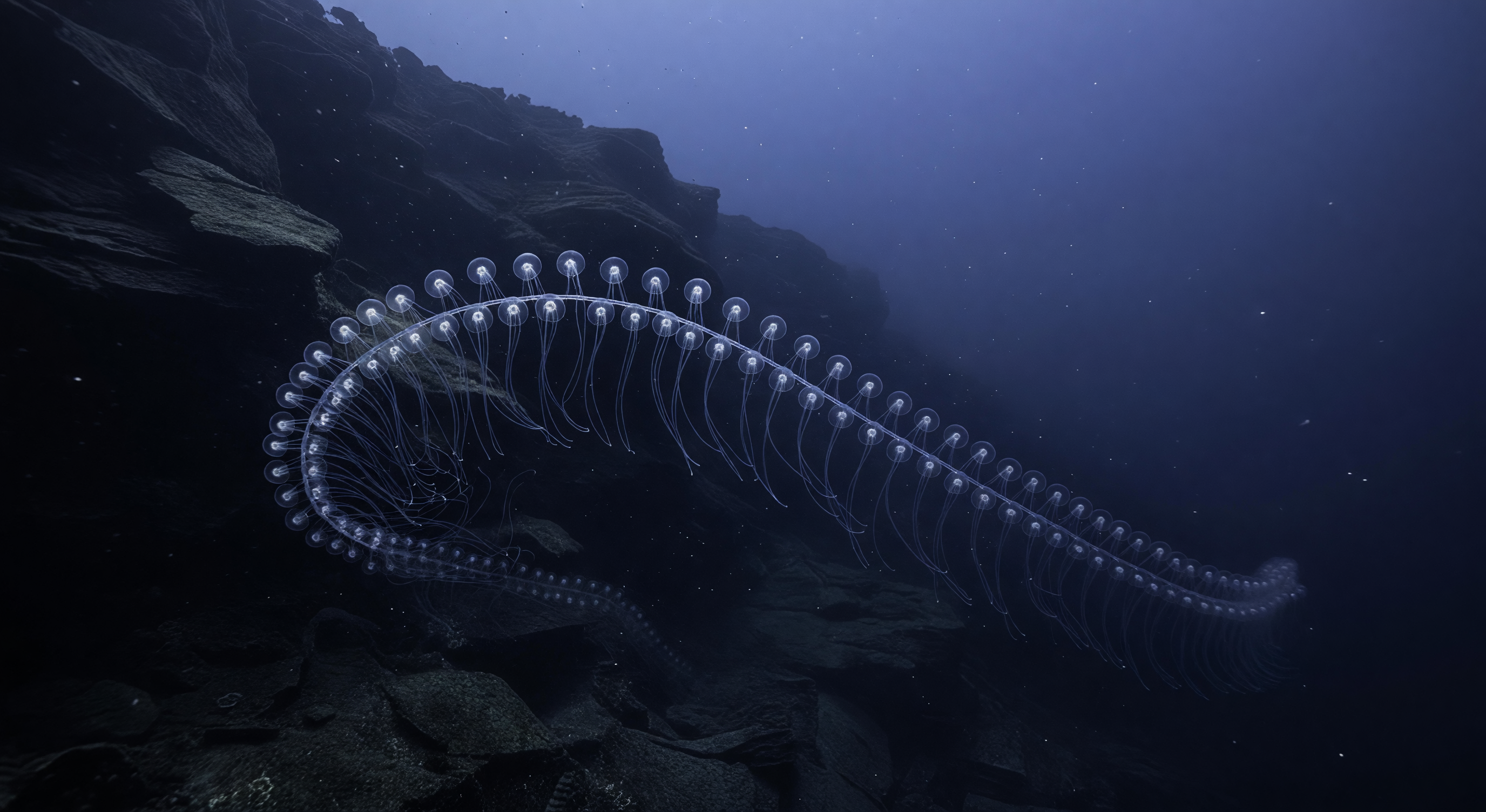
Along the gradual incline of a continental slope, a physonect siphonophore — likely *Praya dubia* or a close relative — extends its colonial body in a long, arcing chain through water that has not seen useful sunlight in hundreds of meters. Each nectophore bell is a lens of near-perfect transparency, catching only the faintest residual blue from far above, where daylight still exists as a concept rather than a reality; at these depths, pressure has climbed to fifty atmospheres or more, cold enough and heavy enough that only animals built almost entirely of water can afford to exist here at all. The siphonophore is not a single organism in any familiar sense but a superorganism — a chain of genetically identical zooids each specializing in propulsion, feeding, or reproduction — and its trailing tentilla fan in fine, silent veils against the distant rock wall of the slope, a dark geometry of ledges and faulted planes that descends without apparent end into blue-black depth. Around it, marine snow drifts in all directions at once, the slow rain of organic particles from the productive world far above, which sustains much of the mesopelagic food web in the near-absence of photosynthesis. Scattered cold pinpricks of bioluminescence mark other unseen bodies in the surrounding water, the only light this world generates for itself — quiet, chemical, and entirely its own.
Other languages
- Français: Physonecte le long du mur d'ombre
- Español: Physonecta junto al muro sombrío
- Português: Physonecta ao longo da parede sombria
- Deutsch: Physonect an der Schattenwand
- العربية: فيزونكت عند جدار الظل
- हिन्दी: छाया दीवार के साथ फिजोनेक्ट
- 日本語: 影の壁沿いの管クラゲ
- 한국어: 그림자 벽을 따라 피조넥트
- Italiano: Physonecta lungo il muro d'ombra
- Nederlands: Physonect langs de schaduwwand