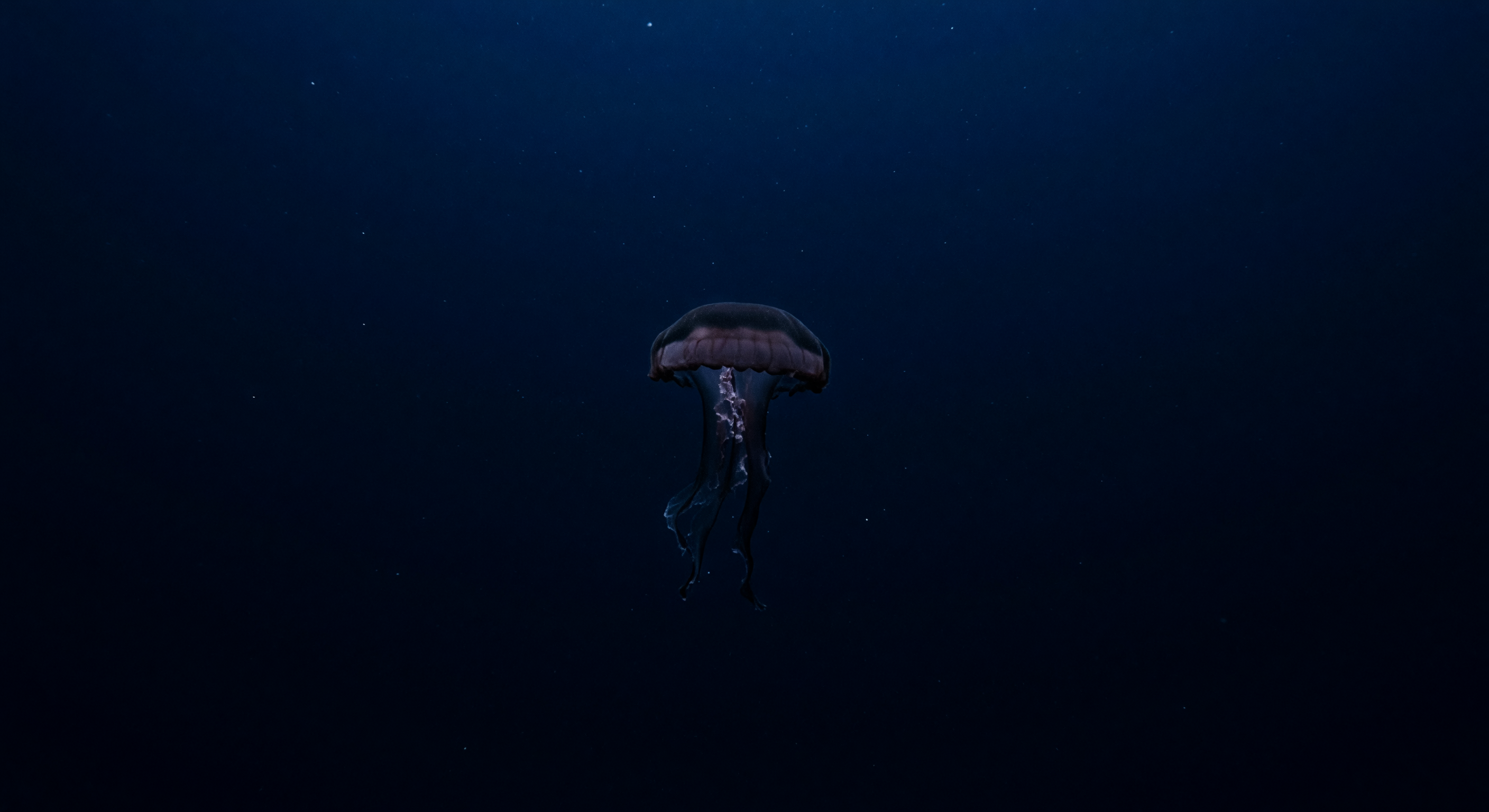
At roughly 500 to 700 meters beneath the surface, where pressure exceeds fifty atmospheres and the last measurable trace of solar energy survives only as a faint cobalt gradient dissolving overhead into absolute black below, a single *Stygiomedusa gigantea* occupies the open midwater column above an unseen continental slope — one of the largest medusae on Earth, yet belonging entirely to this void as if the ocean had willed it into being. Its broad bell, dark wine-maroon and semi-translucent, intercepts the residual downwelling blue just enough to reveal delicate internal membranes and a softly luminous rim where attenuated photons pass through gelatinous tissue only micrometers thick, while the four immense ribbon-like oral arms — which may extend several meters — curl downward and fade, unresisted, into midnight. At these depths, red wavelengths have long since been absorbed by the water column, stripping all warm color from the world and leaving *Stygiomedusa* in near-black maroon shadow, its true pigmentation irrelevant in a realm where the light that reaches it has been filtered through hundreds of meters of seawater and carries almost no energy. Sparse marine snow drifts across the frame, visible only where particles cross the thin ambient field overhead, while isolated cold bioluminescent pinpricks flicker at enormous distances in the surrounding void — other organisms, unnamed and distant — affirming that this water, cold, stratified, and largely empty, is nonetheless alive in the dark way that the mesopelagic has always been alive, long before anything evolved to witness it.
Other languages
- Français: Géant Solitaire dans le Vide
- Español: Gigante Solitario en el Vacío
- Português: Gigante Solitário no Vazio
- Deutsch: Einsamer Riese im Nichts
- العربية: عملاق وحيد في الفراغ
- हिन्दी: शून्य में एकाकी दानव
- 日本語: 虚空の孤独な巨人
- 한국어: 공허 속 고독한 거인
- Italiano: Gigante Solitario nel Vuoto
- Nederlands: Eenzame Reus in Leegte