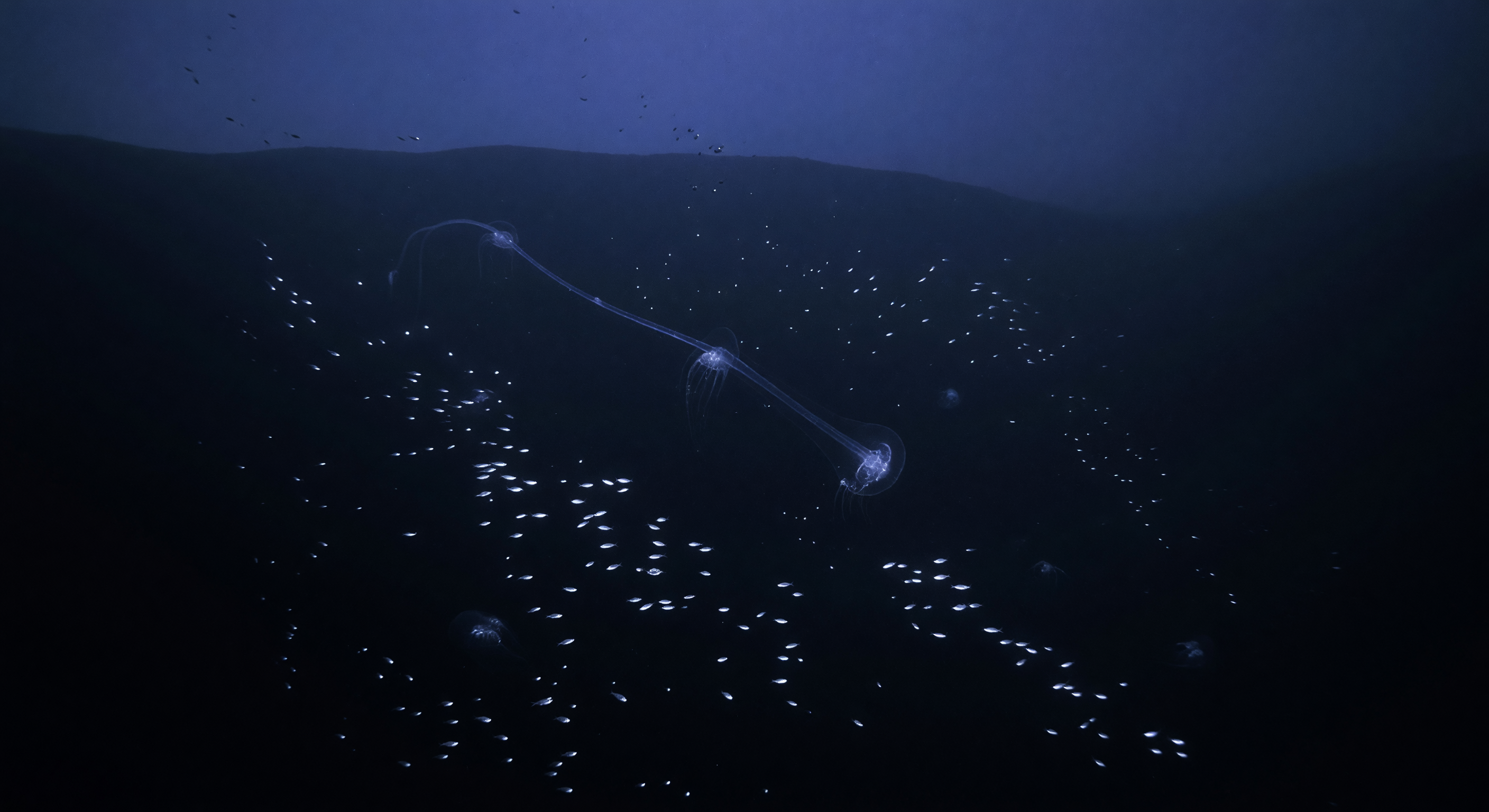
At roughly 350 to 500 metres below the surface, where the last residual blue of sunlight dissolves into a gradient indistinguishable from night, pressures exceeding 40 atmospheres press in from all sides against a world of near-weightless architecture. Here, above the shadowed crest of a continental slope, a physonect siphonophore — likely *Praya* or *Apolemia* — extends tens of metres through the water column, its gelatinous stem and trailing zooids so transparent that only the faintest scattering of dim downwelling blue reveals their presence before the colony fades entirely into the darkness below. This depth marks the upper boundary of the deep scattering layer, a living stratum of lanternfish, myctophids, and mesopelagic crustaceans that ascends nightly toward the surface in one of the ocean's largest daily migrations, their silvery flanks and photophores flickering in cold blue-white bioluminescent sparks that propagate through the rising haze like a slow, scattered electrical storm. Nearby, ctenophores drift as near-invisible bells, their comb rows catching ambient photons in brief spectral sheens, while marine snow — the slow vertical rain of organic particles from productive waters far above — drifts through the frame, each fleck a mote of chemistry descending toward the seafloor. This is an ocean that exists in total indifference to witness, governed entirely by pressure, darkness, and the ancient metabolic logic of creatures built from water itself.
Other languages
- Français: Premiers Éclairs du Versant
- Español: Destellos del Borde Inclinado
- Português: Primeiros Flashes da Encosta
- Deutsch: Erste Blitze am Hang
- العربية: وميض حافة المنحدر
- हिन्दी: ढलान छोर की पहली चमक
- 日本語: 斜面の縁の初閃光
- 한국어: 경사면 가장자리 첫 섬광
- Italiano: Primi Bagliori del Versante
- Nederlands: Eerste Flitsen aan de Helling