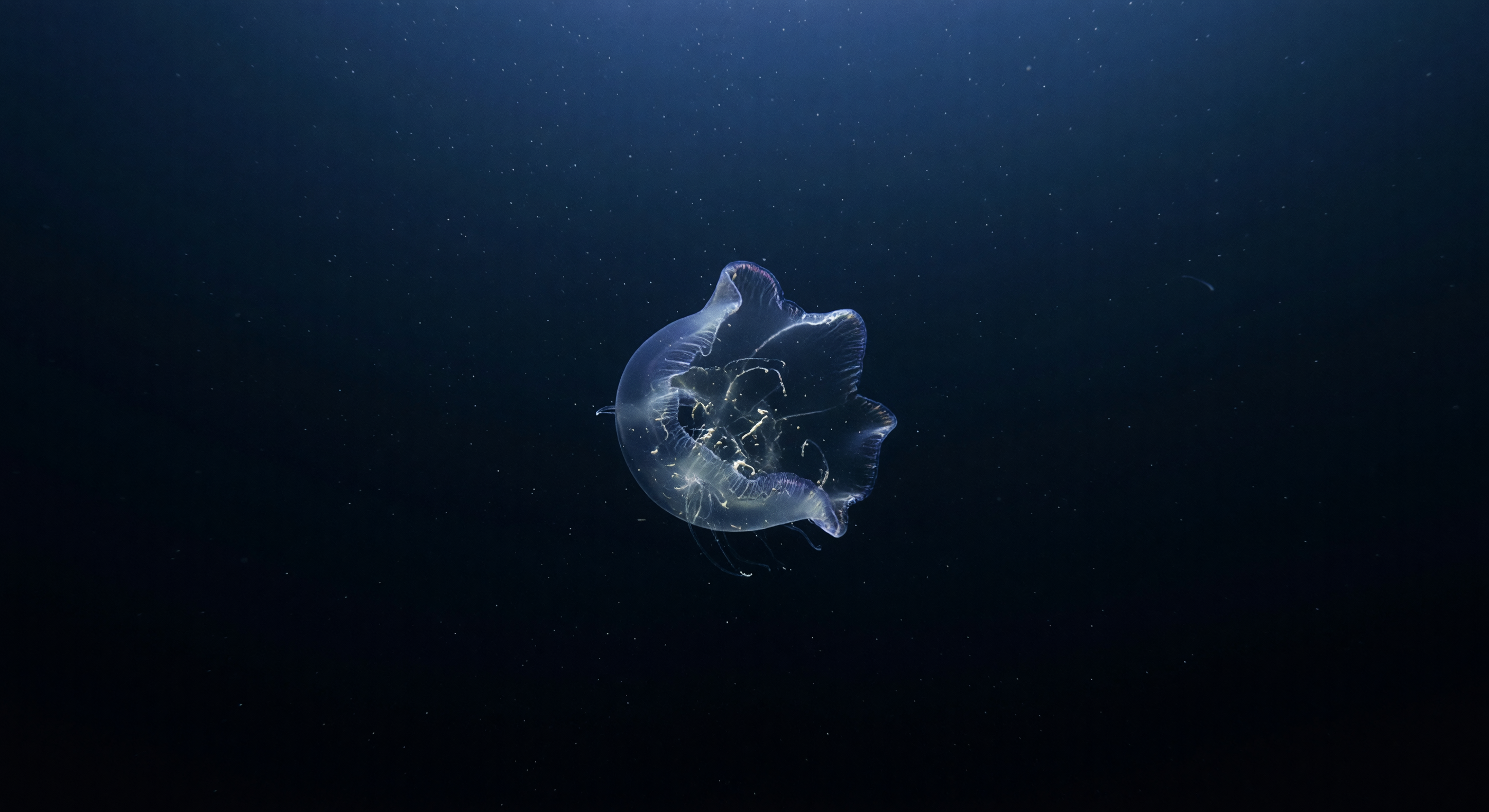
At around 400 metres depth over a continental slope, where the last whisper of sunlight filters down as a barely perceptible cobalt gradient fading into absolute darkness below, a large *Thalassocalyce* ctenophore hangs motionless in the pressurized midwater column — roughly 41 atmospheres bearing silently on its almost entirely aqueous body. Its paired oral lobes have spread wide into the characteristic feeding-cup posture, forming a translucent dome of nearly invisible tissue around a small concentration of planktonic prey, tiny crustaceans suspended inside the gelatinous cavity as though caught in glass. Where the faint residual downwelling light grazes the ruffled membrane edges, violet-blue interference colours ripple in restrained iridescence along the comb rows — not bioluminescence, but the structural optics of extraordinarily thin tissue refracting what little ambient photons still exist at this depth. Around it, the mesopelagic water column stretches away in every direction as a dim, particle-dusted silence, interrupted only by the occasional cold pinpoint of bioluminescent light from organisms deeper in the darkness, where sunlight no longer reaches at all. This is a world of near-perfect stillness, where gelatinous animals have found enormous evolutionary success precisely because their fluid bodies cost almost nothing to maintain, their transparency renders them effectively invisible, and the layered density structure of the water column concentrates the prey that sustains them.
Other languages
- Français: Coupe Nourricière Thalassocalyce
- Español: Copa Alimentaria Thalassocalyce
- Português: Taça Alimentar Thalassocalyce
- Deutsch: Thalassocalyce Fangkelch
- العربية: كأس تغذية ثالاسوكاليس
- हिन्दी: थैलासोकैलिस पोषण कप
- 日本語: タラソカリス摂食カップ
- 한국어: 탈라소칼리세 먹이컵
- Italiano: Calice Alimentare Thalassocalyce
- Nederlands: Thalassocalyce Voedingsbeker