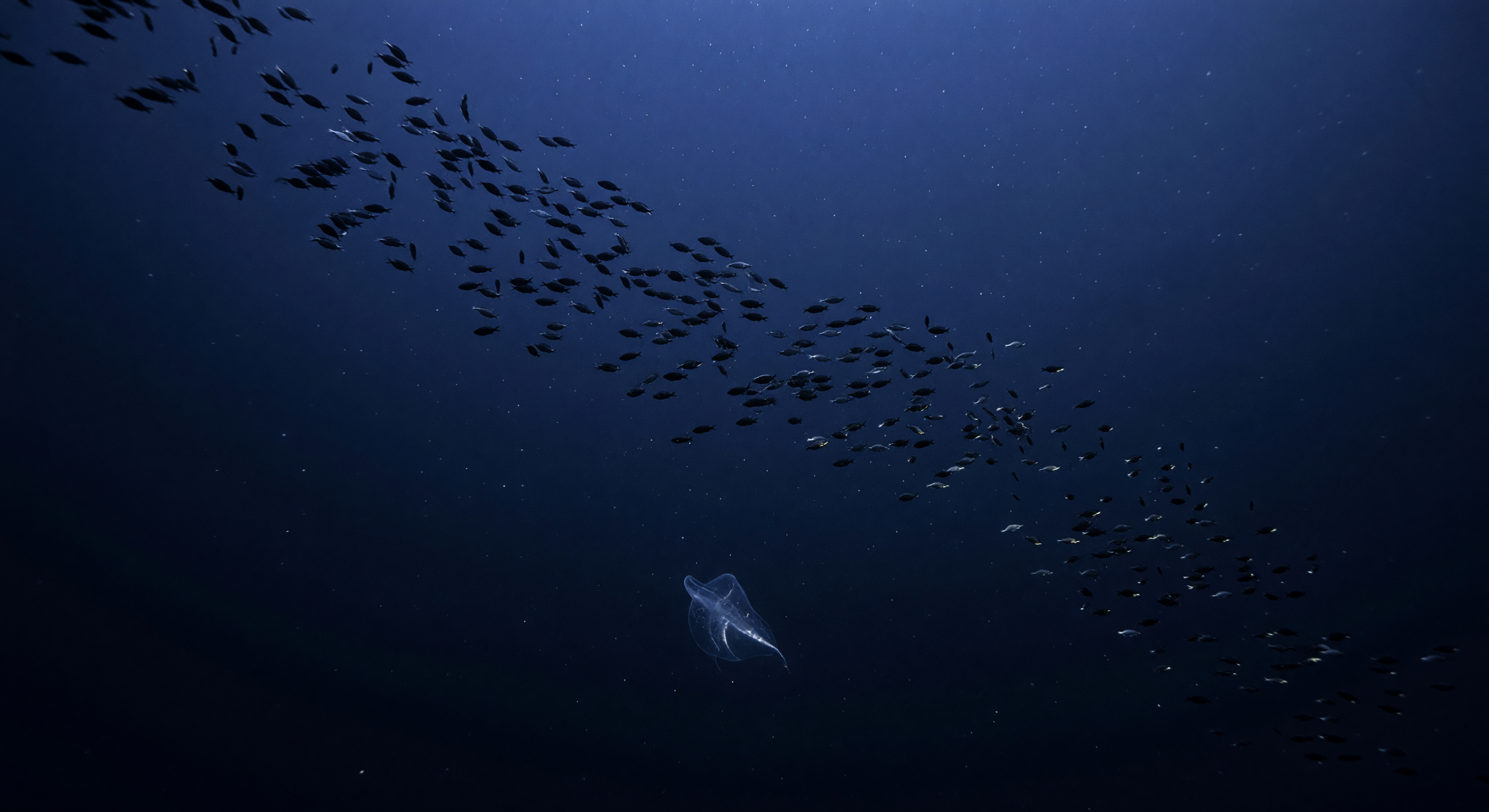
At roughly 450 to 600 metres over the continental slope, where the last ghost of surface daylight survives only as a dim cobalt gradient dissolving into black, a vast oblique curtain of lanternfish — myctophids performing their nightly vertical migration — hangs across the water column like a living veil of blue-black dust, its ribbons and loose constellations shaped by internal-wave shear, each individual fish a small dark silhouette carrying the faintest ventral photophores evolved precisely to counterilluminate against that residual downwelling blue. At this depth, pressure exceeds fifty atmospheres and temperature hovers near seven or eight degrees Celsius; the water is exceptionally clear, carrying only fine marine snow drifting in slow suspension, and the sheer three-dimensional space between organisms makes the scale of the scattering layer — a phenomenon measurable by echosounder across entire ocean basins — all the more astonishing when resolved into its constituent bodies. Below the curtain, nearly invisible until the dim overhead gradient traces its transparent lobes, a single Bathocyroe ctenophore drifts in gravitational suspension, its gelatinous body almost pure seawater by composition, and along its comb rows the mechanical beating of ctene plates splits residual light into the briefest iridescent threads — spectral needles, not bioluminescence, but structural color — that flicker and vanish. Nothing here requires a witness; this geometry of migrating fish and drifting jelly assembles and dissolves in cold silence every day and night of every year, wholly indifferent to the darkness that surrounds it.
Gelatinous giants