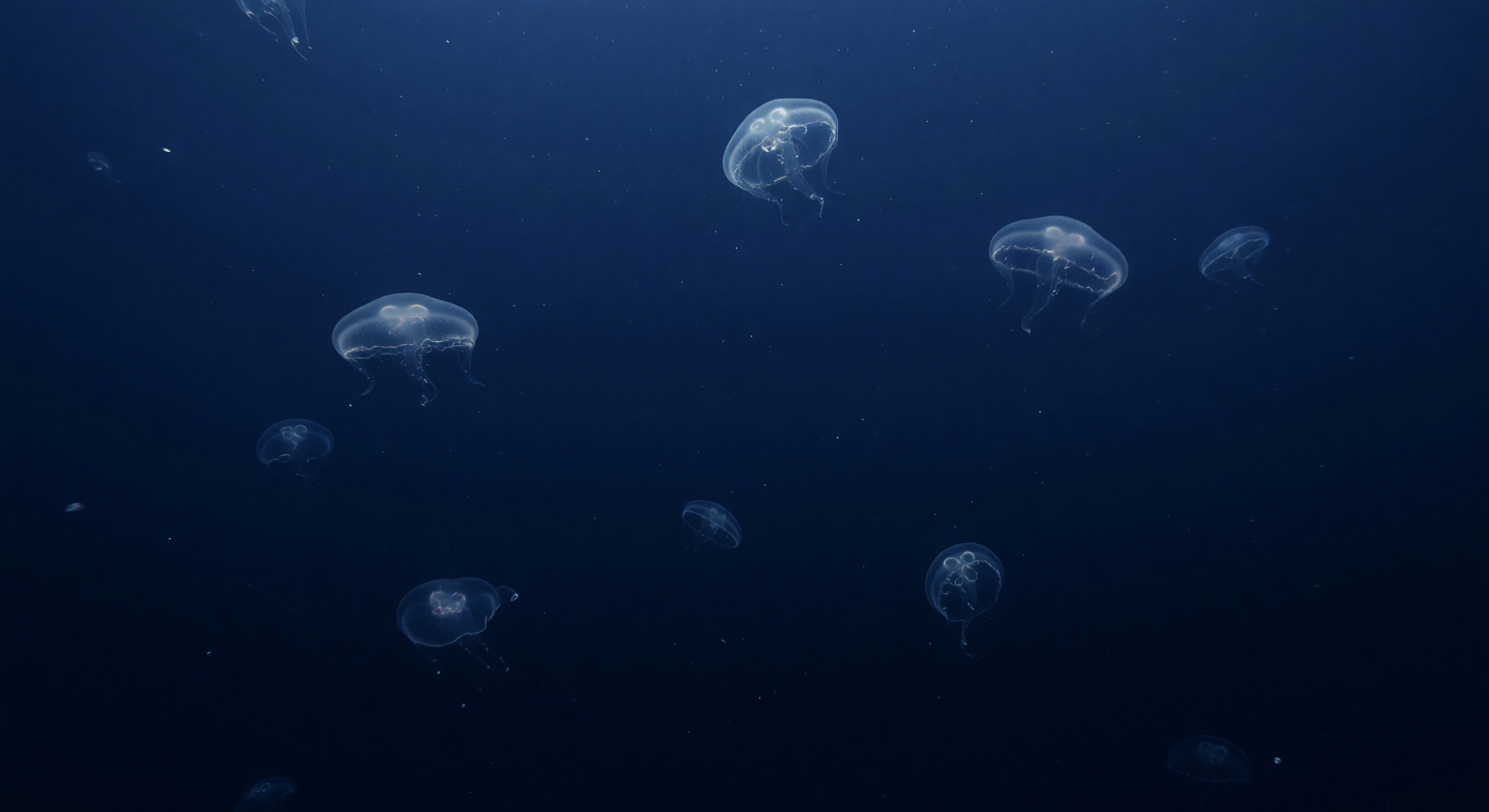
Between roughly four hundred and seven hundred meters below the ocean surface, where the last traces of sunlight have been stretched and filtered into a cold, almost colorless indigo, ctenophores drift in open water like a scattered constellation freed from any fixed plane. Species such as *Bathocyroe fosteri* and the veil-like *Thalassocalyce inconstans* are largely composed of seawater itself — gelatinous bodies with almost no solid tissue — which allows them to hover neutrally buoyant at pressures exceeding fifty atmospheres without expending appreciable energy, their entire architecture an elegant solution to a world defined by cold, stratification, and scarcity. The comb rows, each a precise rank of fused cilia called ctenes, beat in coordinated metachronal waves and scatter the faint residual downwelling light into brief prismatic threads, appearing and vanishing against the monochrome blue field like spectral notation written and erased in the same breath. Around them, marine snow — the slow, continuous fall of organic particles from the sunlit world far above — drifts through stratified water masses where pycnoclines trap prey and concentrate the thin layers on which mesopelagic food webs depend. Here, in a darkness that is neither total nor illuminated but something precisely between, these translucent giants pulse and dissolve and pulse again, tending their ancient biological business in a volume of ocean that has never required a witness.
Other languages
- Français: Dérive des Constellation Cténophores
- Español: Deriva de Constelación Ctenófora
- Português: Deriva de Constelação Ctenófora
- Deutsch: Rippenquallen Sternbild Drift
- العربية: انجراف كوكبة المشطيات
- हिन्दी: कटेनोफोर नक्षत्र प्रवाह
- 日本語: クシクラゲ星座の漂流
- 한국어: 빗해파리 별자리 표류
- Italiano: Deriva Costellazione Ctenofori
- Nederlands: Ribkwal Constellatie Drift