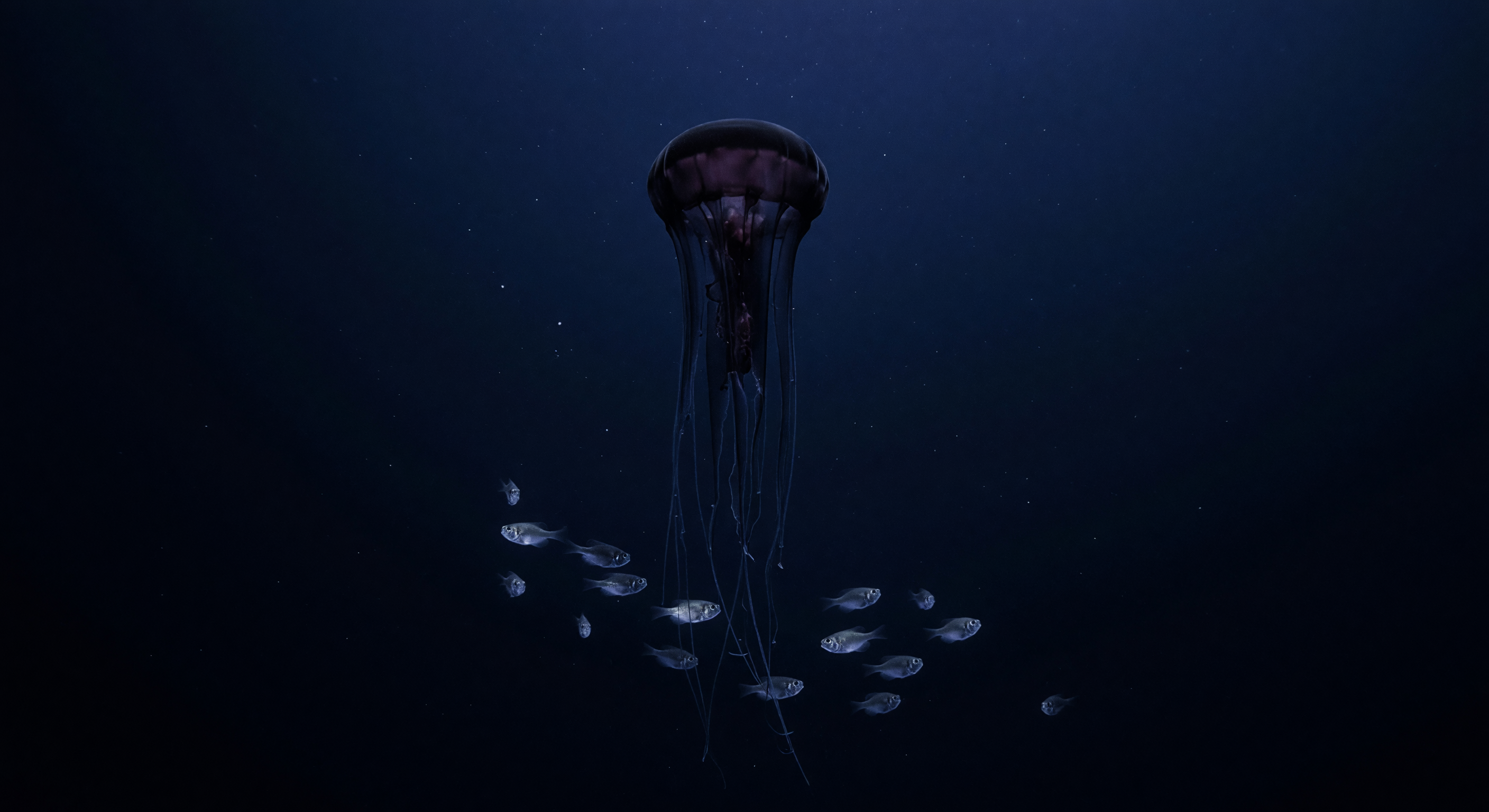
At roughly 400 to 600 metres depth over a continental slope, where residual sunlight has narrowed to a faint cobalt gradient barely distinguishable from the surrounding darkness, *Stygiomedusa gigantea* drifts in near-neutral buoyancy, its broad, softly domed bell — dark burgundy where internal structure absorbs the last trace of downwelling blue — trailing four immense oral arms that fall in loose, asymmetric curtains through cold, stratified water near 7°C and at pressures exceeding 50 atmospheres. Beneath those ribbons, a compact school of lanternfish (*Myctophidae*) cuts laterally through the water column, their laterally compressed silver flanks and enlarged dark-adapted eyes catching the ambient blue for a fraction of a second before the fish dissolve back into the monochromatic field; their presence here is part of a daily vertical migration cycle that connects sunlit surface productivity to the deep midwater through the bodies of countless small, lipid-rich fish. Fine marine snow — disaggregating fecal pellets, mucus threads, and cellular debris — drifts unimpeded through the scene, tracing the slow, continuous rain of organic matter that sustains this community in permanent near-darkness. The jelly itself is almost entirely water, its mesoglea offering no compressible gas spaces to resist the pressure, an evolutionary solution so efficient it has persisted essentially unchanged across geological time. The whole encounter is silent, self-contained, and utterly indifferent to any outside witness.
Other languages
- Français: Poissons-lanternes sous fantôme
- Español: Peces Linterna Bajo Fantasma
- Português: Peixes-lanterna Sob Fantasma
- Deutsch: Laternenfisch unter Geisterarmen
- العربية: سمك الفانوس تحت أذرع الشبح
- हिन्दी: भूत भुजाओं के नीचे लालटेन मछली
- 日本語: 幻のアームの下の提灯魚
- 한국어: 유령 팔 아래 등불고기
- Italiano: Pesci Lanterna Sotto Fantasma
- Nederlands: Lantaarnvis onder spookarmen