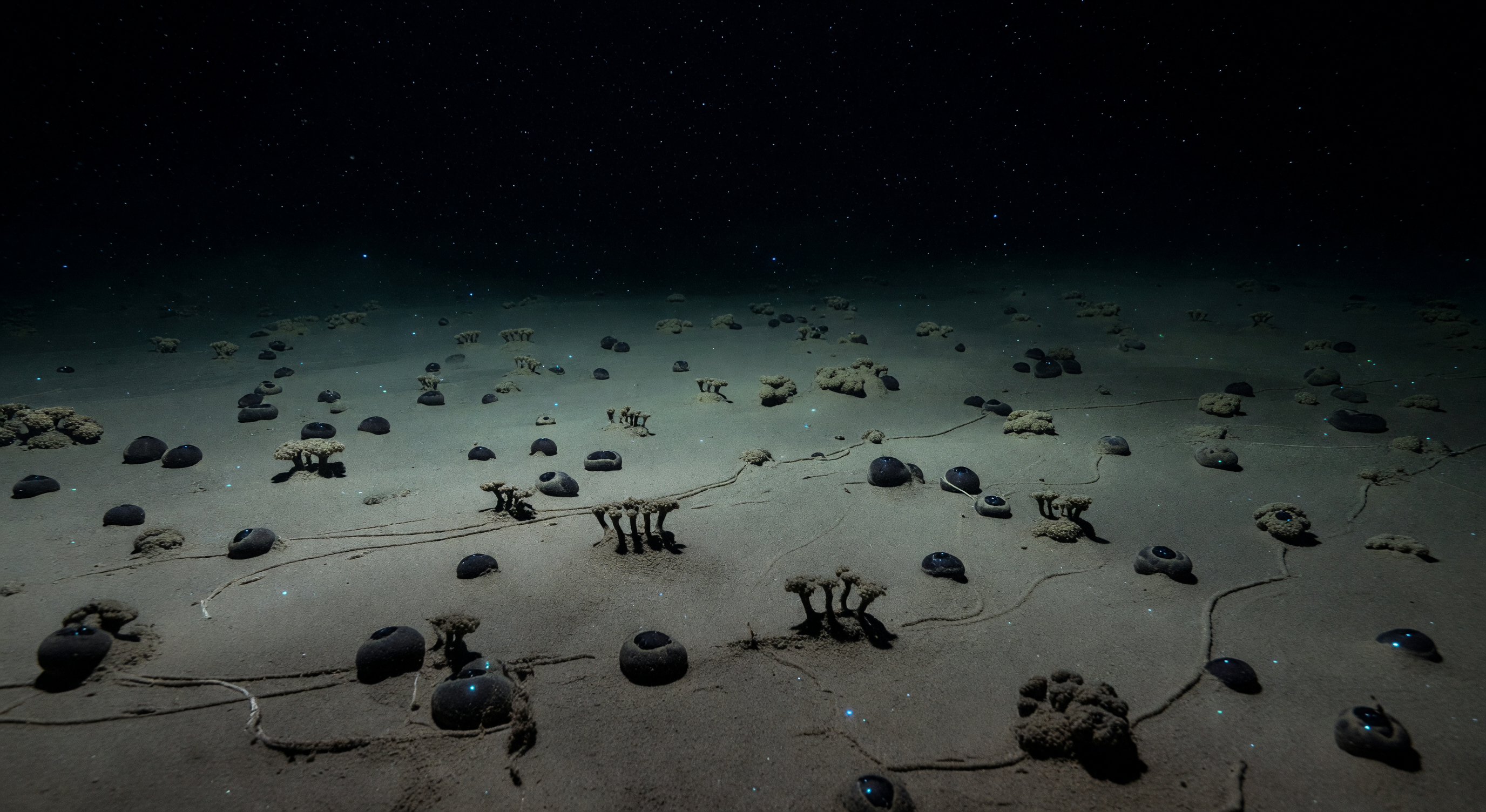
Across the abyssal plain of the Clarion–Clipperton Zone, somewhere between four and five kilometres below the surface, a fresh veil of pale sediment has recently settled over the seafloor, softening every contour into muted taupe and ash, burying the lowest manganese nodules entirely and leaving only the highest ones exposed as dark, polished islands rising from the silt. These nodules, composed of concentric layers of manganese, iron, cobalt, nickel, and copper precipitated from seawater over millions of years at rates measured in millimetres per million years, represent one of the slowest geological processes on Earth, their surfaces now dusted with the same fine detrital rain that perpetually descends from the sunlit ocean far above. Between and upon the protruding nodules, low xenophyophore mounds — giant single-celled organisms among the largest on the planet — retain their fragile irregular forms just above the new silt layer, while thread-fine feeding traces left by holothurians and polychaetes curve in looping furrows across the mud, partially erased yet still legible as evidence of life at pressures exceeding 500 atmospheres and temperatures barely above freezing. No photon from the sun has ever reached this plain; the only light here is the faint, scattered bioluminescence of drifting organisms — cold cyan-blue pinpoints moving slowly through water so stable, so cold, and so dark that the entire landscape exists in a perpetual stillness that human timescales cannot meaningfully hold. This is a world that has never needed witnessing to be complete.
Polymetallic nodule fields