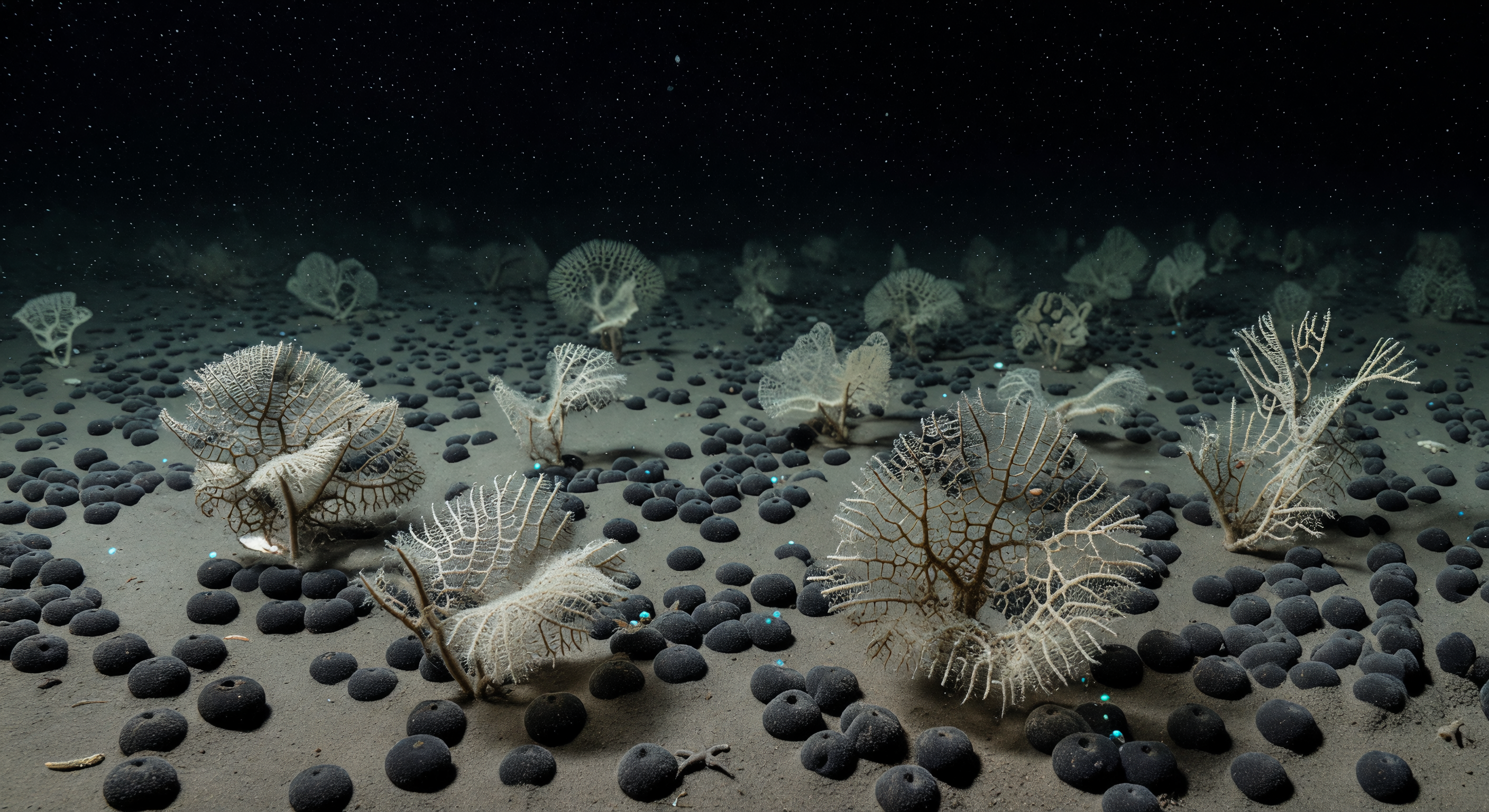
Across the abyssal plain of the Clarion–Clipperton Zone, at depths approaching five kilometers, the seafloor spreads as a near-featureless expanse of pale grey-brown sediment, its surface embedded with countless matte black manganese nodules that have grown at geological pace — accreting at mere millimeters per million years — under pressures exceeding 500 atmospheres and in water barely above freezing. Rising among them, xenophyophores construct some of the largest single-celled organisms on Earth: intricate agglutinated fans of gathered sediment grains, porous and lace-like, held in forms that intercept the perpetual slow drift of marine snow descending from the sunlit ocean far overhead. These giant protists anchor a sparse but finely adapted community — minute translucent crustaceans move through the latticed chambers, their bodies emitting intermittent cyan and blue-green bioluminescent flickers that serve as the only light source across this otherwise absolute darkness, brief cold sparks suspended against black water and black mineral. The seafloor here exists in near-perfect stillness: no photosynthesis, no seasons, no turbulence — only the slow accumulation of particles, the chemical patience of nodule formation, and the quiet metabolic rhythms of organisms that have adapted entirely to pressure, cold, and the near-total absence of energy, in a world that proceeds, immense and unhurried, entirely without witness.
Other languages
- Français: Champ d'éventails xénophyophores
- Español: Campo de abanicos xenofíoros
- Português: Campo de leques xenofíoros
- Deutsch: Xenophyophor-Fächerfeld
- العربية: حقل مراوح زينوفيوفور
- हिन्दी: ज़ेनोफायोफोर पंख क्षेत्र
- 日本語: キセノフィオフォア扇形群生地
- 한국어: 크세노피오포어 부채 군락
- Italiano: Campo di ventagli xenofiofor
- Nederlands: Xenofyofoor waaierenveld