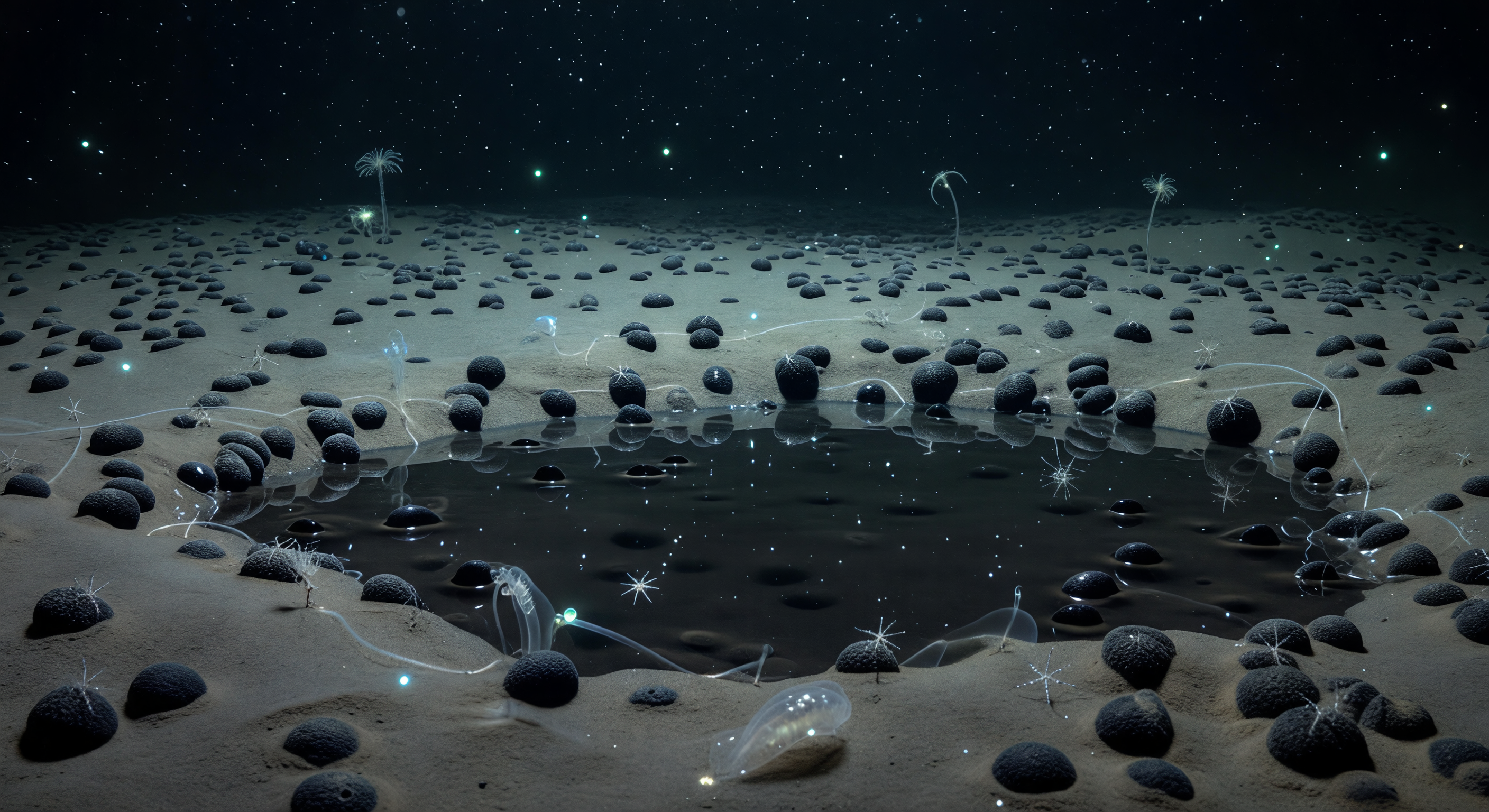
At nearly five thousand metres beneath the surface, where pressure exceeds four hundred atmospheres and temperature barely climbs above one degree Celsius, an abyssal plain stretches in near-total darkness across a vast, almost featureless expanse of pale grey-brown sediment. Scattered across this soft mud lie rounded polymetallic nodules, their matte-black manganese-rich skins accreted over millions of years through the slow precipitation of dissolved metals from seawater and pore fluids — geological time made tangible on the seafloor. The plain ends abruptly at the glassy margin of a brine pool, a hypersaline depression so dense that its surface holds like dark ink, warping the reflections of nearby nodules and drifting particles into liquid distortions, while pale microbial filaments trace irregular contours along the shoreline where chemically distinct water masses meet. Sparse benthic inhabitants — a translucent holothurian moving imperceptibly across the mud, brittle stars draped motionless over nodule surfaces, isolated stalked filter feeders extending delicate crowns into the water column — represent some of the most pressure-adapted and fragile fauna on Earth, their existence shaped entirely by this crushing, lightless permanence. Occasional cold blue-green bioluminescent pulses from drifting organisms drift freely through water otherwise resolved only by the slow, ceaseless descent of marine snow, each particle suspended in a silence so absolute and a darkness so complete that this world proceeds, as it always has, entirely without witness.
Polymetallic nodule fields