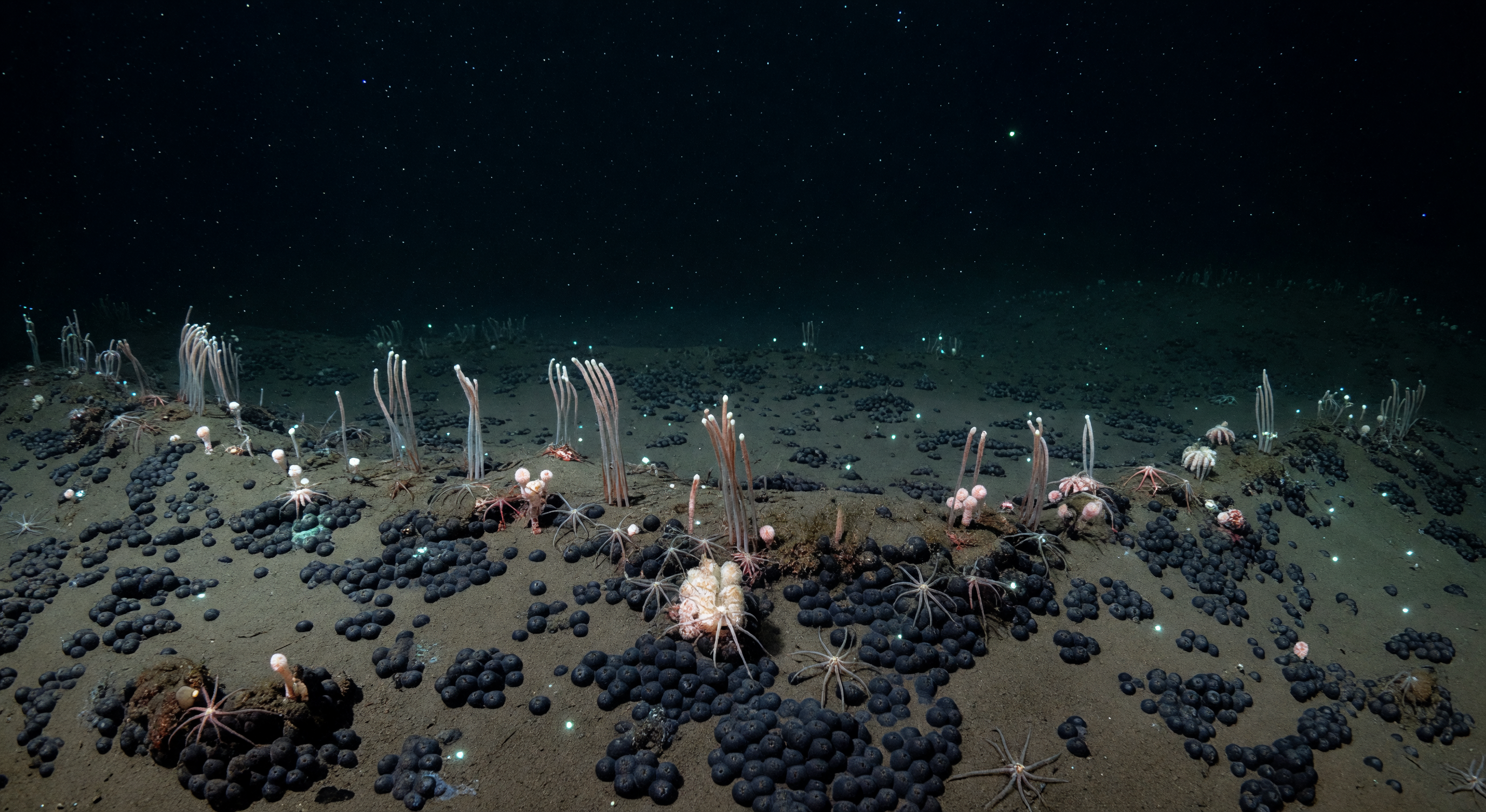
Along a low, ancient ridge rising imperceptibly from the abyssal plain of the Clarion–Clipperton Zone, black manganese nodules cluster thickly in pale silty mud, each one a concretion grown over millions of years at a rate measured in millimeters per million years — among the slowest geological processes on Earth. At roughly 4,800 meters, hydrostatic pressure exceeds 480 atmospheres, water temperatures hover near 2 °C, and not a single photon of sunlight has reached this place since the sediment beneath began accumulating in the Cretaceous; the only light is biological — faint cyan-blue glimmers drifting in the water column as suspended organisms pulse almost imperceptibly, and the softest bioluminescent shimmer tracing the translucent tissues of sea pens rooted between the nodules along the ridge crest. Brittle stars drape their articulated arms across the hard nodule surfaces, feeding on organic particles that descend as marine snow from a sunlit world nearly five kilometers overhead, while sessile sponges anchor themselves to whatever firm substrate the nodules provide in an otherwise yielding mud. The fauna here — pennatulaceans, ophiuroids, hexactinellid and demosponges — are exquisitely adapted to permanent cold, permanent darkness, and permanent stillness, constituting a community so slow-growing and so sparsely distributed that a single physical disturbance could require centuries to leave no trace. This ridge exists in a silence so complete and a darkness so total that life here has never needed to acknowledge a witness.
Polymetallic nodule fields