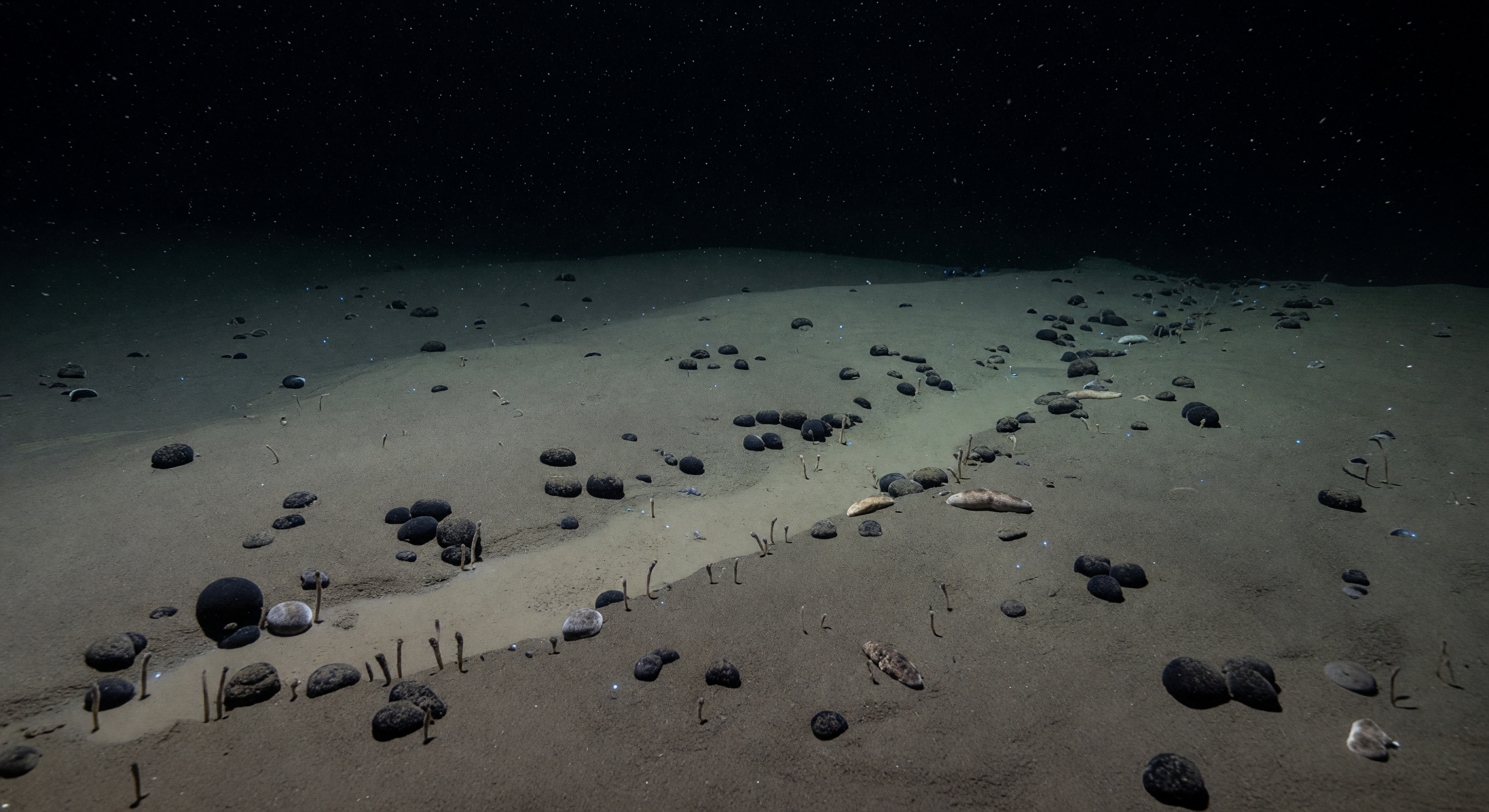
At roughly 4,800 metres below the surface, the abyssal plain of the Clarion–Clipperton Zone lies beneath a crushing hydrostatic pressure of nearly 480 atmospheres, where temperatures hover perpetually around 1.5 to 2 °C and not a photon of sunlight has reached for millions of years. Across this vast, almost featureless terrain, black manganese nodules — each one a geological record spanning thousands to millions of years of slow accretion, layer by layer, around a tiny nucleus — rest half-swallowed by pale grey-brown abyssal mud that carries the finest settling particles of a distant ocean above. In a shallow swale where sedimentation runs slightly deeper, delicate tube-dwelling polychaetes anchor themselves at the sediment margin while holothurians — sea cucumbers whose soft, elongated bodies process vast quantities of mud to extract organic detritus — lie motionless between the nodules, their metabolisms tuned to a world where energy is vanishingly scarce. The only illumination belongs to the organisms themselves: rare, fleeting points of blue bioluminescence cast by invertebrates drifting through the water column above, briefly tracing the matte mineral contours of nodules and the fragile architecture of worm tubes before fading back into absolute darkness. Marine snow — the slow, continuous rain of organic particles from the sunlit world far overhead — drifts through the black water column, sustaining this entire community in a silence so complete and so ancient it reads less like absence than like the ocean's most essential, undisturbed self.
Other languages
- Français: Assemblage de Nodules Marins
- Español: Ensamble de Nódulos Sumergidos
- Português: Conjunto de Nódulos Submersos
- Deutsch: Knollenmulden Versammlung
- العربية: تجمع العقيدات البحرية
- हिन्दी: गहरे तल का संगम
- 日本語: 海底窪地の結核群
- 한국어: 심해 단괴 군집
- Italiano: Assemblea di Noduli Marini
- Nederlands: Nodule Laagte Samenstel