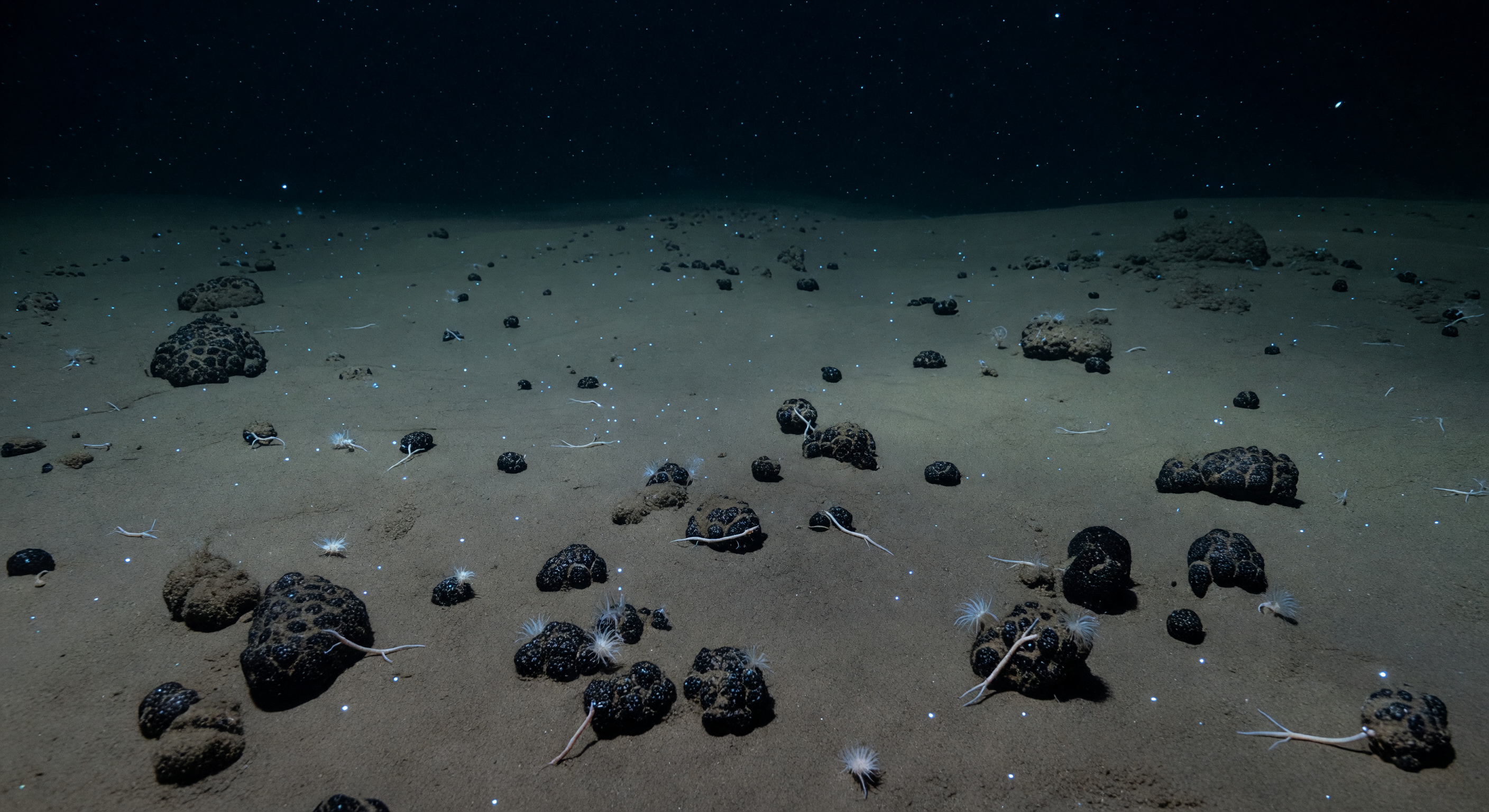
Across the abyssal plain, black polymetallic nodules lie scattered across pale grey-brown sediment in a stillness that has persisted for millions of years — each nodule grown at rates measured in millimetres per million years, accreting layers of manganese, iron, cobalt, and nickel from the slow chemistry of bottom water and sediment pore fluids. At nearly five kilometres beneath the surface, pressure exceeds four hundred atmospheres and the water hovers just above freezing, a thermally stable environment where the only motion is the near-imperceptible drift of marine snow descending from the sunlit world far above. Delicate white anemones anchor themselves to exposed nodule surfaces — the hard substrate offering rare purchase in a landscape otherwise defined by endless soft mud — while pale brittle stars drape loosely across the sediment, their arms extended to intercept organic particles that reach this depth after weeks of slow fall. The scene is not dark in the way a closed room is dark; it is alive with the cold cyan-blue pinpricks of bioluminescence from drifting organisms, the only light that has ever touched this plain, generated by the creatures themselves in a biochemical language entirely independent of the sun. This is one of the most extensive but least disturbed ecosystems on Earth, a slow, pressurized world of extraordinary ecological fragility operating on geological timescales, indifferent to and unaware of anything beyond its own silent chemistry.
Polymetallic nodule fields