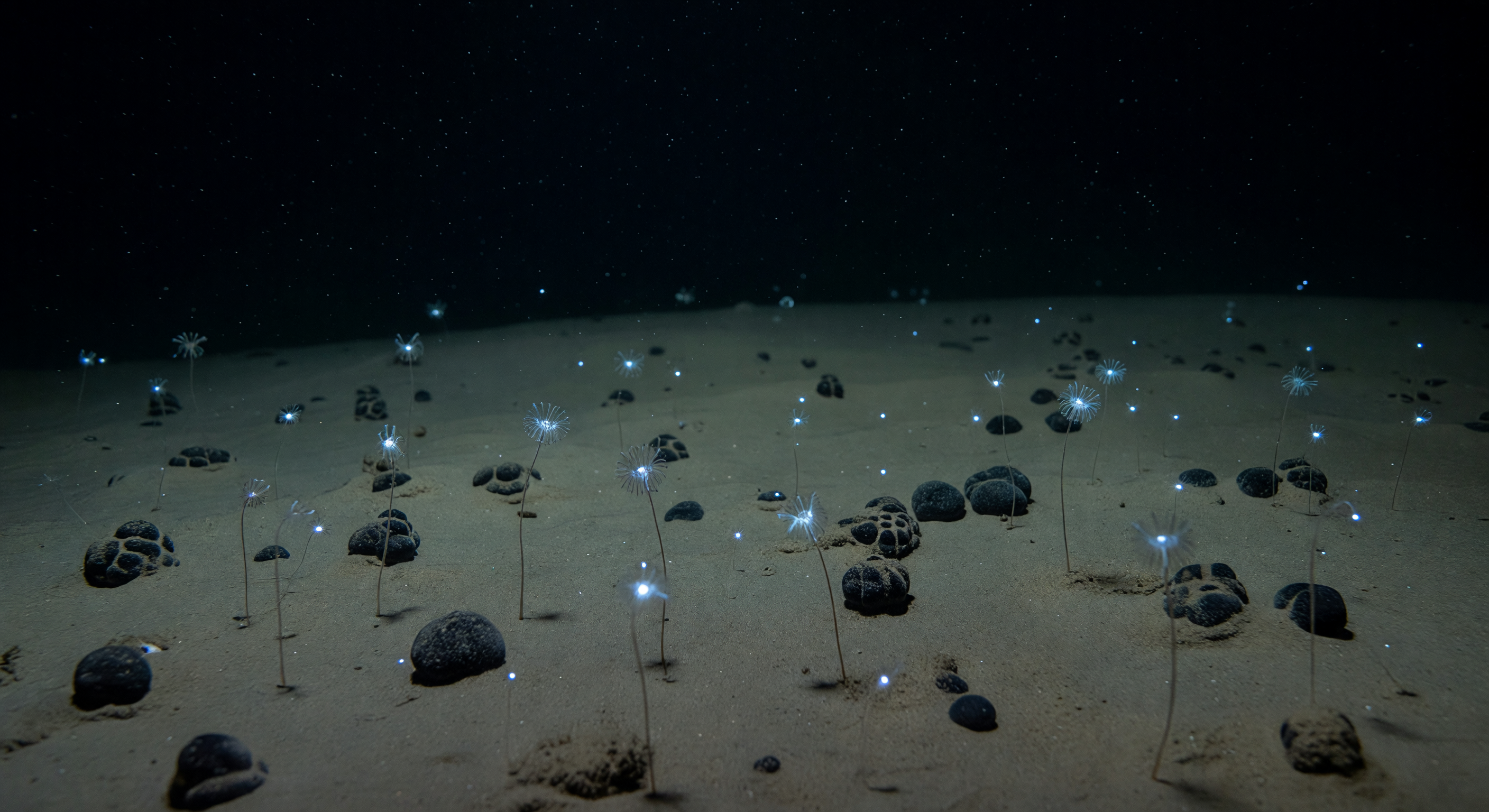
Across the abyssal plain at depths approaching five kilometres, the seafloor unfolds as an almost featureless expanse of pale grey-brown mud, its surface broken only by the scattered presence of polymetallic nodules — black, matte, manganese-rich concretions that have grown at rates of mere millimetres per million years, accreting layer by layer around shark teeth or foraminiferal tests buried in the sediment. Under pressures exceeding 500 atmospheres and in water hovering near 2 °C, a colony of sea pens rises with improbable delicacy from the fine ooze between nodules, their stalks anchored in sediment so undisturbed that the faintest benthic current is enough to incline them gently in unison; a handful of open polyps extend their feathered tentacles into water laden with descending marine snow — the slow rain of organic particles from the sunlit world thousands of metres above, the primary nutritional lifeline for virtually all life down here. Along the translucent tissue of several polyps, pulses of blue-cyan bioluminescence travel in quiet waves, a chemical language whose function — defence, predator deterrence, or intracolonial signalling — remains incompletely understood, the faint light tracing living architecture against a background of charcoal nodules and ashen mud. This is the Clarion–Clipperton-style abyss in its undisturbed state: one of the largest and most biologically fragile ecosystems on Earth, existing in total darkness, in crushing cold, in a silence so complete that the slow drift of a single marine-snow particle through still water constitutes an event.
Other languages
- Français: Plumes de mer entre pierres
- Español: Plumas de mar entre piedras
- Português: Penas do mar entre pedras
- Deutsch: Seefedern zwischen Steinen
- العربية: أقلام البحر بين الحجارة
- हिन्दी: पत्थरों के बीच समुद्री पंख
- 日本語: 石の間の海のペン
- 한국어: 돌 사이의 바다 깃털
- Italiano: Penne di mare tra pietre
- Nederlands: Zeepennen tussen stenen