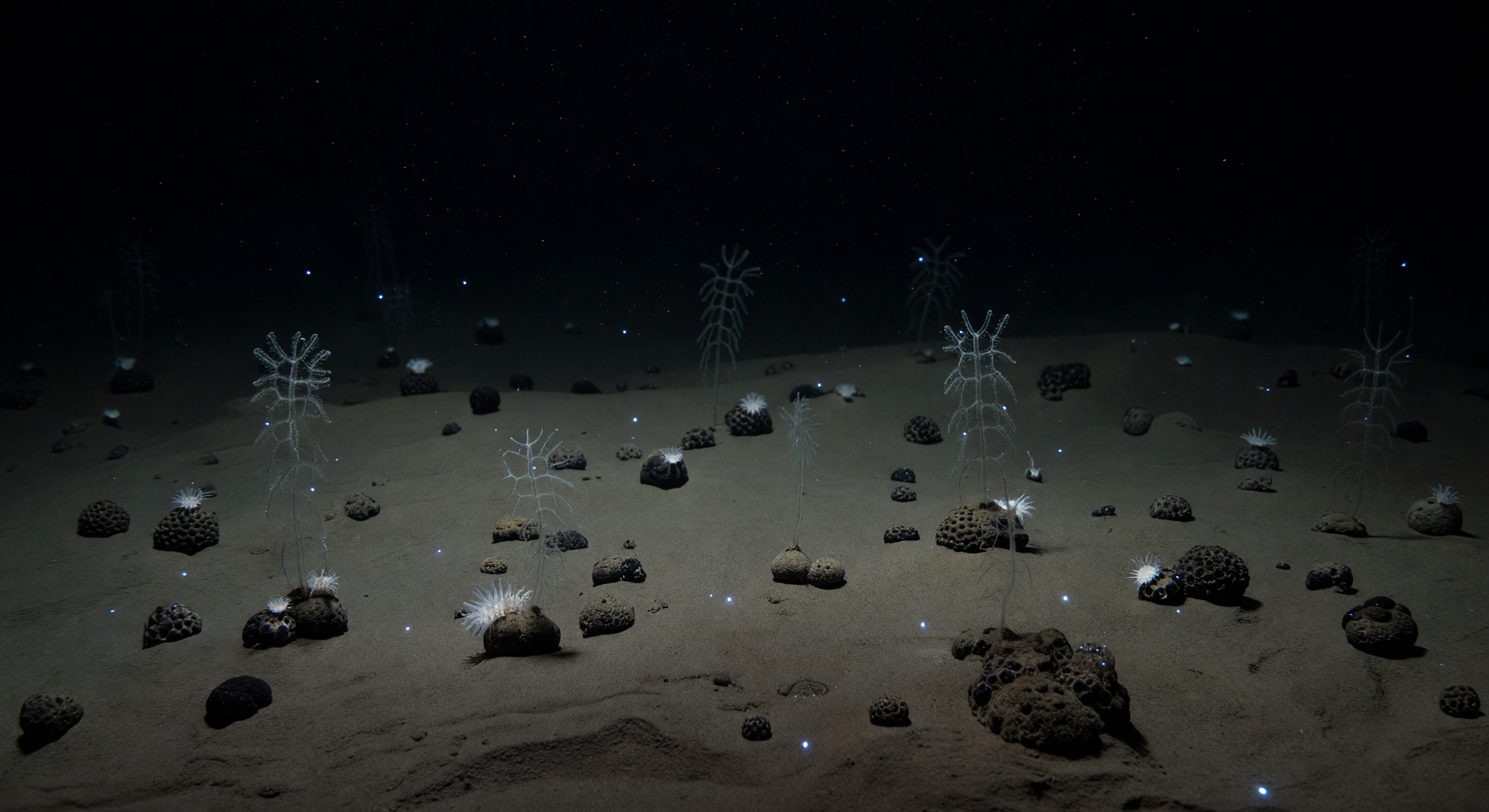
At nearly five kilometres beneath the surface, where pressure exceeds 500 atmospheres and temperatures hover barely above freezing, the abyssal plain of the equatorial Pacific unfolds as an immense, almost featureless expanse of pale grey-brown sediment — a slow accumulation of millennia of marine snow settling onto one of the oldest, quietest floors on Earth. Scattered across this silted plain like dark cobblestones, polymetallic nodules of manganese and iron oxides rise from the mud, each one a geological archive grown at a rate of mere millimetres per million years, their pitted black surfaces offering the only hard substrate for hundreds of kilometres in any direction. From a handful of these isolated nodules, tall hexactinellid sponges extend their intricate silica lattices upward into the darkness, their translucent frameworks catching faint blue-cyan bioluminescent sparks drifting freely through the water column — living flickers produced by organisms whose light has never needed witnesses. Small white actiniarians cling to nodule surfaces and sponge bases with quiet tenacity, their pale bodies barely distinguishable from the ghostly sediment around them, representatives of a benthic community so sparse and slow-growing that a single disturbance could erase centuries of ecological succession. Here, in crushing silence and permanent night, a world of extraordinary fragility persists entirely on its own terms, indifferent to the vast illuminated ocean kilometres above.
Polymetallic nodule fields